

India’s National Eligibility cum Entrance Test (NEET) is the only test used to determine whether individuals wishing to pursue their Bachelor’s Degree in Medicine, Bachelor’s Degree in Dental Sciences, Bachelor’s Degree in AYUSH (all various forms of Indian traditional medicine), and other first-year degrees in medical science are eligible to gain access to colleges offering these degrees, both public and private. NEET will be organized by NTA (National Testing Authority) on May 3, 2026, from 2:00 to 5:00 PM and will be conducted as an in-person written test. Understanding the exam pattern and preparation strategy is the first step toward scoring well in NEET.
The following is the structure of the NEET exam and the marks that can be achieved in each area of study:
| Subjects | Number of Questions | Marks | Percentage |
| Physics | 45 | 180 | 25% |
| Chemistry | 45 | 180 | 25% |
| Biology (Botany & Zoology) | 90 | 360 | 50% |
| Total | 180 | 720 | 100% |
The NEET score that an individual achieves determines their rank among those taking the NEET or any other national medical entrance exam. In addition, it determines the type of school that an individual will be eligible to apply for admission into—governmental vs private.
- Government Colleges: ₹10–30 lakh
- Private Colleges: ₹60 lakh to ₹1 crore
However, not every student secures a government seat due to high competition. In such cases, many students explore options like MBBS in Russia, where admission is more accessible and fees are significantly lower compared to private medical colleges in India.
Related Post : NEET UG Result 2026: Expected Date, Cutoff & Rank Details
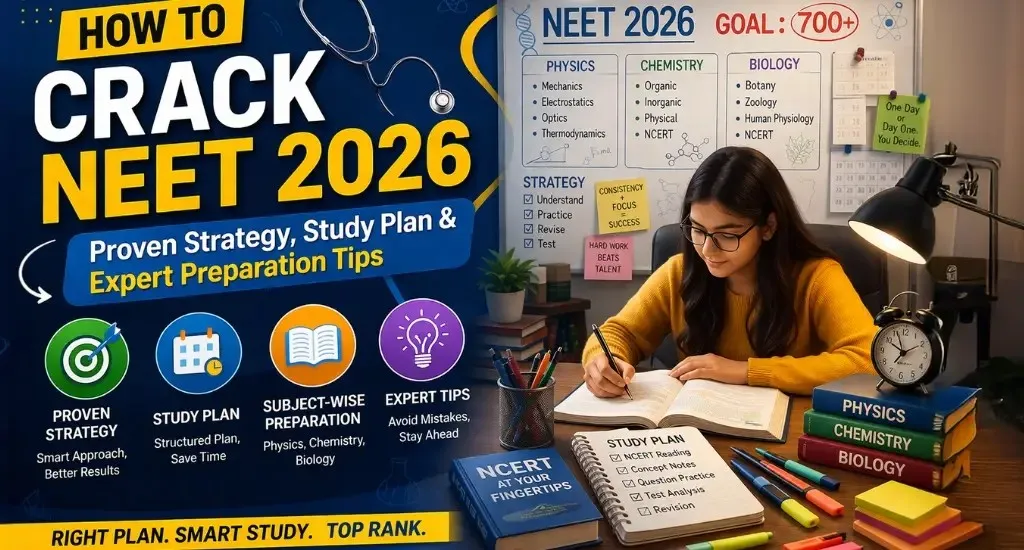
How to Crack NEET 2026: Step-by-Step Preparation Strategy ?
If you want to crack NEET 2026, follow these six steps:
1. Familiarise Yourself with the Syllabus and Exam Format
NEET 2026’s syllabus is totally based on NCERT manuals (Classes 11 & 12) and prior years’ question papers since there will be no change from 2025’s edition. Start by downloading the official syllabus and breaking it down chapter by chapter, be sure to download a copy of the official syllabus from NMC online and list out each topic covered. Also, understand the exam format before you start—180 compulsory multiple-choice questions, with +4 for correct and –1 for incorrect answers only. No negative marking for unanswered questions; be careful with random guessing since the negative marking will reduce your score.
2. Strengthen Your Understanding with NCERT books
The NCERT books are the most important study resource to help you to crack NEET. Approximately 85% of your Biology questions and 70% of your Inorganic Chemistry questions will originate from the NCERT books, including specific sentences, tables, images, and boxed facts. You should read every page of the textbook, not only for understanding but also for memorizing. You should also make short notes in the margin of the textbook about main characters, names of animals, and specific numbers or exceptions.
3. Develop a Realistic and Customized Study Plan
If you cannot create or stick to a study plan, then it is useless to you. When developing a study plan, develop a realistic daily, weekly, and monthly target schedule until May 3rd, 2026. Break the syllabus up into respective phases for completion, practicing PYQs, doing mocks, and finally revising the content. Since Biology is worth 50% of the entire NEET exam, it would also be wise to allot more time to that subject than you will to any other subject.
4. Prioritize Based on Weightage of Topics
It is important to know that not all chapters in the respective syllabi carry the same weightage. Therefore, prioritize the high-yield chapters based on their collective weightage based on the subject (Biology – Human Physiology 35-40%, Physics Mechanics & Electrodynamics – 45-50%, between the two combined, Chemistry Organic & Physical – 60-70% Combined). In addition, Most NEET papers repeat at least one question pattern from previous years, so covering past trends is essential. where the chapter topic from those 10+ years must be covered through by memorization and full understanding (10%).
5. Practicing with old exams and mock exams regularly:
Solving questions from the past ten to fifteen years of exams will be key to passing NEET. You will learn how frequently concepts are reused, which will help you understand the wording of questions by the NTA and help you develop both your speed and accuracy. After practicing chapter-wise questions, you should practice taking full-length, mock exams. To be fully prepared for the exam, you should aim for between forty and sixty full-length exams, including 15-20 mock exams during the last sixty days leading up to your examination.
6. Revise and review consistently:
Studying without reviewing the material you’ve studied is like trying to fill up a bucket with holes. To keep your mind fresh, you may use an Active recall strategy by trying to recall the information you just studied without looking at your textbook again! Using spaced repetition will help keep the information in your mind. One method is to repeat the material after one day, after three days, after one week, and after two weeks after you first read the material. Keep an error log (a notebook) to record every error you make while taking the mock tests and the questions on previous exams, so you can refer back to them each week.
Related Post : NEET Admit Card 2026: Release Date & Download Steps
Detailed Subject-Wise Preparation Tips for NEET 2026
Subject-specific strategies are key to cracking NEET 2026 and achieving a high score; here’s what each subject requires:
Biology (50% of NEET)
- Read NCERT word for word—(85% of biology is directly from NCERT)
- Draw and label all diagrams on your own
- Use mnemonics for classification/hormones/enzymes
- Emphasis on human physiology, genetics & ecology
- Work through previous years’ questions (PYQs) after each chapter
- Create flowcharts (e.g., Krebs cycle, Calvin cycle, etc.)
Chemistry (25% of NEET)
- Organic chemistry: study the mechanism of reactions instead of memorising
- Inorganic chemistry: study NCERT in-depth
- Physical chemistry: practice numericals daily (mole concept/equilibrium)
- Create a reaction summary sheet to help recall named reactions
- Solve previous years’ questions (PYQs) using a timer to develop speed
- Coordination compounds and electrochemistry are two areas for high-yielding questions.
Physics (25% of NEET)
- Conceptual understanding precedes formula cramming.
- Mechanics/electrodynamics make up 45% of the marks in Physics.
- Create a formula sheet for each chapter, ensuring all units are included.
- Solve 5-10 numericals per chapter/every day.
- Modern physics & optics – solvable PYQs with established patterns.
- If you are unable to answer a question in under 90 seconds, do not waste time attempting.
Effective Time Management and Study Routine for NEET Aspirants
As an aspiring NEET candidate, sticking to a routine daily is critical for being able to successfully clear the NEET the first time around. Below is an example of how you could create a study schedule for yourself as a NEET candidate.
Sample Daily Schedule (Weekday)
- 6:00 AM to 8:00 AM — Biology NCERT reading and writing short notes;
- 9:00 AM to 11:00 AM — Studying Physics concepts (including numerical problems);
- 12:00 PM to 1:00 PM — Studying Chemistry (including previous years’ questions);
- 2:30 PM to 4:30 PM — Taking a mock exam or completing previous years’ questions
- 5:00 PM to 6:00 PM — Reviewing mock exams or updating error logs;
- 8:00 PM to 9:30 PM — Reviewing short notes (that were made during study time).
Weekly and Monthly Goals
- Cover 2–3 chapters per subject a week;
- Take 1 full-length mock exam every weekend.
- Revise last week’s chapters on Sundays.
- Every month, accomplish 1 complete revision cycle of your syllabus.
- Take 1 full day off every 2 weeks (guilt-free).
- Get 7–8 hours of sleep every night (non-negotiable).
Related Post: NEET 2026 Eligibility Criteria for MBBS Abroad
Common Mistakes to Avoid While Preparing for NEET
While preparing for NEET, it’s just as important to know what NOT to do as it is to know what to do. The following mistakes will cost you anywhere from 50 to 100 marks every year:
- Not using NCERT textbooks
- Cramming without really understanding the concepts
- Not taking mock tests for fear of getting a low score
- Not analyzing your mock tests after they have been completed
- Overloading yourself with too much study information
- Not revising the material.
How to Stay Motivated and Confident During NEET Preparation
On a side note, preparing mentally for NEET is just as tough as preparing academically. Students who crack NEET aren’t the ones who never feel pressure—they’re the ones who keep going despite it; rather, they are those who have found a way to keep moving forward, even in the face of discomfort.
Set weekly short-term goals rather than just focusing on the final exam date. For example, finishing one chapter, completing one set of PYQs, and achieving 10 additional marks on a mock test are all significant events that should be recognized. By doing small things on a consistent basis, you will build momentum and reinforce the identity of “I am someone who cracks the NEET exam.”
Related Post: 12th Percentage Required for NEET in Class 12 2026
EOCL India: Crack NEET 2026 Support
You can trust EOCL India as your partner to help you crack NEET in 2026 .EOCL India knows that cracking NEET goes beyond just having the right study materials; it also requires using the right resources at the right time through guidance provided by professional educational advisors who specialize in counselling medical students looking to crack NEET. At EOCL India, we provide detailed solutions for each student’s needs. Get personalized guidance, counselling, and complete support for NEET 2026 with EOCL India. Talk to our experts today.
FAQs About How to Crack NEET 2026
Is it possible to crack NEET on my first try?
Definitely, there are also many students each year who have successfully passed NEET on their first try.
How many hours a day do I need to study to successfully crack NEET?
There is extensive research indicating that 6-8 hours of dedicated, focused study a day will yield better results than 12 hours of scattered study. The quality of the time you spend preparing will be more important than the length of time you spend preparing.
Is it possible to crack NEET without coaching?
Of course! Many students have successfully passed the NEET exam without attending a traditional classroom program; they have relied on NCERT textbooks and other reputable references.
What role do practice examinations play in preparing for NEET?
Practice examinations are of the most importance when studying for the NEET exam since they accurately represent the conditions of a real examination (time constraints, number of questions, etc.); assist in preparing yourself to answer 180 multiple-choice questions in a 3-hour time frame; allow for the identification of areas for improvement through analysis of results; and also help develop the necessary speed and accuracy to score 600 or more.
How do I balance preparing for the NEET examination with the Class 12 Board examinations?
The NCERT syllabus for both the NEET and Class 12 Board examinations has significant overlaps. Your study plan for each chapter will therefore satisfy both NEET and Class 12; thus, you should ensure that your methodology for studying will develop your knowledge of the NCERT syllabus.