

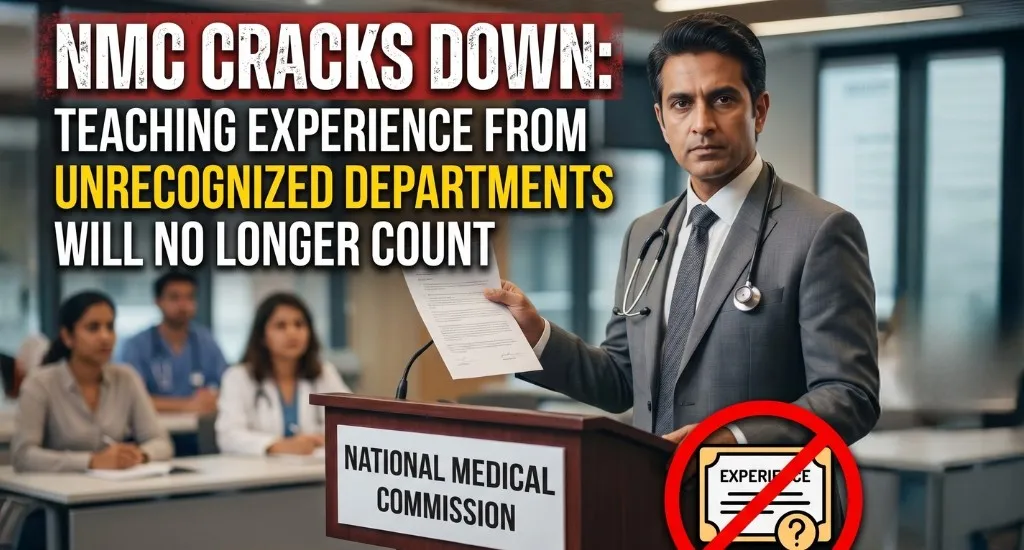
The Indian regulatory agency National Medical Commission has issued a stringent new advisory outlining that any teaching/training experience attained through a department not recognized by them as meeting required standards will be treated as not recognized and therefore invalid to anyone who will be teaching, including Doctors, Faculty Members, and Medical Institutions in this country.
This move aligns strictly with existing regulations explained in detail under NMC guidelines for MBBS, reinforcing the importance of studying and training only in approved institutions.
Through this advisory, PGMEB had sent letters out to Vice-Chancellors from all Health Universities, Directors General of Health Services, and Principals and Deans from any/all Medical Universities/Colleges providing Post Graduate Courses of Study. Copies of the letter were also sent to the Medical Counselling Committee and the Directorate General of Health Services from the Ministry of Health and Family Welfare.
What triggered this advisory?
The NMC has seen a concerning pattern. Faculty members at many institutions have been reporting their teaching experience from unrecognized departments, and there are institutions that have issued them official experience certificates based on this experience. In other words, doctors are using teaching experience from departments that are not in the records of the NMC, and colleges are issuing them certificates.
This is happening in direct contravention of existing NMC regulations-specifically the Postgraduate Medical Education Regulations, 2023, and the Medical Institutions (Qualifications of Faculty) Regulations, 2025. Both of these regulations clearly state that teaching experience can only come from medical schools that have been accredited by the NMC with appropriate infrastructure, faculty strength, and sanctioned seats.
Also Read: Nmc Pg Application 2026 Deadline Feedback Form
What this advisory now prevents
- It cannot be used to qualify as a postgraduate teacher or research supervisor.
- It will not count for appointment or promotion to any faculty position.
- Any certificate of teaching experience that is issued based on such services is to be declared invalid.
Before issuing official documents or issuing experience certificates, universities and colleges will now need to confirm their accreditation status with the NMC.
What Does “Unrecognized Department” Mean?
A recognized department is one approved by NMC based on infrastructure, faculty, and sanctioned training capacity. In order to be considered recognized, there are certain elements that need to be valid and verifiable. These include having adequate resources (i.e., physical space, beds, and a laboratory) and being staffed by the appropriate number and qualifications of faculty (i.e., those who have the required postgraduate qualifications). Additionally, they must also have NMC-approved seats available for Postgraduate (PG) students.
Departments that do not meet any or all of the above criteria but still have a physical presence in the medical college, i.e., are involved in patient care, are considered unrecognized regardless of whether or not they actually have patients. There are many new departments or small departments that have a highly functional operation and faculty members who have provided teaching for years; these faculty members will not be able to use this experience as a valid credential for any academic or career advancement since these departments have not been formally approved by the NMC.
In accordance with the above statement, to obtain teaching experience to be considered for faculty appointments or be recognized as a PG faculty member, the faculty member must have received their teaching experience at NMC-recognized medical colleges and/or taught at NMC-recognized departments of medicine with adequate resources, an adequate number and credentials of faculty, and NMC-approved PG seats.
Responsibility Is Placed Firmly On Institutions
In an effort to ensure proper accountability at the institutional level, the National Medical Commission (NMC) has issued guidance about the verification process between institutions issuing certificates of experience and the NMC.
When issuing a certificate of experience to a faculty member, institutions are expected to ensure and verify that the department is NMC-recognized before issuing certificates.
Also Read : Next Exam Mbbs Nmc Guide
If not, the certificate will be treated as invalid.
This is a serious warning to institutional leaders and administrators, as they could be subject to regulatory action.
Why Does This Matter – And Who Is Affected?
The NMC advisory will have a broad impact on various stakeholders in the ecosystem of medical education.
For example, young physicians pursuing academic careers who work in unrecognized departments run the risk of suddenly having their accumulated experience invalidated for all official purposes.
Similarly, senior faculty members who were promoted based on the use of their unrecognized departmental experience will also be subject to scrutiny.
Moreover, universities that have been issuing experience certificates without verification may now face regulatory action from NMC.
All of these implications have a direct impact on students; if faculty members are not able to get appointed or promoted, the quality and consistency of their instruction may suffer if colleges rush to get their departments recognized.
Complete Guidance for Studying MBBS Abroad
EOCL India offers comprehensive support to students applying to schools outside of India and helps students find universities that meet both NMC requirements and university admission requirements, especially for popular destinations like MBBS in Russia. All of the universities we recommend to students are approved by NMC. By guiding students from the time of answering their questions about universities until they become practicing doctors in India, we work collectively with students to help them.