

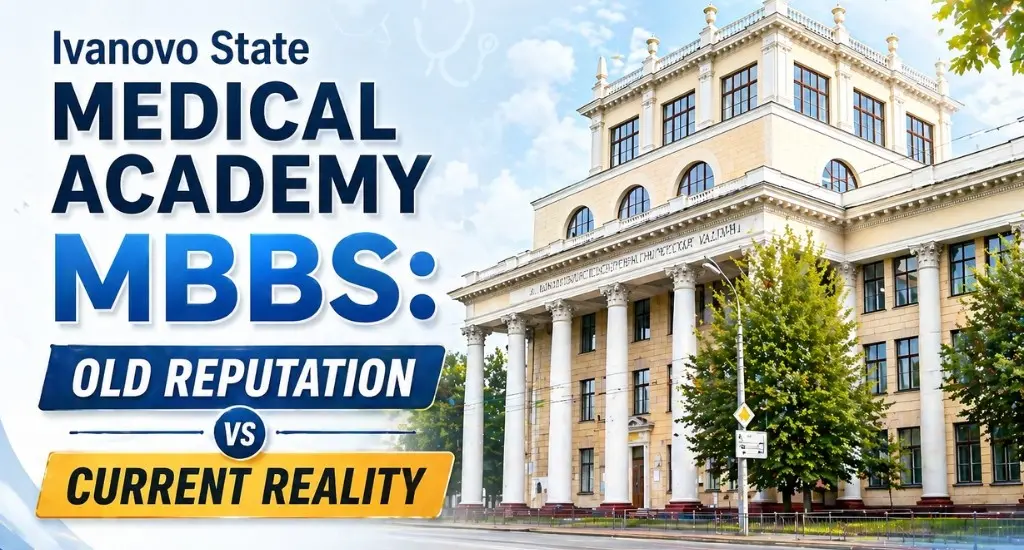

For Indian parents exploring MBBS abroad options for their child, Ivanovo State Medical Academy (ISMA) is a name that has been heard for decades through various consultants. Established in 1930, ISMA carries a legacy of nearly 100 years in medical education.
But what does this legacy really mean in 2025? Has the academy kept pace with modern medical education, and does its historical reputation still reflect its current reality?
This blog aims to clear the confusion between ISMA’s past reputation and its present-day ground reality. It will examine key factors such as MBBS fees in Russia, FMGE performance, and real-life student experiences to give a more accurate and practical understanding of studying at ISMA today.
From Soviet-Era Medical Institute to Modern International Academy
The Evolution of Ivanovo State Medical Academy from a Soviet-Era Medical Institute to an International Academy Today
Its initial purpose was to provide physicians for the lack of qualified medical personnel in the central textile region of Russia. Early leadership at ISMA included prominent Russian medical professionals who helped build its clinical training foundation. Early leadership at ISMA included respected Russian medical professionals who focused on building a strong clinical training foundation rather than purely theoretical education.
For many years after being established, ISMA was utilized only by Russian nationals to train physicians. In 1991, following the breakup of the Soviet Union, ISMA was granted the ability to operate autonomously from the former USSR government and thus opened its doors to international medical students for the first time. 1991 allowed ISMA to develop its very first relationship with Indian aspiring physicians and since that time, the relationship has continued to strengthen. Presently, ISMA has between 280 and 320 Indian nationals attending ISMA in the MBBS program from many different states in India to include: Maharashtra, Tamil Nadi, Kerala, Uttar Pradesh, and West Bengal.
The Old Reputation: What Made ISMA a Trusted Name
The historical reputation of ISMA as a reputable institution among Indian households has been built upon several permanent and consistent pillars. To begin with, the school was one of the first Russian medical institutions to accept Indian students in substantial numbers; thus, early graduates from Ivanovo, who returned to India, passed the FMGE examination and became successful in their respective fields, serve as proof that the degree they obtained from this university is valuable.
In addition, as ISMA is affiliated with the Ministry of Health of the Russian Federation and is official, ISMA is listed in the World Directory of Medical Schools (WDOMS), which is an important requirement for global medical licensing pathways. Students should verify current NMC guidelines eligibility before admission. It has credibility as a medical institution that other newly established Russian medical institutions do not have. Furthermore, the combination of the established faculty at ISMA, consisting of more than 400 faculty members, which includes over 70 full physicians and over 270 candidates of science, provides reassurance to parents hesitant about sending children to study abroad, and the well-established clinical structure of ISMA further backs up the above-mentioned credibility.
Tver Medical University vs Other Russian Medical Colleges: What Actually Matters
Also read – Why Immanuel Kant Baltic Federal University Is Gaining Popularity Among Indian Students
Current Reality: What the Numbers Actually Say in 2025
The real picture of ISMA is more complicated in terms of its facilities and capabilities as compared to yesterday’s development. These are the metrics that matter:
Global/National Rankings
- Global Rank: 4,237
- National Rank Russia: 160
These rankings put ISMA in the middle tier of Russian Universities, while not ‘elite’ on a global scale, is relatively stable and credible in Russia.
The FMGE Exam performance of ISMA graduates has been a point and a source of real concern and action toward positive progress. FMGE pass rates for ISMA have historically been lower than the national average, although recent trends suggest gradual improvement. Students should always verify the latest official FMGE/NExT data before making a decision.
Although ISMA has not yet caught up with the national averages, the pace of improvement shows the institution is making true internal reforms rather than remaining stagnant.
Currently, there are over 150 students from over 28 different countries attending ISMA as international students. While this is a relatively small number of international students compared to much larger Russian federal institutions, the number qualifies ISMA as having a legitimate multicultural environment.
MBBS Fees in Russia at Ivanovo State Medical Academy: The True Cost Breakdown
The most important case for ISMA (Ivanovo State Medical Academy) is its incredible tuition fee structure. The following is a detailed breakdown of MBBS tuition fees, which include tuition costs, visa extensions, hostel fees, admission fees, and miscellaneous expenses.
| Category | Sub-Category | Details |
| Tuition Fee | One-Year Tuition Fee | ₹ 1,80,000 – ₹ 2,50,000 per year (≈ $1,982 – $2,900 USD) for 6 years |
| Total 6-Year Tuition Fee | 10,80,000 Rubles (≈ ₹ 10,50,000 INR) | |
| Hostel Fee | One-Year Hostel Fee | 35,000 Rubles (≈ $385 USD per year) |
| Admission Fee | One-Time Admission Fee | Admission-related charges may apply (varies by intake and service inclusions) |
| Visa Extension & Registration | Yearly Visa Extension Fee | $300 USD per year (from Year 2 onwards) |
| Living Expenses | Monthly Living Expense | $100 – $150 USD (includes food, transport, daily expenses) |
| Total Estimated Living Expenses | ₹ 15 – 18 Lakhs INR (excluding textbooks) |
When compared with the cost of a private university for MBBS in India, which can range from ₹70-₹1.5 crores, the savings through attending ISMA are approximately ₹50-₹80 Lakhs, regardless of the degree’s legitimacy.
ISMA does offer a limited merit-based scholarship program for academically exceptional students that covers between 10% and 25% of tuition costs for 1st, 2nd, and 3rd-year students, which is not offered by the majority of private medical colleges in India.
Also read- Tver Medical University vs Other Russian Medical Colleges: What Actually Matters
Curriculum Architecture: Theory to Bedside in Six Years
The MBBS program at ISMA is typically a 6-year integrated course, combining pre-clinical studies in the early years with clinical training in later years.
The Academic portion of the curriculum includes traditional “preclinical” disciplines of Anatomy, Physiology and Biochemistry, as well as “clinical” subjects (Pathology, Pharmacology, Microbiology, and Internal
Medicine/Surgery/Pediatrics/Obstetrics/Neurology/Community Medicine) that deal with diagnosing and treating patients.
Other distinguishing components of the ISMA curriculum are always aligned with FMGE / NEXT preparing the graduate for all aspects of patient care, including high-yield topics covered during review sessions as part of the last year of medical school, and mock exams based on FMGE / NEXT format (designed in response to the difficulties of passing licensing exams given to Indian graduates). Recognizing that preparing students for licensing exams is part of their education instead of being an afterthought, this is a fundamental change from several years ago, when students were required to utilize coaching centres for exam prep after graduating.
The program is taught in English initially, with Russian language training provided for clinical interaction with patients.
Eligibility and Admission: What Indian Students Need to Know for 2026
Have passed 12th (Science Stream) board examinations with Physics, Chemistry, Biology and English subjects from A recognized Board of education & have a minimum of 50% aggregate in the listed subjects to qualify for General / EWS categories and 40% for SC / ST / OBC Categories.
Indian Students seeking admission to Ivanovo State Medical Academy for 2026 have to meet following criteria as per NMC norms:
- A valid NEET-UG score is mandatory as per current NMC guidelines.
- Must be 17 years by 31st December of the year of joining
- No separate University entrance test
- Students should expect their offer letter to be issued to them within 10 to 15 working days, once the documents submitted are complete.
- The primary intake is in September, and students should begin the mbbs abroad admission process at least 4–6 months in advance.
Also read – Chechen State University MBBS Review: Pros, Cons, and Ground Reality
Conclusion
So, where is Ivanovo State Medical Academy in 2025? The short answer is yes, the old reputation was earned, and now ISMA is cautiously rebuilding its reputation in this current time and place.
As a result, ISMA is not the top-ranked medical university in Russia. Historically, their success rate with the FMGE required students to receive structured coaching after graduation to pass. Still, ISMA does have a 95-year history. ISMA is listed in the World Directory of Medical Schools (WDOMS), which is essential for global licensing pathways. However, students must independently verify eligibility as per the current National Medical Commission guidelines before admission.
Ivanovo State Medical Academy is a viable, cost-effective, and structurally well-built MBBS in Russia option for students who qualify for NEET, as long as they understand those limitations before choosing to start at Ivanovo State Medical Academy.
Students who have succeeded at Ivanovo State Medical Academy are those who came to the school with their eyes open; they understood that the degree from ISMA is recognized and the fees paid to ISMA are real, and while they understood the importance of FMEG/NEXT, they also realised how important personal discipline and preparation were for them to succeed.
Making the Right MBBS Abroad Choice with EOCL India
EOCL India provides guidance and support for those evaluating options like Ivanovo State Medical Academy, particularly from the perspective that understanding academia includes more than just numbers, fees, and reputations; it involves understanding real-world issues evident in the data collected (as opposed to figures alone) by looking at performance measures (such as FMGE results), clinical experience (what kind of experience students have received—level of education provided vs time spent actually learning on campuses), feedback from students (given how many are successful after becoming licensed), and future employment opportunities (sometimes measured by ability to gain employment six months after graduation).
Contact EOCL India today for honest guidance and make a safe, well-informed decision for your MBBS abroad journey.