

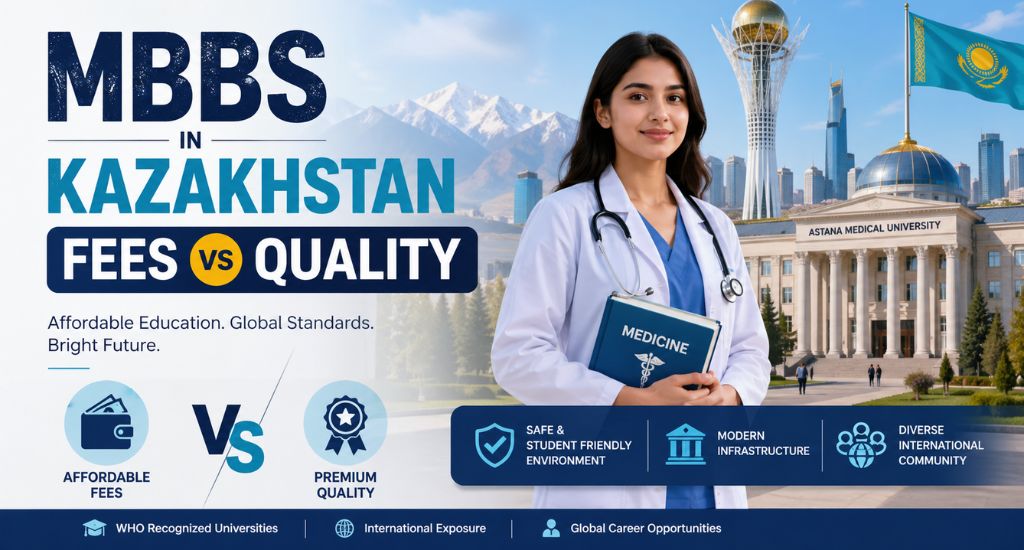

When considering an MBBS in Kazakhstan, Indian students usually ask about the fee structure. The truth of the matter is much more complicated than that, however. Over the last 20 years, Kazakhstan has developed a real and legitimate medical education system with numerous universities that are recognized by the National Medical Commission (NMC) of India and have produced graduates who have passed their licensing examinations successfully.
This guide discusses the difference between undergraduate Kazakhstan MBBS fees versus the associated quality of education offered by each university in the country, so that you can reach your final decision based on factual information and by assessing several aspects of the institutions you are interested in attending.
Why Kazakhstan Became a Serious MBBS Destination
The reasons for Kazakhstan’s MBBS destination stem from its ability to fill a particular void in students’ lives, those who have met the qualifying requirements for the National Eligibility cum Entrance Test (NEET) but do not have sufficient funds available for the private MBBS program of any of the medical Colleges from India.
In addition,MBBS in Kazakhstan has filled the need for students who wish to earn an internationally recognized degree. but do not wish to pay the large amount of money required to attend a medical school in Russia or Europe — making it one of the most practical MBBS abroad destinations available today.
MBBS in Kazakhstan falls within the same range as the average cost of obtaining a medical degree in India.
To complete a standard 6 year medical degree, including tuition fees, accommodation, food, and essential living costs, at a typical Kazakhstan based university will set you back either ₹18 or ₹28 lakh (INR), depending on the institution. Conversely, the typical cost of completing a 6 year MBBS at a privately operated Indian medical college under management quota exceeds ₹80 lakh and can be as high as ₹1 crore.
Breaking Down the Fee Structure Honestly
Here is what MBBS in Kazakhstan actually costs across different tiers:
| Tier | Annual Tuition Fee | Total 6 Year Cost (Including Living) | Key Features | Risk Level |
| Budget Tier Universities | ₹1.8 – ₹2.8 Lakhs | ₹18 – ₹22 Lakhs | Smaller universities, developing infrastructure, limited clinical exposure | High |
| Mid-Tier Universities | ₹3 – ₹4.5 Lakhs | ₹22 – ₹28 Lakhs | Well established institutions | Moderate |
| Premium Institutions (e.g., UIB Faculty of Medicine, Almaty, Kazakhstan) | Higher than ₹4.5 Lakhs | Depending on lifestyle and accommodation | Advanced clinical infrastructure, international faculty, | Low |
Living Expenses (Separate Breakdown)
Expense Type | Monthly Cost |
| Living Cost (Average) | ₹10,000 – ₹15,000 |
| City Variation | Almaty (Higher), Astana & Shymkent (Lower) |
Where MBBS Quality Is Strong in Kazakhstan
Medical education quality is measured by three distinct factors: quality clinical training, quality teaching or instructor competence, and success on a licensing examination.
- Clinical exposure: The quality of clinical education provided by top Kazakhstan medical schools is, in fact, quite high through the close association with leading teaching hospitals in Almaty and Astana , where students have meaningful access to patients throughout their clinical education beginning their 4th year of training.
- The Kazakhstan health care system is undergoing rapid modernization; therefore, students at these schools have access to traditional practice sites as well as modern diagnostic sites.
- Faculty competency: Teaching competence also varies widely among Kazakhstan medical schools. At the UIB Faculty of Medicine (Almaty, Kazakhstan), students benefit from faculty with a wide range of specializations from Russia and Europe, as well as from Kazakhstan professors.
- This creates a degree of diversity among the faculty of UIB that results in superior curriculum delivery via English compared to a faculty composed primarily of local professors teaching only a few token international professors.
- Licensing exam outcomes: Success on licensing exams represents the ultimate measure of quality. To practice medicine in India. MBBS graduates of Kazakhstan medical schools must complete NEXT (expected to replace FMGE in the future).
The supporting structures provided, along with the understanding of NEXT by the faculty in their respective institutions, will usually result in higher pass rates than institutions where there are fewer structured supports for completing NEXT and fewer faculty members who are familiar with the examination.
Always request copies of the most current verified pass rate data for each institution, as opposed to annual pass rate averages for each institution.
Also Read: MBBS Russia vs Kazakhstan — Which Is Better for Indian Students?
Where Quality Falls Short
Rural or smaller Kazakhstan universities that received recent recognition from the NMC frequently lack the variety of hospitals needed to give students a complete clinical education. As a result, students may finish clinical year training technically but graduate having seen very little in the way of complex case presentations, which is essential for taking the licensure exam.
In addition, agents tend to push students towards an MBBS program in a Kazakhstan university that pays them more in commission than one that may help students realize their career goals. Therefore, there is a misalignment between the goals of students and the structural issues of the MBBS market in Kazakhstan, and students must protect themselves by independently verifying every agent’s claim as to the benefits of a specific university.
Language also affects clinical training. Although classes are taught in English, most patients are residents who speak Kazakh or Russian. Students who do not acquire basic functional abilities to speak either language will have limited ability to participate in clinical experiences. This issue is shaped similarly to the issues faced by Indian students in their clinical experiences in Russia while pursuing the MBBS degree.
Why UIB Faculty of Medicine Stands Out in Kazakhstan
The Faculty of Medicine at UIB in Almaty, Kazakhstan, has an entirely different philosophy than other institutions that are solely focused on attracting the lowest possible fee. Instead of competing based on fee structure, the UIB Faculty of Medicine competes in the areas of quality of education, international standards of accreditation, and clinical facilities.
Almaty is not only the largest city in Kazakhstan but also its commercial and academic capital, which is very relevant to the quality of medical education at the UIB Faculty of Medicine. Medical facilities located in urban areas (especially in large cities) treat substantially more patients than those in smaller towns and areas, which means students at Almaty based medical colleges have a significantly higher quality of clinical training.
For students who can afford to pay slightly more than the absolute minimum, attending a medical school at the UIB Faculty of Medicine, Almaty, Kazakhstan, can offer better preparation for international licensing exams.
Also Read: MBBS Abroad Fees Country Wise 2026 — Complete Comparison
Is MBBS in Kazakhstan Worth It?
There is a solid level of value associated with an MBBS in Kazakhstan at any of the verified and NMC-recognized institutions with good clinical infrastructure. As far as the overall quality of education is concerned, if we consider the fees charged by many mid-tier and premium universities in Kazakhstan, then there would be no doubt that they represent good value for money when compared to private colleges in India, as well as to many Russian universities. While MBBS in Russia remains a popular alternative, Kazakhstan has steadily emerged as a more affordable and equally credible option for Indian students.
But beware of the more budget friendly segment of the market that has very low medical school fees and yet ultimately results in students receiving substandard clinical training, poor English language instruction, and uncertain outcomes for licensing examinations; there is little to gain from saving ₹3-4 lakhs in terms of tuition at a substandard university versus the cost of your career in the long run.
Your MBBS Journey, Our Responsibility
EOCL India will help you every step of the way by offering complete transparency about your options and giving you the necessary tools to make a well informed decision.
EOCL India assists you in finding universities that provide value, as opposed to being light on your pockets. To eliminate any confusion when deciding on an institution, such as the UIB Faculty of Medicine, based on their strong academic and clinical infrastructure, we verify that they are registered by the NMC or provide support for NEXT preparation.
FAQs About MBBS in Kazakhstan Fees vs Quality
What is the total cost of MBBS in Kazakhstan for Indian students?
Total costs, including tuition, hostel, and living, range between ₹18–28 lakhs, depending on the university and lifestyle.
Is UIB Faculty of Medicine, Almaty, Kazakhstan recognized by NMC India?
Yes, but students must verify the latest NMC eligibility on official sources like the NMC and WDOMS before applying.
How does clinical training quality in Kazakhstan compare to Russia?
Top Kazakhstan universities provide students with similar clinical exposure as Russian mid-tier universities; however, the cost of living is more affordable in Kazakhstan than it is in Russia, and some students find Kazakhstan culturally more comfortable than Russia
Does the language barrier affect MBBS students in Kazakhstan?
Yes, hospital settings in Kazakhstan are conducted in either the Kazakh or Russian languages; therefore, students who rely only on English may struggle to function effectively in hospitals unless they learn basic Kazakh or Russian before beginning their clinical rotations.
What should I verify before choosing a university for MBBS in Kazakhstan?
You should verify that the university is recognized by NMC, listed in WDOMS, and has recent NEXT and FMGE performance data. Do not rely on any information provided to you from your agents.