

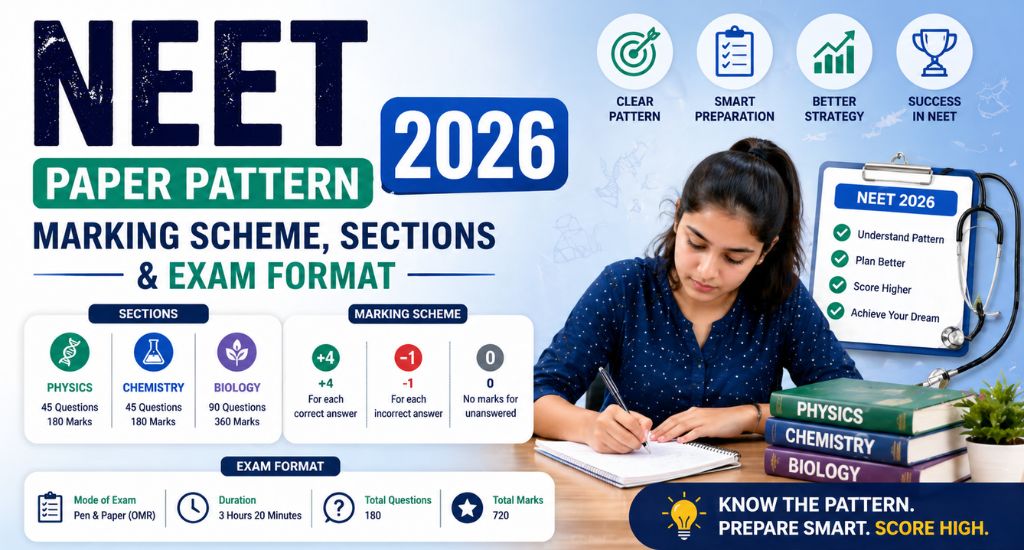

Understanding the NEET paper pattern 2026 is essential for building an effective preparation strategy. Instead of guessing what to study, knowing the question distribution, marking scheme, and exam format allows you to prepare with clarity and precision. This guide breaks down the NEET paper pattern 2026 so you can prepare with clarity instead of guesswork.
NEET Paper Pattern 2026 (Quick Answer)
The following table will provide you with the NEET exam pattern and all of the relevant facts on one sheet so that you do not need to refer back and forth between different source documents:
| Factor | Detail |
| Exam Date | May 3, 2026 |
| Mode | Offline (Pen & Paper) |
| Duration | 3 Hours (180 Minutes) |
| Timing | 2 PM – 5 PM |
| Total Questions | 180 (All compulsory) |
| Total Marks | 720 |
| Marking Scheme | +4 (Correct), −1 (Incorrect) |
| Unattempted | 0 marks |
| Question Type | MCQs |
| Conducting Body | National Testing Agency |
Related Post: NEET Admit Card 2026 Live: Download Link & Updates
NEET Paper Pattern 2026 Overview
The NEET Paper format has a structure that was confirmed for 2025. There will be three Subjects: Physics, Chemistry, and Biology, with Biology being divided into two Sections: Botany and Zoology.
All 180 questions are compulsory. With a maximum of 720 Points for the total test. The earlier section A and section B formats have been removed, meaning there are no optional questions.
NEET Exam Structure 2026 Subject-Wise
This is how you break down each subject by the number of questions and the total number of marks possible to make up your score.
| Subject | Number of Questions | Total Points | Marks Possible |
| Physics | 45 | 180 | 180 |
| Chemistry | 45 | 180 | 180 |
| Biology – Botany | 45 | 180 | 180 |
| Biology – Zoology | 45 | 180 | 180 |
The total number of questions in NEET will be 180 out of 720 (Total) points.
Note that Biology has 2x more weight than Physics or Chemistry because the biology section is divided into two subject areas. Therefore, if you are strong in biology, you can increase your score significantly. Most NEET top scorers or toppers have near-perfect scores in biology (360/360) and use physics and chemistry to help increase their overall score.
Related Post:Medical Courses After 12th: Complete Guide (2026)
NEET Marking Scheme 2026: Exactly How It Works
The NEET exam follows a simple +4 and −1 marking system. Each correct answer gives +4 marks, while each incorrect answer leads to −1 due to negative marking in NEET. Unattempted questions carry no penalty.
If you answer more than one option for a question, you will lose points as if you answered it incorrectly (−1). If your NTA drops a question, all students will receive 4 points regardless of whether or not they attempted the question.
If the NTA states that more than one answer for a question is correct, anyone who selected any of the correct options will receive 4 points. A wrong answer effectively costs you 5 marks (loss of 4 potential marks + 1 negative mark), so avoid blind guessing. You lose the 4 points that you could have received for getting the answer correct and the 1 point penalty for getting the question wrong. A random guess is not worth it unless you have eliminated at least two options with confidence.
- Maximum possible score: 720
- Minimum possible score (all incorrect): −180
Exam Mode and Language Options
NEET 2026 will be conducted strictly in offline mode. NTA will not use an online option for the NEET Examination. At the examination venue, NTA will provide an OMR Answer Sheet and will also distribute the Question Booklet for the candidate.
How to mark answers:
- Marked Answers can only be made with the Black Ballpoint Pen or Blue Ballpoint Pen, which are provided for the Candidates by NTA during the testing period.
- Do not bring your own Ballpoint Pen for marking answers.
- You may only mark ONE answer out of those provided on the OMR Answer Sheet.
- If there are any multiple responses marked for any question, they will all be treated as incorrect answers.
- Language Examination: NEET 2026 will be available in 13 languages, including English, Hindi, and regional languages.
Where discrepancies occur between the English version of the Question and the Regional Language version of the question, the English version will be considered the approved and correct version.
Related Post:NEET Dress Code for Female 2026: Complete Guidelines
Syllabus Basis for NEET Question Paper Pattern
The NEET exam paper pattern includes questions from the NCERT books of both Class XI and Class XII across Physics, Chemistry, and Biology, based on the syllabus prescribed by the MCI, covering both CBSE and state boards. For better results, choosing the best books for NEET preparation alongside NCERT can make a big difference in understanding concepts and improving accuracy.
Key high-weightage areas by subject:
- Physics: Subjects with the most number of high-scoring topics include Physics—Mechanics, Thermodynamics, Electrostatics, Modern Physics, and Optics; Chemistry—Physical chemistry (e.g., Equilibrium and Electrochemistry), Organic Chemistry (e.g., Reaction Mechanisms and Names of Reactions), & Inorganic Chemistry (the Periodic Table and Coordination Compounds).
- Biology: Cell Structure and Function, Genetics and Heredity, Human Bodies, Plant Bodies, Ecology, Reproduction, and Evolution. Biology is largely NCERT-based and relatively easier, while Physics is more calculation-intensive.
Big Change: No More Section B in 2026
In the past years, each subject on the examination consisted of Section A (35 questions) and Section B (15 questions, of which you must attempt 10). This created a situation where you could pick & choose questions between sections.
This change is going away with the introduction of the new format for the NEET exam paper pattern 2026, where each subject will consist of one set of 45 questions (a total of 45 questions)—all questions on the test will be mandatory. Therefore, there will be no picking & choosing between questions. As a result, you will have simplified time management, as there will no longer be any scheduled questioning; you will have to attempt every question.
Related Post: NEET 2026 Cut Off – Category Wise (Updated After Result)
Time Management Based on the NEET Paper Pattern
You get roughly 1 minute per question, so time management is critical. In reality, however, Biology will be the fastest subject you will work in, as most of your questions will be based on direct NCERT readings. Therefore, students typically will allocate their time to work in this fashion:
- Complete Biology within 60-70 minutes
- Allocate approximately 50-60 minutes to Physics
- Allocate approximately 50-60 minutes to Chemistry
- Use the remaining time to revisit flagged/unanswered questions.
During your first pass, you should not spend more than 2 minutes on any one question; otherwise, you will spend too much time on one question and not enough on other questions. Once you mark the question, move on and come back to the question later. This type of discipline is the difference between high scores and low scores.
Get Expert NEET Guidance & MBBS Abroad Support with EOCL India
EOCL India helps students understand the NEET paper pattern, build smart strategies, and plan MBBS careers. We will provide support and assistance to you through all stages of the process, including but not limited to understanding the new exam pattern, developing a solid strategy, etc. Our team will provide you with accurate, current, and student-centered direction of assistance.
Whenever possible, please contact us for information, evaluation, and complete assistance with your NEET preparation or MBBS Abroad queries.
Related Post: 650 Marks in NEET Rank 2026: Expected Rank, Percentile
FAQs on NEET Paper Pattern 2026
Q1. What are the total marks and number of questions in the NEET paper pattern 2026?
A total of 720 marks will be awarded to 180 compulsory multiple-choice questions in the NEET exam pattern of 2026, with each subject having 45 questions, while Biology (Botany + Zoology) totals 90 questions.
Q2. What is the marking scheme in the NEET exam paper pattern?
The marking scheme for the NEET exam follows a +/- 4 and -1 mark for every question. The score for the provided answers will give the candidate 4 points, while any incorrect response will result in losing 1 mark. An unattempted question will earn the candidate no points and carry no penalties. An answer will be disqualified (zero score) if the candidate provides more than one response to any question (from a total of 4 possible responses on the answer sheet).
Q3. Has the NEET question paper pattern changed for 2026?
There have been no large-scale changes made to the NEET question paper pattern 2026 (i.e., 720 marks, 180 questions, and all subject matter is to be completed offline). The only confirmed larger item of change from recent years has been the removal of Section B (optional) question sets—there will no longer be any “optional” questions, and each question from the traditional teaching system (45 questions/each subject) is to be completed.
Q4. Is NEET 2026 conducted online or offline?
The NEET Exam 2026 is an offline pen-and-paper exam administered in a strict format. Candidates will be answering questions on OMR (Optical Mark Recognition) answer sheets, which will be filled using either a black or blue pen (provided to them by NTA) inside the Exam Hall. There will be no computer-based testing or use of an online option for the NEET UG examination.
Q5. How many languages is NEET 2026 available in, and what happens if there is a translation error?
The NEET Exam 2026 will be offered in 13 different languages—English, Hindi, and 11 different regional (mother tongue) languages, including Tamil, Telugu, Kannada, Bengali, Gujarati, Marathi, Odia, Punjabi, Malayalam, Assamese, and Urdu. If there is any discrepancy between the regional language version of any question and the English version of that same question, then the English version will be considered the final and correct version of that question.