

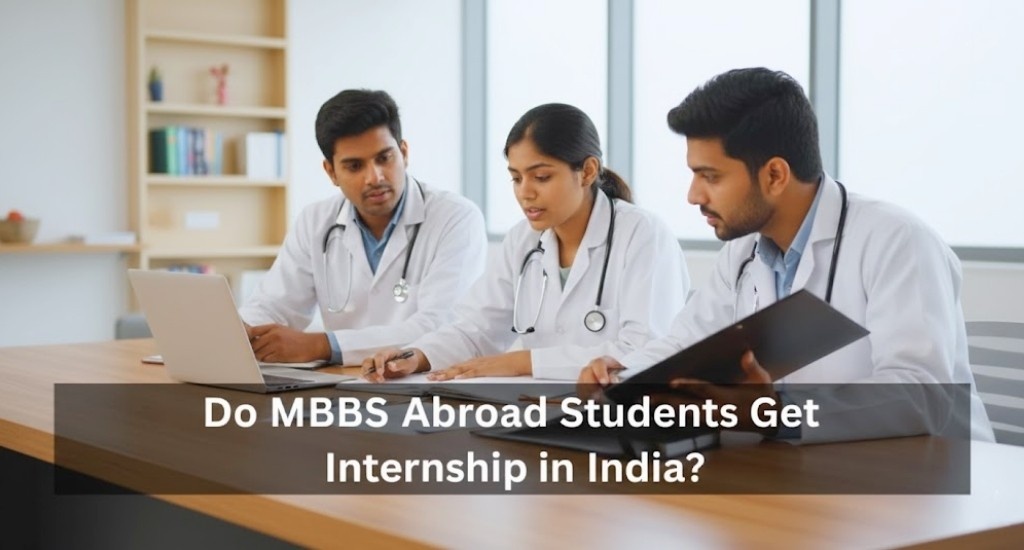

Even though these Indian students graduating from numerous foreign nations, such as China and Georgia, may have many unique challenges related to graduating, perhaps the most pressing is figuring out if their final stage of training (i.e., internship) can occur on Indian soil. While this situation is based more on personal preference than practicality (as it has an impact on career development) and results in an additional challenge for these graduates, as they now must navigate and understand a complex network of laws and regulations that differ greatly from those faced by domestically trained medical graduates. In short, yes, these graduates will have the opportunity to do their internship in India. However, doing so will require a thorough understanding of the legalities involved, a strategic plan to complete the necessary components of the training efficiently and effectively, and a willingness to pursue the appropriate licensing process to be able to practice medicine within the borders of India.
Understanding the Indian Medical Internship System
To know what the foreign medical graduates (FMGs) should know about medical internship in India, first, we need to define “medical internship” in the context of India. The medical internship is a required one-year rotation through the various medical specialties before receiving the necessary full registration as a licensed physician. The Compulsory Rotatory Residential Internship (CRRI) allows an intern to work in all of the major specialties, such as Medicine, Surgery, Obstetrics & Gynaecology, Paediatrics, Community Medicine, and, of course, any number of other specialty areas as well.
Indian Medical Graduates (IMGs) attending Medical Colleges that are affiliated with MCI (now NMC) are eligible to complete their internship at the Medical College or its affiliated hospital, whereas IMGs attending Medical Schools outside of India will need to go through additional steps and paperwork and, most importantly, pass the FMG Exam, now known as the NExT for Foreign Medical Graduates, and are required to take the National Medical Examination to complete their internship programs in India.
FMGE/NExT Requirement
The FMGE/NExT Requirement is that unless a Foreign Medical Graduate passes the NExT, he or she is not eligible for an internship program in India. Therefore, the most important consideration for IMGs seeking to complete an internship in India is passing the FMGE (now called NExT), which is administered by the National Board of Examinations (NBE) and is the means of evaluating foreign medical graduates and determining that they have the same essential knowledge and skills necessary to be a physician as an Indian Medical Graduate.
- FMGE Overview
The exam assesses students on their understanding of all aspects of medicine, including anatomy, physiology, biochemistry, pathology, microbiology, pharmacology, forensic medicine, and community medicine, as well as medicine, surgery, obstetrics and gynecology, pediatrics, and other clinical specialties.
FMGE is administered twice annually (usually in June and December; however, exact dates vary). The FMGE format consists entirely of multiple-choice questions and is delivered via computer. In order to pass FMGE, a student must achieve a score that ranks at or above the 150th percentile of Indian medical graduate students who took an identical test during that same time period.
Historically, the overall pass rate is between 15% and 25%, making FMGE one of the world’s most difficult medical certification tests to pass. This low percentage of successful examinees further emphasizes the need for rigorous preparation; prepare in advance, ideally during the final year of MBBS studies outside India.
If an MBBS student studying outside India has not been successful in passing the FMGE, he/she cannot:
- Apply for a medical internship in India
- Obtain a temporary/provisional or permanent registration to practice as a physician in India
- Work as a physician in any capacity in India (regardless of his/her location of practice)
- Apply for Postgraduate Medical courses (MD/MS) in India
In summary, the FMGE must be passed for anyone pursuing a career as a physician in India after having obtained an MBBS degree from an international school.
Eligibility Criteria for Internship in India
The criteria are as follows:
- Recognized by a State Medical Council
The NMC provides a list of recognized foreign medical colleges (i.e., schools) that comply with NMC standards. If a foreign medical school is not on the list, then its student/graduate cannot practice medicine in India, even if he/she passes the FMGE.
- Degree Validation
Your MBBS (or equivalent) degree must be verified and validated by your medical school. You will also need to submit the following documentation:
- Original certificates of your degree
- Official transcript from your medical school showing all courses taken
- A Certificate from your medical school stating that your education was conducted in English,
- A Certificate from your medical school stating that the student completed their internship program through the medical school
- FMGE test result
Once you have taken and passed the FMGE, you will receive an FMGE Eligibility Certificate. This certificate must be submitted with your application to the State Medical Council for provisional registration.
- Provisional Registration
Before you will be allowed to begin your internship in India, you must obtain provisional registration from the State Medical Council of the State in which you wish to complete your internship. Provisional registration is temporary until you complete your internship.
- No Objection Certificate (NOC)
Many of the State Medical Councils may require you to obtain an NOC from the medical institution in which you will be doing your internship, indicating that it is willing to accept you as an intern.
The Application Process: Step-by-Step Guide
- Step 1
FMGE Test Preparation. Begin preparing for an FMGE test at least 6-12 months before the scheduled test date. After successfully passing the FMGE test, print the eligibility certificate from the NBE website.
- Step 2
Select Your State. Determine the state where you wish to complete internship training and do the following:
- How many internship slots are available?
- What is the turnaround time for the State Medical Council?
- What hospitals offer internships?
- Step 3
Gather Required Documents. To be successful, you will need to provide the State Medical Council with the documentation needed to secure provisional registration. The documentation needed is as follows:
- FMGE Eligibility Certificate
- Foreign Medical Degree (original)
- Foreign Medical Degree Transcript
- All educational certificates that have been attested
- Passport and Visa information
- Equivalence Certificate
- Medium of Instruction
- Migration Certificate from Foreign Medical School
- Character Certificate
- Passport-Size Photos
- Step 4
Application for Provisional Registration Once you receive the eligibility certificate, you can submit your application to the appropriate State Medical Council for Provisional Registration, along with the necessary documentation and fees.
- Step 5
Applying for Internships Once you have received Provisional Registration, you can begin applying for internship positions. The following are examples of where to apply:
- Government Medical College(s)
- Municipality/District Hospitals
- Private Medical College(s)
- Corporate Hospitals that have Teaching Facilities
- Step 6
Completing Joining Formalities. After obtaining your internship position, please complete all necessary joining formalities with the Hospital. Examples of Joining Formalities include:
- Submission of the required organization’s original documents for verification
- Execution of Internship Agreement/Bond with the Hospital (which may be required)
- Payment of necessary fees for your internship
- Medical Fitness Certification
- Documentation related to background verification
EOCL India
EOCL India is known for helping Indian students pursue MBBS abroad at the best and most affordable rates. We also keep in mind the problems students face before and after getting their degree, so we try to eliminate all those problems from the very beginning and provide a stress-free environment for the students.