

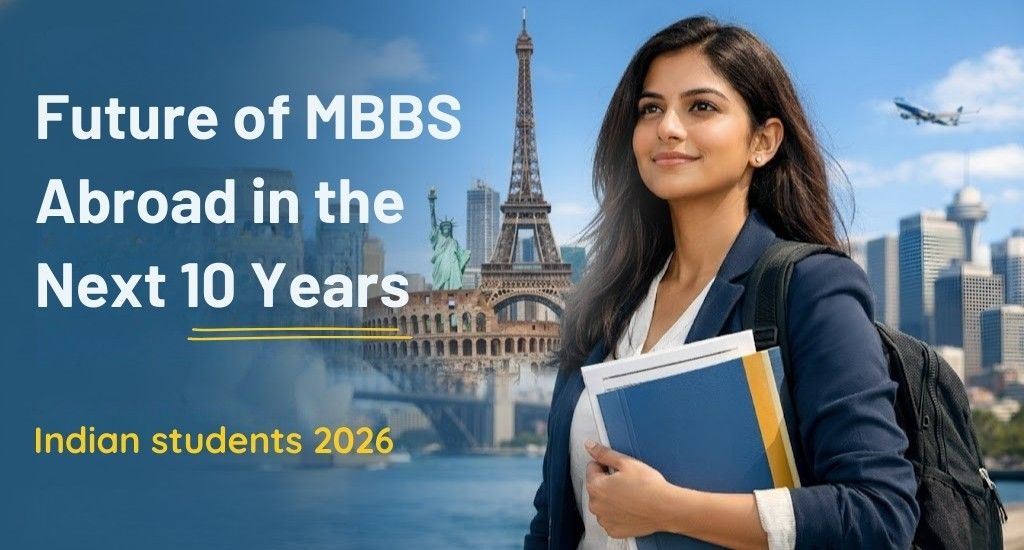
More than 8,00,000 Indian students prefer to study abroad every year, and 20,000 to 40,000 students get admitted to MBBS abroad. There could not be a higher demand for MBBS courses due to significant competition for admission to MBBS in India. The future of MBBS abroad in the next 10 years for Indian students 2026 is set to undergo a significant transformation. While there are 2.4 million NEET applicants, there would be only 1.1 lakh seats in 2026, so thousands of meritorious students will have to opt for MBBS abroad due to:
- Affordability: The total cost involved in Russia, Kazakhstan, and Uzbekistan will be mostly between ₹15–35 lakh rupees, which is relatively very low compared to the private institutions of India.
- Global Standards: Infrastructure is highly advanced, and foreign university exposure in early clinical practice is possible through WHO and NMC recognized degrees.
- Direct Entry: The procedure for entering has been simplified. This route is a major component of the plan to supply the nation with physicians because there are no donation or capitation fees.
The geopolitical situation, regulatory trends, and, of course, economic factors are shaping not only the location selection for Indian MBBS students but also changing the landscape of MBBS abroad. In a world marked by wars, political uprisings, and diplomatic tiffs, the existence and popularity of certain nations among Indians vary. Geopolitical tension between China and India, along with particular visa rules and concerns regarding the transparency of MBBS education in this country, has made MBBS less attractive than it would have appeared earlier, even though it historically enjoys first place. The regulatory landscape is the most crucial step for any medical aspirant embarking abroad in 2026. The National Medical Commission has set non-negotiable criteria to ensure that degrees received from foreign countries are indeed equivalent to the Indian MBBS.
Key regulations include:
- Duration & Medium: At least 54 months of regular studies and a 12-month compulsory internship in the same institution, entirely in English.
- NExT Shift: It is expected that by the year 2027, FMGE will be replaced by NExT. This will be a unified exam serving as a common entry point for both Indian and Foreign graduates to a license and PG seat.
- Validity of NEET: The conduct of NEET remains compulsory. After going abroad, it has now been made valid for three years.
Moving into the 2026-2036 decade, the map for medical education is shifting as traditional hubs are joined by a new tier of “strategic destinations,” offering a balance of high technology, NMC compliance, and global mobility.
If you are planning your medical career in this new era, here are the trending regions to watch:
The Central Asian "Power Corridor": Uzbekistan & Kazakhstan
Central Asia has transitioned from a “backup” to a primary choice. Countries like Uzbekistan and Kazakhstan have invested billions in medical infrastructure to align with the 2026 global standards.
- Why they are trending: They offer 5-year programs that focus on early clinical rotation. With fees ranging between ₹18–30 lakhs total, they provide the highest ROI for middle-class Indian families.
- Key Advantage: Direct air connectivity and a growing “Indian-friendly” ecosystem (including Indian messes and faculty).
The European Pivot: Romania, Poland, and Hungary
But for students who go beyond the budget and strive for global recognition, Eastern and Central Europe offer new frontiers.
- EU Advantage: Having a degree from Poland or Hungary is essentially the “Golden Ticket” for practicing medicine in the entire EU region. These institutions are currently incorporating USMLE or PLAB tutorial courses in their curriculum to attract students who want to pursue their goals in the US or UK markets.
- The Cost Factor: Though pricier than Central Asia (€5,000-€15,000 a year), the facilities, with AI simulation laboratories, observation of robot-assisted surgeries, et cetera.
The “Legacy Hub” Evolution: Russia & Georgia
Russia is currently the first choice, given the tremendous number of government-subsidized spots available. The next ten years, however, will witness a trend towards “Super-Specialized” Russian Universities, which will have bilingual support as well as state-of-the-art research centers.
A Georgian Renaissance: With its application to join the EU, Georgia presents an interesting amalgamation of European standards and an affordable lifestyle. In fact, many favor this over another country because they want to experience the lifestyle with a Western twist but without the price tag attached to Western Europe.
Southeast Asian Consistency: The Philippines
The Philippines is also a major contender if the person is interested in a US-based curriculum of studies in the field of medicine. Starting from the next 10 years, clinical exposure would be the primary focus, since the kind of diseases that the Philippines has are no less similar to the kind of diseases that India has, and therefore, they will have a pre-existing advantage over NExT.
By the year 2026, technology will no longer be an ‘extra’ but will be an essential component of medical education. The future generation of medical students will make use of adaptive technology with AI capabilities for personalized studying, as well as Virtual Reality for surgical practices with no risk.
- VR Cadavers: Investigating 3D Anatomy Without the Limitations of a Conventional Laboratory.
- AI tutors: Quick feedback on diagnostic reasoning and clinical cases.
- Obtaining telemedicine training to provide remote patient care in a digital healthcare setting.
EOCL India
Being one of the top MBBS abroad consultants, EOCL India is the destination for all your answers when it comes to studying MBBS abroad. We provide the best guidance and counseling to students planning to study MBBS abroad. We are dedicated to making students aware of the dynamic nature of MBBS studies abroad. Call today.