
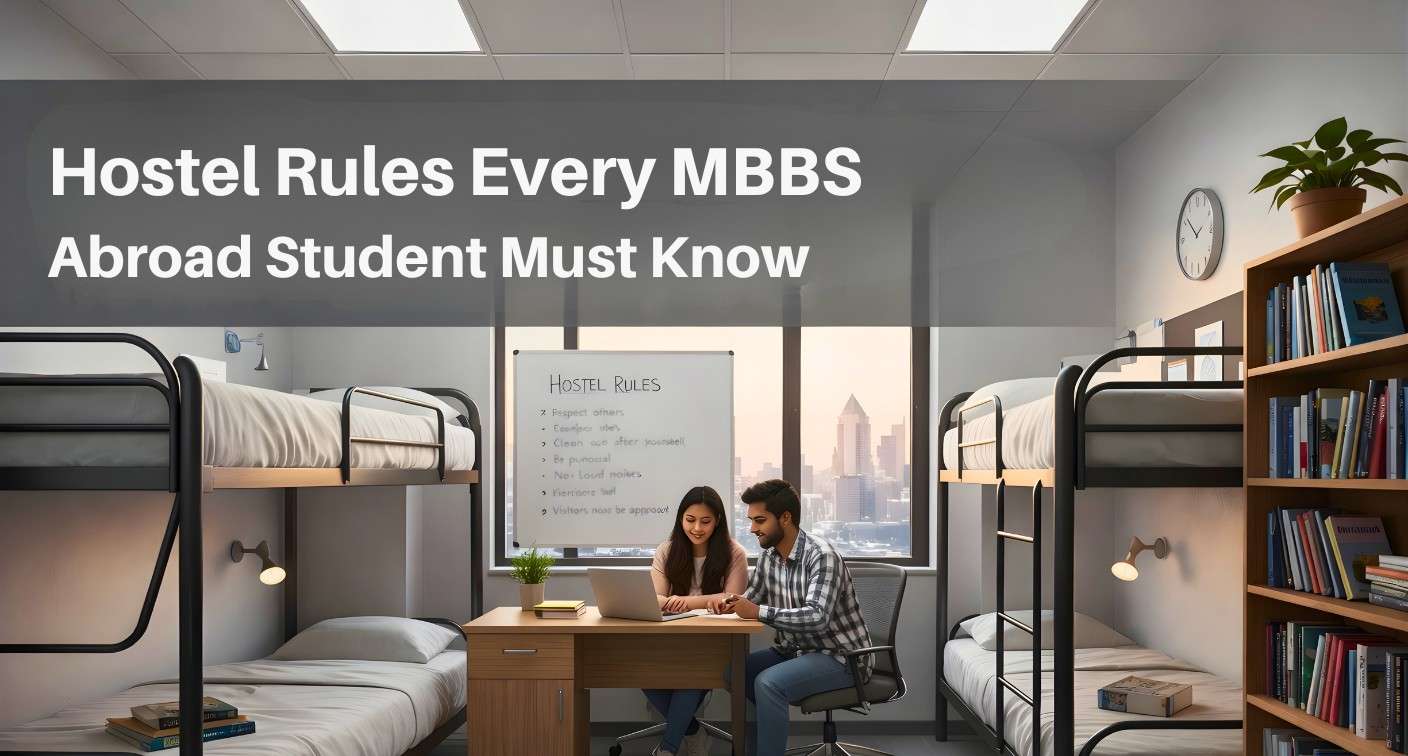
Hostel Rules Every MBBS Abroad Student Must Know

Hostel Rules Every MBBS Abroad Student Must Know
Entering a foreign hostel is one of the most thrilling yet intimidating aspects of your MBBS abroad experience. Your hostel room is your home, your reassurance, your study area, and your social outlet, all at once. You will also need to learn the rules (spoken and unspoken) that govern this new environment for you to avoid unnecessary problems, fees, and awkward situations. Having a full understanding of your hostel rules, regardless of your destination (Russia, Kazakhstan, Georgia, Ukraine, or the Philippines), can help you avoid problems in your hostel.
The following information will help you navigate through your dormitory experience as an MBBS student abroad, giving you the ability to concentrate on what is essential: your medical education.

The Importance of Hostel Rules

Understanding why hostel rules exist and why it is vital to follow them will help you to be successful in your time abroad. The regulations that govern hostels are not intended to limit your freedom or complicate your life; rather, they exist to protect you and ensure safe living conditions, as well as maintain cleanliness and provide you with an ideal study atmosphere, observing the lifestyle and cultural values of the local population, and coexisting peacefully with students from other cultures.

Entry and Exit Timings

Curfew hours, the hours in which you must be at your hostel, are one of the most common hostel policies at international universities. Most hostels have an established time when their gates close, typically, depending on the country or university policy, between 10 PM and 12 AM.
Curfew hours vary by country: In both Russia and Kazakhstan, for example, the majority of hostels will close their gates at around 11 PM on weekdays, while on weekends the gates usually won’t close until midnight. If a student fails to return to the hostel before the designated close time, they will find themselves locked out of their accommodation. Furthermore, many universities require their students to “sign out” when leaving the building and sign back in upon returning. This serves both as a record of student movements for safety purposes and enhances the overall safety of students.
Most hostels also have procedures in place for students who need to arrive late due to valid reasons (for example, late-night study sessions at the library, medical emergencies, or attending university events).
There are increasing levels of consequences for violating curfew hours. The first time a student violates curfew hours, they may receive a warning; after that, they can expect to pay a fine of $10–$50, depending on the university, or risk being expelled from the hostel for a period of time, during which time the student will need to find alternative accommodation options.
In some cultures, curfew hours are derived from cultural norms as well as legitimate safety concerns. By understanding local culture and customs, you will be able to better appreciate or respect the regulations established by local societies instead of resenting them for being a form of authoritarianism.

Room Maintenance and Cleanliness Standards

At your hostel, you’re responsible for the condition of your room. Universities expect a higher level of cleanliness and care for your room than you may have been used to before.

Hostels may clean their public areas and bathrooms on a weekly or biweekly basis; however, each student is responsible for his/her own room. Each student’s room should meet the following cleanliness standards daily: Make the bed every day. Take out the trash every day and always use the designated trash can. Sweep the floor once daily. Clean the desk and other surfaces regularly with an antibacterial cleaner. Use organization for all personal items. Never leave food or drink in your room that will attract insects or rodents, and dispose of food immediately.

Most hostels have a system in place where they periodically inspect rooms for cleanliness and compliance with hostel rules. These inspections may be announced in advance or may be surprise inspections. Wardens or management will inspect rooms normally to check for cleanliness, health and safety, unauthorized electric appliances or items (alcohol and/or smoking), structural defects, and unauthorized modifications. They may also check to see that what you provided is in good working condition.
If you share a room, then your cleanliness will be everyone’s responsibility. It is recommended that you set up a cleaning schedule and garbage duty, and that you agree on how to keep your shared living space organized and clean. If there is an issue with one roommate consistently violating these standards of cleanliness, then you should inform the hostel management.

Noise Regulations and Quiet Hours

To ensure medical students can focus on their studies, hostels establish their noise regulations. These rules are in place to promote harmony and avoid disputes between students who respect the noise regulations and those who do not.
Most hostels implement strict quiet hours between 10 PM and 7 AM during the week, with more lenient times on the weekend. During this time period, students are expected to create little noise; loud music or conversations, turning the television on at high volumes, answering phone calls on speaker mode, and making loud foot and door noises are prohibited. Students must also be particularly quiet in common hallways.
During exam week, most hostels make quiet hours last all day, creating a 24-hour low-noise study environment. While students not preparing for exams may not have to adhere to the strict regulations as long as they are not disturbing others studying or taking exams, students preparing for exams will be required to respect the enhanced quiet hour regulations created to support their fellow students during exam week.
There are expectation guidelines set for the use of lounge areas, TV rooms, and rec areas, allowing the use of background music (at low volumes), requiring headphones or extremely low volume, and prohibiting group discussions in common areas and encouraging students to use designated study areas for all group discussions, especially late-night gatherings with large groups.
Excessive noise complaints result in warnings from wardens or fellow students, fines for multiple violations of notifications during designated quiet hours, limited access to common areas, and, in severe cases, forced changes of rooms and/or suspension from the hostel.
Different cultures have different levels of noise tolerance. What might seem to be a normal level of conversation to you may be perceived as loud by someone from another culture, and therefore, having consideration for and making an effort to be quieter rather than risk offending someone will avoid a potential conflict.
Buy a good set of quality headphones for entertainment and online classes. If you are on the phone during quiet hours, go to the hallway or to a designated phone booth if one is available. When you study or work in a group, use a designated study room instead of your personal room. Reach out to your neighbors and let them know if you are having a small gathering or celebration. Give them a heads-up ahead of time and invite them to participate if they wish.

EOCL India

Have you made the decision to obtain an MBBS Outside of India? If so, please get in touch with EOCL India ASAP! We offer a fully comprehensive Pre-Departure Orientation for students, including information on hostels.


Policy, Culture Adaptation, and everything else necessary for you to be successful while enrolled at an Offshore Medical School. As part of your holistic approach to education, we will assist you in every manner possible to ensure your success!
Share this :
WhatsApp
LinkedIn
Facebook

Leave a Reply

Your email address will not be published. Required fields are marked *