
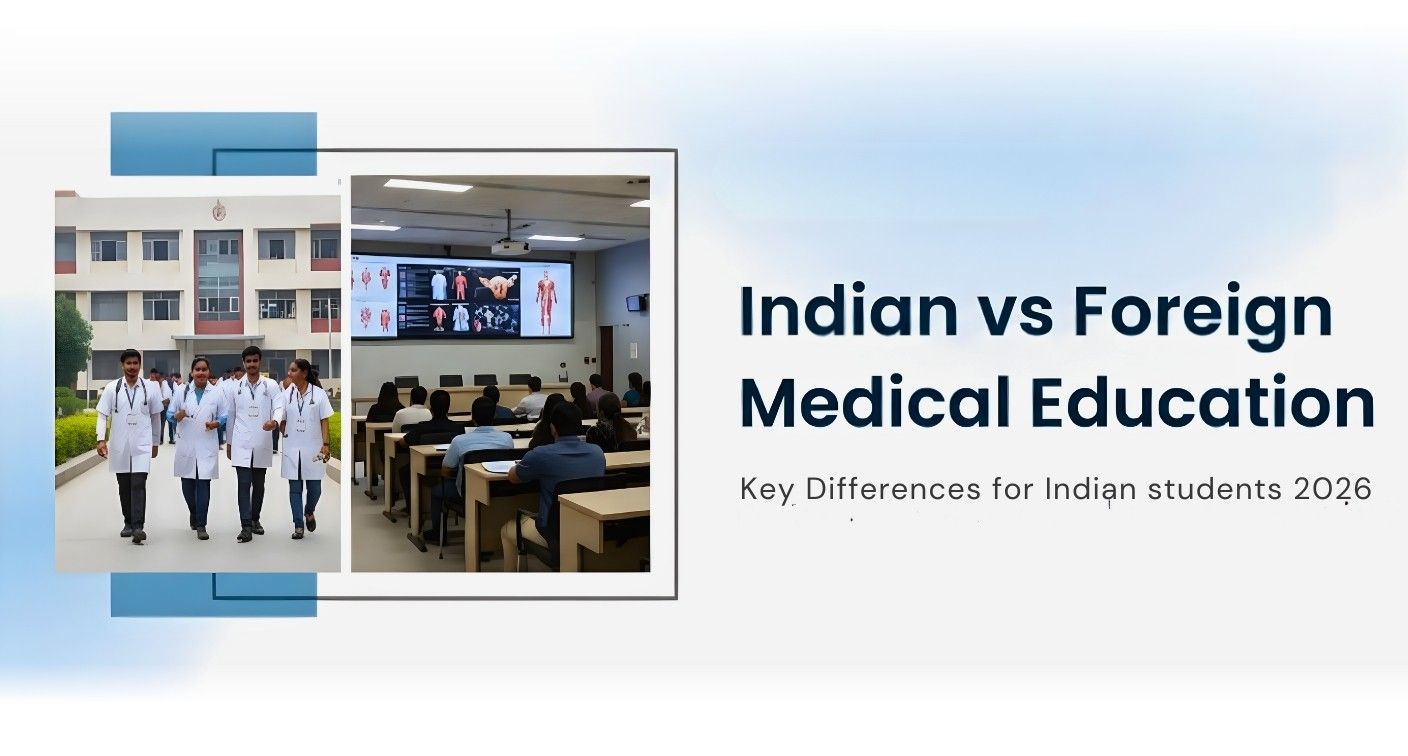
Indian vs Foreign Medical Education – Key Differences

Indian vs Foreign Medical Education - Key Differences

Although Indian medical graduates are sufficiently skilled to begin practicing after their MBBS and internship, foreign medical students are required to clear a compulsory licensing exam to obtain their license to practice in their countries.

When finished with their MBBS of 4.5 years and 1 year of rotational internships, medical students in India receive their registration in either the National Medical Commission or the State Medical Council.
For foreign medical students, after achieving a primary medical qualification from an NMC recognized college abroad, they are required to give the National Exit Test (NExT).
In the meantime, until 2026, the gap between candidates and available MBBS seats for Indian medical students will remain at its highest.
Although 23.3 Lakh aspirants appeared in the last NEET-UG examination, there are only 1.18 Lakh MBBS seats available in 780 medical colleges in India. This would mean that 95% aspirants won’t receive admission in India.
While pursuing their medical career, it becomes pertinent to examine and draw differences between Indian vs foreign medical education – key differences for Indian students 2026.
On the other hand, foreign medical universities in hubs like Russia or Georgia have abundant seats and less competition.
The bar moves from “getting in” to “staying under compliance” of NMC 2026 rules.
These rules necessitate only a valid NEET and a 54-month study period. NExT is the latest unified test for both Indian and foreign-trained students for licensure and PG admissions. Before NExT, foreign medical graduates had to appear for the FMGE. In 2026, the financial choice for MBBS is a story of three poles.
Indian government colleges remain the holy grail of value, 10 times less than several private colleges in India, with total costs as low as ₹50,000 to ₹5 lakhs over 5 years, although they will require elite NEET ranks.
At the other end of the spectrum, Indian Private Colleges can command a “sticker shock” investment between ₹75 lakhs and over ₹1.5 crores, often yielding lower ROIs due to high initial debt. MBBS Abroad forms the middle ground, with high value for a total cost of ₹15–40 lakhs (including living expenses) in hubs like Russia, Uzbekistan, and Georgia.
Yes, you are saving millions, but do not forget the “hidden” costs: compulsory coaching for the NExT exam to practice in India and the increasing living costs, now averaging ₹15,000–₹25,000 per month. The passing rate for this test has historically been low, making this a major challenge.

Syllabus and Practical Exposure

The quality and structure of the MBBS syllabus and practical exposure can vary significantly between Indian and foreign colleges. When comparing the curriculum of an Indian MBBS with a foreign medical degree, the difference isn’t usually what you learn—as the NMC 2026 guidelines mandate 19 core subjects globally—but how and where you learn it.

The syllabus pattern in India is quite conventional and linear in its approach:
  • Years 1-2: Extensive emphasis on pre-clinical theory.
  • Years 3-5: Transition into clinical subjects.

Even though it is very comprehensive, it sometimes leads to “rote learning.” On the other hand, most foreign universities (especially in Europe and the USA) adopt Integrated Problem-Based Learning (PBL). In this case, clinical experience is introduced as early as the first year. You don’t just read about the heart in a textbook. You review a case study of a patient with a cardiac condition while learning anatomy.

This is where the Indian system remains unbeaten, as the number of cases handled by a student in an Indian government hospital is enormous, given the high population density present in the Indian continent.
  • Number of patients: As an intern in India, one sees 50+ patients in a single OPD session, from simple ailments to exotic diseases like Malaria and TB.
  • Clinical Skills: Compared to students training overseas, Indian students are clinically exposed to simpler procedures like suturing, drawing blood, and giving birth much earlier.
Foreign universities usually compensate for having limited patient flow with the most modern technological developments.
  • Simulation Labs: Realistic simulation labs in Russia, Georgia, and Kazakhstan utilize real simulation of human crises such as a stroke or heart attack, through the use of 3D cadavers and sophisticated human mannequins.
  • Research Focus: In a foreign curriculum, a lot of time is spent on studying medical research and electives, which is a huge benefit if one is pursuing a PG in the US (USMLE) or a PG in the UK (PLAB).

Lifestyle and Global Mobility: Becoming a Global Doctor

Pursuing education in foreign countries like Kazakhstan and Poland is no longer “Plan B,” it’s “Plan Smart and Global.” Living among main centers like Georgia, Poland, or Kazakhstan can turn a student into a “global citizen.” Indian students get to remain under their own sky, whereas foreign ones have “The Golden Ticket” to success worldwide.

Bottom Line: If you’re looking for unmatched ‘street-smart’ skills, the winner is clearly India. But if you’re looking for a technology-savvy and research-oriented system that will prepare you for global exams, the advantage lies abroad.

Education Orbit Counseling & Link

With the help of Education Orbit Counseling & Link, you can get an overseas MBBS at a limited budget, from a top-ranked medical university, according to your merit and distinction. Education Orbit Counseling & Link can rightly be named an expert in overseas MBBS. We assist the students in helping them realize their goals in the medical field. Call today.


Share this :
WhatsApp
LinkedIn
Facebook

Leave a Reply

Your email address will not be published. Required fields are marked *