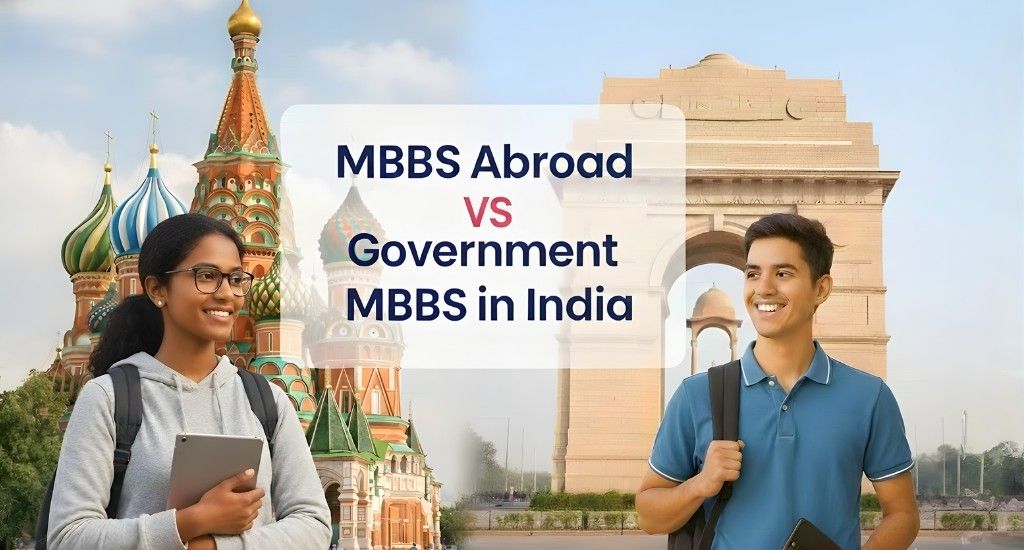
MBBS Abroad vs Government MBBS in India

MBBS Abroad vs Government MBBS in India
The education system of India is highly prestigious, making it a highly competitive atmosphere for MBBS aspirants.
It depends on the personal choices of students, whether they wish to pursue MBBS in India or abroad. However, it is necessary to consider the advantages and disadvantages of MBBS in India before making any decision. One of the most important eligibility requirements for MBBS in India is passing the NEET-UG Exam. The National Testing Agency organized the NEET Exam 2025 on 4th May 2025. According to the National Medical Commission, around 24 lakh NEET UG registrations have been made.

Keeping this into consideration, students often get confused about selecting the ideal destination to study MBBS abroad. Even for MBBS aspirants who wish to study MBBS from abroad, the NEET qualification is also needed to obtain an eligibility certificate from the National Medical Commission. Students must adhere to the NMC guidelines for MBBS abroad. Before deciding to pursue MBBS abroad, students must make sure that they know how much they have to spend in the entire MBBS program. If someone has studied MBBS abroad and wishes to practice medicine in India, then he/she are required to give the FMGE Exam. It is the sole licensing test in India for MBBS aspirants.

On the other hand, for different nations, there are different medical licensing tests after studying MBBS abroad that students must qualify for.

Comparison of MBBS Education and Career

When comparing MBBS abroad vs government MBBS in India for Indian students 2026, the Indian standard is very high. However, the world’s top medical schools either meet or exceed Indian standards in terms of research facilities and post-MBBS career opportunities. In India, MBBS graduates have a wide range of career options, such as private practice, postgraduate study, and government employment. After passing the FMGE Exam, students pursuing MBBS abroad can either work overseas or return to India to continue their studies. Every year, hundreds of students in India dream of becoming doctors. While some are lucky enough to turn that dream into reality, many others are left heartbroken due to several challenges.

The level of challenges for studying MBBS in India are more than MBBS abroad:

MBBS in India

For most Indian students, studying an MBBS course in India is the obvious first choice. However, there are various challenges along the way that students might not yet be aware of.
The first level of a student’s MBBS journey starts with 2 years of preparation for the NEET Test. Each year, around 24 lakh students appear for the NEET Test. However, with only 1 lakh seats available in both private and government colleges in India, lakhs of students have to look for other options for their MBBS journey.
This is basically how seats are handed out to students, whether it’s through the State Quota (for local students) or the All India Quota (for students from anywhere in the country). You then get assigned a seat in an Indian medical college based on the program you chose and your rank. The hard part? It’s really tough for most students to actually get admitted to India. There simply aren’t enough government seats available, and getting into private universities often requires huge, unaffordable donations (extra payments).
One of the main challenges of pursuing an MBBS in India is the huge class sizes, with 1 teacher for every 10 students and 1 assistant teacher for every 5. The syllabus is mostly theory-based, and some sections are outdated, which means students often miss out on gaining strong clinical skills.

Getting into a postgraduate (PG) medical course after MBBS is incredibly tough. The NEET PG exam is even more competitive than the entrance exam you took for MBBS, simply because there are many more doctors fighting for fewer specialty training spots. After finishing the 5.5-year MBBS degree, Indian doctors need to spend another three years specializing. Even then, there’s no guarantee they’ll get a great job in the medical field they chose.

MBBS Abroad

Students who fail to get an MBBS seat in India either look for the next best option in the medical stream, opt for dentistry, or they drop the idea of becoming a doctor altogether.
No matter what the NEET score is, whether average or below average, students still have the opportunity to become a doctor by opting to pursue MBBS abroad. Passing the NEET exam is the only requirement for studying medicine abroad and then coming back to India to practice. When conducting their research, students should make sure to take into account universities that are affordable, provide extra benefits for students, and offer excellent post-graduation employment prospects worldwide.
It is comparatively easier to secure admission abroad in any of the chosen colleges by shortlisting them as per their budget. A valid passport, NEET score, college acceptance letter, and medical clearance certificate are all necessary for MBBS admission overseas. Students are not required to appear for any additional tests to secure admission in a medical college abroad.

EOCL India

We are aware of how important it is to apply to medical school abroad! For this reason, we at EOCL India are here to support you at every stage. From locating the ideal residence (a suitable dorm) and obtaining your visa to investigating the top medical schools for you, our knowledgeable counselors will walk you through every step of the process. We have a great history of assisting students just like you in gaining admission to international universities so they can pursue MBBS degrees. We are eager to assist you in realizing your dream.

Share this :
WhatsApp
LinkedIn
Facebook

Leave a Reply

Your email address will not be published. Required fields are marked *