NMC Gazette 2026: What Students Should Know

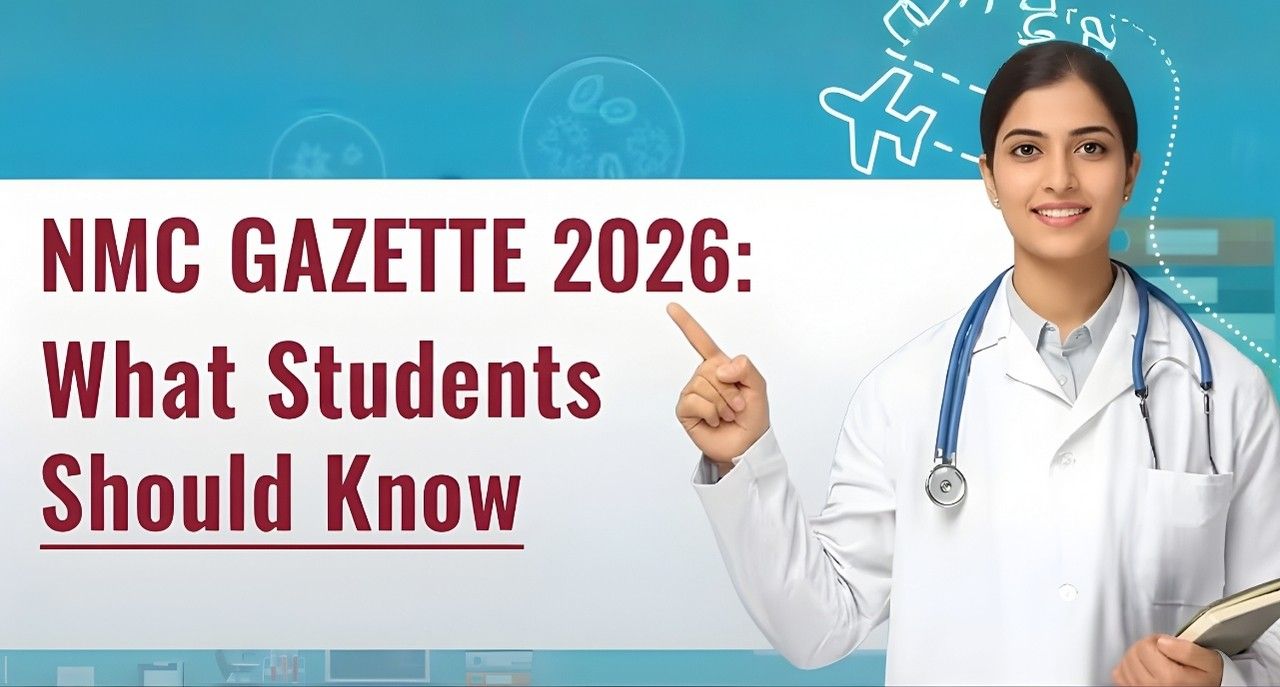
NMC Gazette 2026: What Students Should Know
As we approach 2026, the NMC is continuously introducing new transformative regulations affecting MBBS admissions, licensing requirements, foreign medical education standards, and post-graduate entrance examinations. We will break down what the NMC Gazette for 2026 means for your medical journey and how staying informed on changes can help you to stay on the right course toward success, and will help to prevent any further disruption of your medical career.
The NMC Gazette is the official publication through which the National Medical Commission publishes all legally binding regulations, amendments, notifications, and guidelines. All regulations affecting medical education in India—from NEET Eligibility Criteria through Internship Requirements and Licensing Procedures—are published first in the NMC Gazette.
Therefore, consider the NMC Gazette to be the Constitution of Indian Medical Education. Citizens must have a basic understanding of laws, and medical students must understand the notifications contained in the NMC Gazette to remain compliant and avoid making mistakes that could jeopardise their careers.
The NMC is the successor to the Medical Council of India, having been created through the National Medical Commission Act of 2019, which became effective in September 2020. The NMC publishes these gazettes on a regular basis to promote transparency and consistency in medical education throughout India.

NExT Exam 2026

The NMC Gazette for 2026 will fully implement the National Exit Test (NExT), which will significantly change how medical professionals get their licenses and enter postgraduate medical schools.
The National Exit Test (NExT) is a two-part exam that will replace several current tests, including the NEET PG, INI-CET and FMGE (Foreign Medical Graduate).
Under the current NMC regulations, NExT will be required for both Indian and foreign medical graduates.

Two Parts to the NExT:

Expected to begin in August 2025 for the MBBS graduating class of 2020. The theory portion of NExT will include an exam on each of the six essential subjects of medicine — it will replace the final examinations taken by MBBS graduates before entering into the postgraduate level.
The theory portion will take place via computer-based testing. The scores obtained on NExT will be valid for two years for the purposes of applying for postgraduate medical school.
Expected to be conducted in February 2026, Step 2 will consist of clinical assessments on seven clinical subjects and will be available only after a candidate has completed their mandatory 12-month internship. The practical portion of NExT will allow the examining body to evaluate candidates’ hands-on clinical abilities as well as their ability to perform patient assessments.

Important Dates: The NMC recently released an academic calendar showing the NExT for the 2023-24 MBBS class will begin in February 2028; pilot tests and practice questions are expected to be published in 2025 for training purposes.

The most significant development in the NMC Gazette for 2026 is the anticipated full-scale implementation of the National Exit Test (NExT). This unified examination will fundamentally transform how medical graduates obtain their license to practice and gain admission to postgraduate programs.

NMC Gazette 2026: Critical Guidelines

The National Medical Commission (NMC) Gazette has introduced a set of rules and regulations with strict measures for Indian students who go to study abroad in MBBS programs to ensure they receive a quality education as well as adhere to proper licensing requirements upon their return to India. These rules have been outlined in the Foreign Medical Graduates License Regulations (FMGL) 2021 and will continue to be refined and revised as time goes on.
NMC Gazette notifications must be followed and therefore require that all Indian students wishing to obtain an MBBS degree from abroad must take and pass the National Eligibility cum Entrance Test (NEET)-UG Exam. NMC will not register any student’s license back in India who has not taken this examination, regardless of where they have taken their MBBS degree.
In accordance with the NMC Gazette, all MBBS degrees completed outside of India will have a minimum course duration of 54 months of medical training, followed by at least a 12-month internship at the same institution where the student has completed their medical degree.
The onus is on students to ensure they attend a university that meets the following qualifications: Recognized by NMC (check NMC’s website for the latest versions), approved by WHO, listed in the World Directory of Medical Schools, and has been established for at least ten years (should avoid newly formed universities).

Internship Requirements

Recently, the NMC Gazette has issued guidelines with regards to the requirement for foreign medical graduates to serve one full year as interns (12 months).
It is important to understand that this information is contained in the NMC Gazette and has been interpreted in different ways by various individuals.

The “Primary Internship” is defined in the regulations as 12 months in a foreign medical institution (where the applicant completed his/her studies) and must include clinical experience in the following departments:

“Secondary Medical Internship” requires all foreign medical graduates who will be returning to India for the purpose of obtaining provisional registration to serve an additional 12 months of supervised apprenticeship in a medically-accredited Indian medical college, except for applicants who completed their post-graduate practical training in the same country where they received their medical education.

Competency-Based Medical Education (CBME)

The introduction of the NMC Gazette (National Medical Commission) marks a shift in medical education in India towards using a Competency-Based Medical Education (CBME) approach, which focuses on producing doctors with the ability to demonstrate specific competencies instead of just theoretical knowledge. The following are some key features of the CBME approach:
The introduction and continued clinical placements starting in the first year of study are designed to allow students to interact with patients; develop skills through simulated lab experiences, hands-on experiences, and patient/clinical learning opportunities; integrate ethics, professionalism, empathy into their experiences; develop personalized self-directed electives to pursue their interests; create an integrated public health system based on preventive medicine; and measure their ability to use their knowledge in clinical practice through real-time clinical assessments.

According to the NMC Gazette, in addition to preparing students with the knowledge from books, colleges must ensure that they also have had sufficient clinical practice (so that when they graduate, they are prepared to enter the workforce) through organized, structured clinical exposure to real patients.

New Infrastructure and Expansion

The NMC Gazette 2025-26 Provides For Medical Colleges Being Able To Form Affiliation With District Hospitals As Long As They Meet The Minimum Bed Requirement; This Can Help With More Effective Use Of Publicly Funded Infrastructure, Increased Practical Exposure For The Students, and provide an Opportunity For Students To Have Experiences In Different Environments.

The NMC Gazette 2025-26 mandates that all Medical Colleges Use Simulation Labs As Well As Online Modules For Theoretical Components; Create Skill centers with New Equipment; And utilize digital Learning Resources.

The NMC Gazette 2025-26 Provides A Better Salary Structure To Attract And Retain Qualified Teachers; It Also Mandates Faculty Development Programs And Creates A Digital Monitor System To Track Faculty Appointments And Their Availability; It In addition Provides Research Incentives To Encourage Medical Educators.

How to Access and Interpret NMC Gazette Notifications

Access to the NMC Official Gazettes is available on the NMC Official Website, and all information is accessible through the Information Desk section.
Under Rules and Regulations, visit the NMC Official Website to read more about the following NMC policies:
  1. FMGL Regulations – 2021
  2. NMC Act – 2019
  3. UGMER
  4. PG Regulations
  5. E&M Registration Board
  6. Competency-Based Medical Education Regs.
The NMC Gazettes are written in Legalese and can be very difficult to comprehend. Here are some key elements to look for in the NMC Gazette:
  • The Effective Date: The date the regulations come into force and are applicable.
  • Who it Applies To: The year/batch of Medical Students who will be impacted by it.
  • What it Supersedes: The regulations that have been replaced
  • Compliance to Follow: The steps that students must take to comply with it.

EOCL India Provides NMC (National Medical Commission) Compliance Assistance

  • Confirms that selected universities will be recognized by the NMC and comply with such recognition
  • Confirms the most up-to-date status (in accordance with the NMC Gazette) of the university selected
  • Ensures that the chosen universities provide a curriculum that meets 54 months of training and 12 months of internship
  • Confirms that the curriculum is offered in English and covers subject materials required by the NMC
  • EOCL India remains in contact with the NMC and follows changes that may impact current students via the NMC Gazette
  • EOCL India will provide notifications to current students of any compliance issues that arise at their universities
  • EOCL India provides guidance on what types of documents students need to maintain in support of future licensure
  • Provides support to students whose university recognition status changes
  • Provides applicants with assistance when applying for the FMGE/NExT exam and conducting candidate registration
  • Provides support and guidance for the 12-month Indian internship
  • Assists with the provisional and permanent registration application process
  • Provides documentation assistance for a license to practice in India

EOCL India has qualified counsellors who remain current with the NMC Gazette and can interpret complex legal language and provide actionable guidance to EOCL India students. EOCL India counsellors are knowledgeable about the specific regulations that apply to each student, the transitional provisions available and how to resolve confusion that may exist around compliance issues.

Contact EOCL India today for expert guidance.
Share this :
WhatsApp
LinkedIn
Facebook

Leave a Reply

Your email address will not be published. Required fields are marked *