

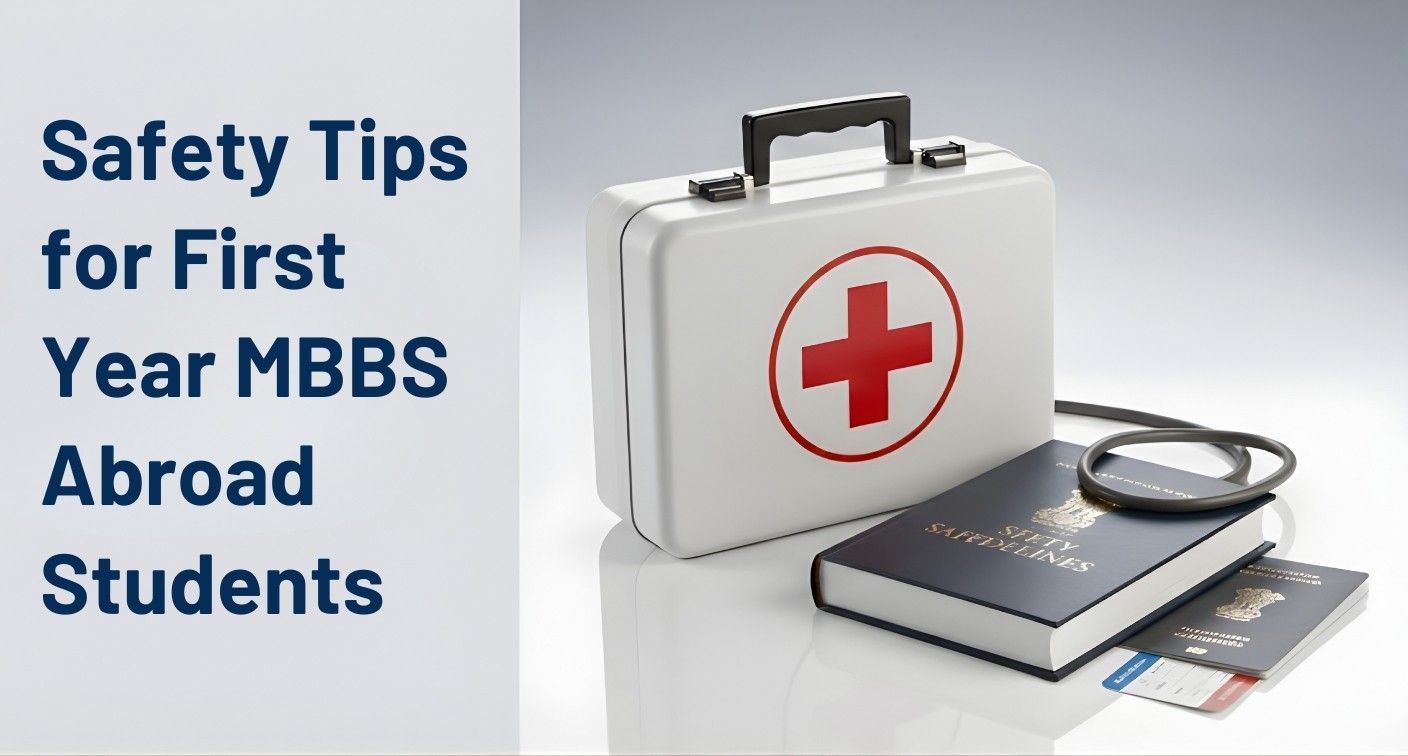
Every year, many Indian students have plans to pursue higher education abroad. It is the first time for most students that they have experienced life away from their families. It is the concern for dealing with medical emergencies, accommodations, and food that the parent feels. In order for the students to have a smooth transition into medical school, it is important that safety tips for first-year MBBS abroad students 2026 be checked.
Creating the Background: Travel Precautions Before Departure
Ensuring safety while abroad actually begins even before your plane takes off. Your first year of MBBS is going to be a rollercoaster ride; hence, it is a good time to set up your virtual safety net.
First, digitize everything: scan your passport, visa, and medical records onto a secure cloud folder; share access with your parents.
Then, print an “Emergency Cheat Sheet” for your wallet, containing the local police number, the address of the nearest embassy, and your university’s security hotline. Lastly, prepare for health issues: pack up a six-month supply of essential medications, along with prescriptions that can help you avoid legal or supply hurdles at customs.
Another factor is rumors and misleading information. What often gets ignored is the fact that foreign students are among the most protected groups in most education-focused nations.
Safety in the Scrub: Lab and Clinical Protocols
As an MBBS student, your safety concerns extend beyond the streets and into the wards. First-year labs—especially anatomy dissections—require a “safety-first” mindset. Always wear your Personal Protective Equipment (PPE); your lab coat and gloves are your primary barriers against chemical fixatives and biological hazards. Be hyper-aware of sharps safety. Practice steady hand-eye coordination with scalpels and needles, and never overfill a sharps container.
Most importantly, familiarize yourself with the university’s accidental exposure protocol on day one.
Knowing exactly who to call after a needlestick injury is vital for your long-term health and peace of mind.
How Safe is the Most Popular Destination to Study Abroad?
Most of those nations attracting students do have strict rules concerning safety.
Colleges have strict rules and regulations, and student safety is directly related to their prestige and international standing. Cities that have a large population of students are designed with safety, public transportation systems, healthcare accessibility, and other emergency handling systems in mind.
The general notion that studying MBBS abroad is unsafe usually stems from unfamiliarity rather than reality.
Finding Your Safe Haven: Housing and Neighborhoods
Housing is more than just the rent; it’s a lot about peace of mind, too. First, prioritize university-managed dorms or verified student housing that usually offer 24/7 security and CCTV. If you rent privately, visit the place around noon and night, considering whether there’s adequate street lighting and a “student-friendly” atmosphere.
Mastering Your New Map: Navigating the Local Environment
Stepping out of the airport in a new country is exhilarating, but the transition from a “tourist” to a “resident” requires a shift in how you perceive your surroundings. For a first-year MBBS student, your commute between the university, the hospital, and your home will become a daily routine. Staying safe during these transits is all about situational awareness and cultural adaptability.
The Golden Rule: Situational Awareness
The biggest threat to safety isn’t usually a specific person; it’s distraction. It is tempting to walk with noise-canceling headphones or keep your eyes glued to Google Maps while navigating a new street. However, being “tuned out” makes you an easy target for petty theft. Keep your head up and one ear free. By staying alert, you can spot potential hazards—like an approaching vehicle on the wrong side of the road or a poorly lit alleyway—long before they become a problem.
Learning Public Transportation
Public transport is very often the lifeblood of a medical student’s expenditure on transport. Whether it is the Metro in Tbilisi, transport in Cebu, or trains in Poland, the following safety rules always have to be adhered to:
- Use Official Apps: You can download the official transport app of your city to monitor live timings. When you wait at distant stops for a longer period of time, your exposure gets maximized.
- “Middle Carriage” Strategy: For trains or subways, it is best to sit inside the middle carriages or near the driver’s cabin, which is more populated.
- Verify Rides: If one uses e-rides such as Uber, Bolt, or Grab, they should always verify the license number and ask the driver, “Who are you picking up?” before entering the car.
The Buddy System and Night Safety
Night shifts in hospital settings and night library hours are part of medical school. All opportunities, of course, must be taken advantage of. Use the Buddy System whenever possible. Walking with a classmate not only speeds you along, but it also lessens the likelihood of you being approached by a stranger. When walking alone at night, it is best to take the main road.
Blending In
Every city had its own rhythm. You had to feel the rhythm of the place. You had to notice how the people dressed. You had to notice how the people acted in public. You had to avoid drawing attention to yourself through the display of obvious wealth. Blending with the culture was not only a form of giving respect to the culture of the host country.
EOCL India
As a team of professionals, we, with our knowledgeable staff, are there to assist and counsel for admissions and visa formalities. Our aim is not only to empower the students to make their own decisions but also to provide them with the best possible education and start their successful MBBS career with us. In the realm of international MBBS education, the name of EOCL India stands for reliability, professionalism, and devotion. Give the numbers a call today.