

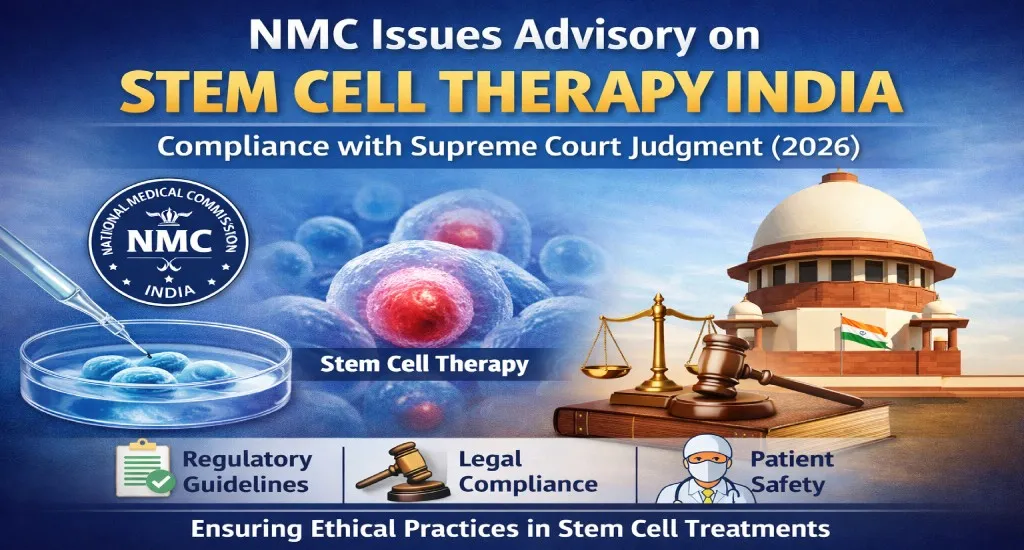
On March 25, 2026, the National Medical Commission (NMC) of India released an important advisory on Stem Cell Therapy India for all medical colleges and institutions to adhere to the Supreme Court ruling issued on January 30, 2026 (W.P. (C) No. 369 of 2022; Yash Charitable Trust & Ors v. Union of India & Ors). The Supreme Court addressed significant and critical issues related to stem cell therapy in India regarding its use as a treatment for Autism Spectrum Disorder.
The NMC advisory signifies a pivotal point in how stem cell therapy India is regulated, conducted, and researched throughout the country.
As a result, medical professionals, institutions, researchers, and patients must be made aware of the implications of this directive.
What Prompted the Supreme Court Judgment?
The Yash Charitable Trust filed a petition against the unregulated and commercially exploitative use of stem cell therapies in India, which were being marketed primarily to families with children diagnosed with Autism Spectrum Disorder (ASD), and the lack of evidence supporting the efficacy and safety of these therapies and their very high cost.
The Supreme Court of India recognized the issue of stem cell therapy India, and there was a judgment dated 30th January 2026 that provided the necessary legal framework, as well as the subsequent Department of Health Research (DHR) communication dated 10 March 2026 (D.O. letter to NMC Chairman).
Following these developments, the National Medical Commission issued its advisory on 25th March 2026 to all medical colleges across India, introducing clear guidelines for the regulated use of stem cell therapy India. These NMC guidelines emphasize that such therapies must only be used under approved conditions, either as a recognized standard of care or within properly authorized clinical trials, ensuring strict compliance with safety, ethical, and regulatory standards.
Key Directives in the NMC Advisory
In both ordinary clinical practice and research contexts, the recommendation establishes clear guidelines for stem cell therapy India.
1. For Approved Conditions Only.
Stem cell therapy India is only permitted for diseases that have been established as Standard of Care by the Ministry of Health and Family Welfare (MoHFW). The only reason to use stem cells in a Standard of Care capacity is through the use of HSCT (Hematopoietic Stem Cell Transplantation) procedures through regulatory oversight.
The situations in which stem cell therapy may be conducted under Standard of Care are broken down by age groups:
Adults:
- Acute Myeloid Leukaemia
- Acute Lymphoblastic Leukaemia
- Chronic Myeloid Leukaemia
- Myelofibrosis and Myelodysplastic Syndromes.
- Chronic Lymphocytic Leukaemia.
- Diffuse Large B Cell Lymphoma, Follicular Lymphoma, and Mantle Cell Lymphoma.
- Peripheral T-Cell Lymphoma, Hodgkin’s Lymphoma, and Multiple Myeloma.
- Severe Aplastic Anemia, Acquired and Constitutional.
- Aplastic Anemia and Paroxysmal Nocturnal Hemoglobinuria.
- Germ Cell Tumors.
- Multiple Sclerosis, Systemic Sclerosis.
Pediatric:
- Acute Myeloid Leukaemia
- Acute Lymphoblastic Leukaemia
- Chronic Myeloid Leukaemia
- Myelodysplastic Syndromes
- Juvenile Myelomonocytic Leukaemia
- Non-Hodgkin Lymphoma
- Hodgkin Lymphoma
- Primary Immunodeficiency Diseases
- Mucopolysaccharidoses
- Thalassaemia/Sickle Cell Diseases
- Osteopetrosis
- Severe Aplastic Anemia, Acquired.
- Inherited Bone Marrow Failure Syndrome.
- Ewing Sarcoma.
- Neuroblastoma.
2. Stem Cell Research: Regulatory Approval & Oversight
Outside of listed indications, stem cell therapies in India are only allowed as part of a clinical trial. Such treatments may be used only after obtaining the necessary approvals from the relevant regulatory bodies. Different types of stem cell treatment will require different levels of regulatory approval:
- Greater than Minimal Manipulation: Clinical trials involve greater than minimal manipulation of a stem cell; hence, any research must be regulated by the CDSCO.
- Less Than Minimal Manipulation: Clinical trial research using less than minimal manipulation of a stem cell must be regulated by the Department of Health Research (DHR) and approved by the National Stem Cell Advisory Committee as well as by Institutional Ethics Committees (IECs) established under the DHR.
Also Read : NMC New Order (18 March 2026):
3. Prohibition of Unapproved Stem Cell Treatments
The Advisory specifically states that any stem cell therapy that is not part of standard care and has not received the necessary regulatory approvals (from CDSCO and/or DHR) is prohibited. Practitioners and institutions that provide unapproved stem cell therapy India can expect regulatory action and may be subject to prosecution for violations of applicable laws.
Why This Matters: Protecting Patients
The regulation of stem cell therapy India is necessary for the following reasons:
- To ensure patient safety, treatments that have not been validated carry risks, including the risk of infection, reactions from the immune system, and the formation of tumors.
- To prevent financial exploitation: Many families of children with autism and other developmental disabilities may spend lakhs of rupees on unvalidated treatments without benefiting.
- To uphold our integrity as a nation in producing valid medical research, India must enforce ethically sound and evidence-based guidelines for the development of new therapies like those using stem cells.
In summary
This advisory aligns with the judgment of the Supreme Court and with the guidelines of the ICMR/CDSCO/DHR and other governing bodies. The advisory mandates that stem cells should only be used when there is sufficient evidence that they are safe and effective, thus protecting patients, facilitating legitimate research, and eliminating fraud.
All medical institutions must comply with this advisory according to the letter of the law, and non-compliance is not negotiable. The era of unregulated stem cells in India has come to an end; we are now in an era of accountable, evidence-based care.
For students planning their medical careers, understanding such regulations is crucial-not only in India but globally. Many Indian students exploring options like MBBS in Russia must also be aware of NMC guidelines, as these directly impact their eligibility to practice in India after graduation.
Also Read : NTA NEET Result 2026: How to Check Scorecard, Rank & Merit List
Stay Ahead with EOCL India’s Verified Information
We provide you with current and correct information about medical standards. This ensures that our clients, including both students and institutions, keep current with changing regulations, which ensures that they make informed decisions that comply with the law related to their medical education and/or training.
Don’t take the risk of relying on inaccurate or outdated information. You need to trust EOCL India to provide you with accurate and timely information so that you can make decisions until you have established a relationship.