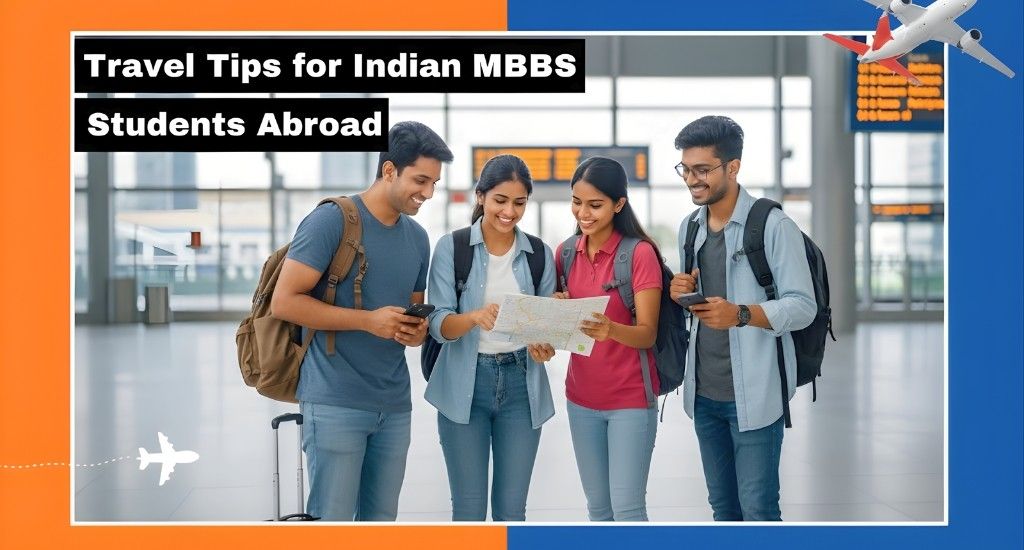
Travel Tips for Indian MBBS Students Abroad

Travel Tips for Indian MBBS Students Abroad

This guide provides essential travel tips for Indian MBBS students to have a safe, legal, and affordable travel experience abroad.

The first thing to do when considering any travel is to review your student visa terms and conditions. Understanding this aspect of your study abroad experience is critical, as violations may result in severe consequences, including deportation, inability to apply for future visas, and difficulties with your academic standing.
Most student visas allow travel within the host country but have restrictions on international travel. For example, many countries require students to notify university authorities of their intention to travel abroad, whereas in some countries, students may be required to obtain permission prior to their travels. For example, many students in Russia must register their visa at their residential address, as well as provide an invitation letter to re-enter Russia if travelling internationally.
Always ensure that you have at least 6 months remaining on the validity of your passport before any travel. Maintain a valid student visa and do not allow it to expire before completing any allowed period of stay.
If you plan to travel home during holiday break or visit other nearby countries, make sure you verify that your visa allows you multiple entries into that country.
Most medical universities require students to obtain written permission before travelling, especially during the academic year.

The first thing to do when considering any travel is to review your student visa terms and conditions. Understanding this aspect of your study abroad experience is critical, as violations may result in severe consequences, including deportation, inability to apply for future visas, and difficulties with your academic standing.

Budget Travel Strategies for Students

Due to their limited financial resources, medical students must carefully consider how they plan their travel in order to save as much money as possible. Fortunately, a thoughtful approach to travelling can allow a student to see the world without stress and debt.
Traveling to and from destinations during off-season or shoulder seasons will save travelers a lot of money. When tourist demand is high, flights, hotel rates, and even tourist attractions will cost two to three times more than in the off-season. Travel during school breaks when it is less busy.
You should always keep your Student ID with you. Most of the attractions and places of interest for students to visit offer substantial student discounts of up to 50% off full price. Therefore, do not leave home without your Student ID and International Student ID Card (ISIC).
Whether you are travelling by train, bus, or budget airline, booking your trip in advance will give you the best travel rates. In addition to saving you money on your transportation, many of the European and Asian rail companies offer student travel packages that provide unlimited travel within a certain period of time for a very low fee.
If you want to save money on your accommodation, consider staying in a hostel. Staying in hostels will save you money on your accommodation and provide you with the opportunity to meet other travelers. Many of these hostels have kitchens where you can cook meals to save even more money on food. You can also check many of the student-friendly websites, such as Hostelworld, Booking.com, and Airbnb, for student-friendly options.

Safety First: Protecting Yourself While Traveling

Adventure and budget savings should never take priority over personal safety! International students, especially those who are alone, need to pay attention to what they can do to protect themselves.
It’s always a good idea to research the area you are planning to visit before you get there. This means checking out the travel advisory from the Indian Ministry of External Affairs, as well as researching what areas of the city you should avoid, especially after dark.
Always let your friends and/or roommates know where you will be going, what hotel or hostel you are staying at, your travel itinerary, and when you expect to return home. Communication while on the road is critical, so make sure to stay in contact throughout your travels.
Make sure you have both a digital and a hard copy of your passport, visa, student ID, and insurance policy, and keep those copies in a separate place from the originals. You should also save the Indian Embassy or Consulate’s address and phone number in the countries that you visit. Be sure to register with the Indian Embassy’s MADAD portal (Ministry of External Affairs) while traveling in new countries.
Many students choose not to purchase travel insurance to save money, but this is a very dangerous choice. Medical emergencies, cancellations, or lost luggage can create a financial nightmare for you.

Listen to your gut instinct! If it feels unsafe, get away from it! Avoid going into remote areas after dark, don’t take any drinks from strangers, and be careful when disclosing personal information to new acquaintances!

Cultural Sensitivity and Adaptation

International trips will help you understand cultures better and be able to adapt to the different ways people live. By respecting another culture and being open to it, your experience will be enriched.

  1. When you visit a new place, learn at least a few basic phrases in the local language. All you need is a simple “hello,” “thank you,” and other words that show respect, and you are more likely to be treated warmly and interact with people more easily. People often appreciate the fact that you took the time to learn their language and will be more helpful to you.
  2. Know what to wear when you are visiting another culture, and do your homework before you leave. There are places in the world where modest dress is expected. Wearing appropriate clothing shows respect for that culture and makes it easier for you to fit in.
  3. Always ask before you take someone’s picture, especially if you are in a rural area or a religious environment. In some cultures, taking pictures without asking first is considered disrespectful or intrusive.
  4. When you eat in a different country, learn how to dine according to their customs. In some cultures, it is rude to eat with your left hand; in others, finishing all the food on your plate may be considered rude or polite depending on the circumstances. Knowing how to navigate through these different customs will help prevent any unintentional offenses.
  5. When you visit any temple, church, mosque, or other religious site, follow the appropriate guidelines regarding what to wear (footwear, head covering), as well as your behavior, while there. Remain quiet and show respect in these sacred places.

EOCL India

In this EOCL India blog, you can learn all the details necessary for student travel. We publish blogs and articles on our website to address every doubt and problem students may have. For further questions or doubts related to MBBS Abroad, please contact us.

Share this :
WhatsApp
LinkedIn
Facebook

Leave a Reply

Your email address will not be published. Required fields are marked *