Visa Process for MBBS Abroad Students 2026

Visa Process for MBBS Abroad Students 2026

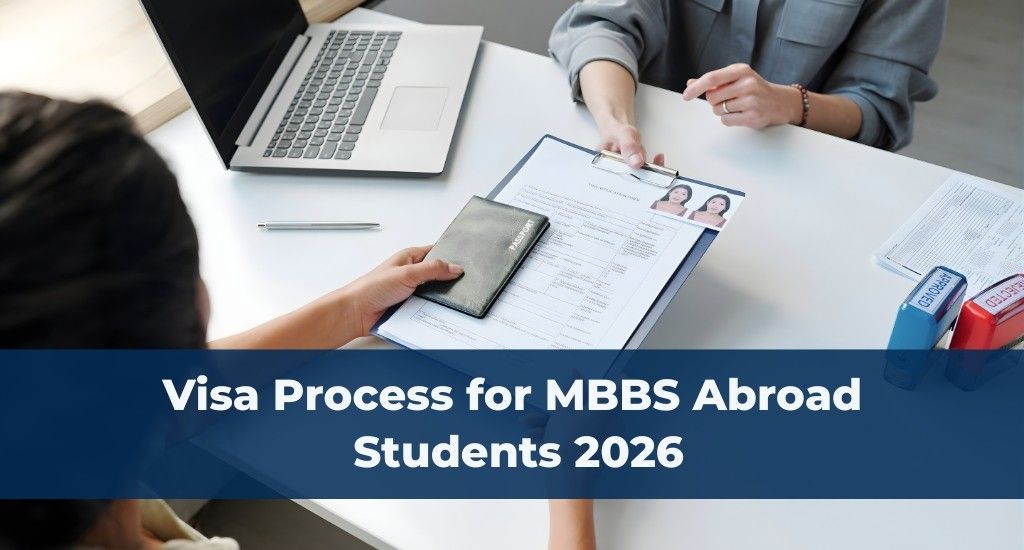
The first step toward becoming a doctor is obtaining admission from a foreign medical university. The second major step to consider now is going through the visa process, since applying for an MBBS abroad can be one of the most stressful and time-consuming parts of preparing to study abroad. This is because obtaining your student visa can make or break your future success, and many students fail to realize the importance of understanding the requirements, documents, and steps before they apply for their visa.

The student visa is an official document that allows the student to enter and remain in that particular country to pursue their MBBS degree. For those pursuing an MBBS abroad, the time frame on this type of visa varies depending on the length of the MBBS program (which can last five to six years), as determined by the country offering the program.
Although the visa process for MBBS students will vary considerably from country to country (i.e., Russia’s requirements are different from China’s requisitos as an example, while the same is true for all the MBBS programs located in Ukraine, Georgia, and the Caribbean) There are, however, several fundamental principles and documentation that are common to most countries to form the core foundation of a Visa Application.

Starting Your Visa Application Early

Students planning to study MBBS overseas should consider the importance of timing in relation to their visa processing. Starting the visa application process at least two to three months before departure is recommended by the majority of embassies, as it allows for sufficient time to gather all required documents, process the request by the embassy, and potentially schedule an interview, as well as address any unforeseen problems that may occur.
By starting the application process early, you also provide yourself with additional time in case your visa application requires more documentation or has processing delays. During peak times for the acceptance of medical school applications, there is a significant increase in the workload of embassies; this can add to the time it takes for applications to be completed. Starting your application as soon as possible will help you avoid issues relating to missing the university’s reporting date, due to delays in the visa process.

Required Documents for Student Visa Application

Academic documentation represents an integral part of the visa application process for MBBS students studying abroad. Academic documentation will include attested copies of your Class 10 and Class 12 mark sheets and certificates. The majority of foreign locations will require that academic documentation be apostilled or attested by the Ministry of External Affairs (MEA) in India.
If you are a medical student, you will need to include your NEET scorecard with your application for a student visa, as nearly all countries now require medical students to provide proof of passing the NEET before they can study medicine in that country. Additional documents required for a student visa application include evidence of acceptance into a university, as well as information regarding the course, duration of study, and fees associated with the course. The university admission letter is considered the primary evidence of the applicant’s intent to study.
Financial capability verification is a necessary step in the visa application for students studying MBBS abroad. Visa issuance requires that embassy officials confirm that you, or the person or persons supporting you, will be able to support your tuition and daily living expenses while you are attending school. Typically, an embassy will require bank statements from the last six months showing sufficient funds.
Each country and university will have different amounts of money that you need to show; however, generally, you will need to show that you have sufficient money to pay for at least the first year’s worth of tuition and your daily living expenses. Some countries will require you to have a specific “blocked account” from which you can draw money to cover the entire length of your course of study. You can also use educational loans to satisfy the financial requirement; you must submit the sanction letter from the loan provider and proof of disbursement.

You must have a passport that is valid for at least six months beyond the intended date of travel and has enough space to accommodate the visa stamp. Recent passport-sized photographs that meet the specifications of the respective country where you are applying for a visa are required. It is recommended that you check with the embassy of that country regarding the photo requirements (i.e., photo size, background color, and quality of photo).

A birth certificate may also be required, along with a police clearance letter and a medical fitness certificate, which typically indicates that you have been tested for certain infectious diseases, that you have received all vaccinations, and that you are in good overall health to travel and study internationally.
Students pursuing an MBBS degree abroad must provide, in addition to standard supporting documents, a cover letter that outlines their reason(s) for selecting a specific country and university; this will help to substantiate their application. Depending on the host country, students may be required to obtain travel insurance for the duration of their studies or for the first few months upon arrival.
Students must provide proof of a place to stay (accommodations), either through a university hostel booking confirmation or a rental agreement. Proof of accommodation can assist embassies in confirming that the applicant is prepared for the duration of his or her studies. A detailed plan of study describing what the applicant intends to study, as well as the applicant’s long-term career goals after graduation, may also be required by some embassies.

Specific Country Visa Requirements

In Russia, students studying for an MBBS degree abroad must first obtain an invitation letter from their respective universities, which will then be registered with the Federal Migration Service of the Russian Federation. Students must submit this invitation letter along with the application for a Russian student visa, an HIV test certificate, and other standard supporting documents.
Typically, Russian student visas are valid for an initial period of 90 days. After entering Russia, students must register with local authorities and extend their student visas to cover the entire duration of their studies. Coordination with the International Office of the student’s university is necessary to facilitate the completion of both steps.
The JW202 form from your university in China is the official admission document that will allow you to obtain a visa for studying MBBS abroad. The same documents required for any other international student applying to China will also apply when overseas medical students apply; in addition, overseas medical students must have a health examination performed by an institution designated by the Chinese government and provide the visa office with complete GPA information on their prior international travel history.

Long-term study students studying in China will receive either an X1 or X2 visa status. Once students enroll in their respective courses, the immigration office requires all foreign national students to apply for a residence permit within 30 days of arrival in China, which will act as proof of legal residency for the duration of their education program.

The visa processes in Ukraine and Georgia as a whole can be characterized as comparatively simple processes. Ukrainian international medical students require standard documentation, as well as an official invitation letter from their respective universities. In contrast, Georgia offers e-visas for a large number of countries, making the process much easier.

Both Georgia and Ukraine expect students to have medical coverage throughout the entire duration of their stay. Students need to verify that their insurance coverage is valid in Georgia or Ukraine, as well as to determine whether the amount of coverage they receive meets the minimum requirement established by the immigration authorities of Ukraine or Georgia.

Common Reasons for Visa Rejection

Not meeting financial requirements is the top reason for rejection of applications. If the bank statements are not clear and show that the applicant can provide for education expenses, then they will be denied.
Applying with an inconsistent or incomplete document sequence is the next leading cause of denial. Be sure to review all requirements carefully and ensure that every document meets those specifications.
If there is any doubt about an applicant’s intention to return to their home country following completion of their studies, it may result in a rejection. Having prior visa violations, a criminal record, or giving false information may lead to an automatic denial and a permanent ban from obtaining a visa. To apply for a visa as a student pursuing MBBS abroad, there must be full disclosure and integrity in all documents and all communications.

Role of the Educational Consultant in the Visa Process

Through continual study of the latest changes in visa laws, processing timeframes, embassy-specific guidelines, etc., professional consultants are experts in the visa process. Other than reviewing your completed application documents before submitting, consultants will review your interview preparation process and offer recommendations to help you prepare a strong interview and increase your chances of being approved for your visa application.

EOCL India provides a full range of visa services, including document verification, guidance on how to attestate (attest) documents, instructions on how to fill out the application form, setting up appointments with the embassy and making travel arrangements after obtaining a visa. By providing a full range of services throughout the visa process, MBBS students pursuing their education outside of India will be able to concentrate on obtaining their education outside of India and have less stress during the transition period from student to professional.

Final Tips for Visa Success

When applying for an MBBS Program in Another Country, you must prepare very well beforehand, have everything in order and be truthful in all matters. Start preparing as early as possible. Ensure that you have all the required documents and submit them according to the requirements of the embassy. Never cut corners or send falsified documents; the penalties for doing so are much more severe than just having your application denied.
Be aware that the requirements for obtaining a visa for the country where you wish to study will continually evolve. That is why you should connect with people who have successfully gone through this same process in the country you want to attend school in; their knowledge will help you avoid pitfalls that may not be covered in the official guidelines. In addition, patience is critical while waiting for a visa. The processing of visas is tedious, and worrying or stressing over it will not make it happen any faster. Have faith in the process, prepare your initial application accurately and submit it honestly. Remain confident because thousands of students gain a visa each and every year, and with proper preparation, you will too.

EOCL India

By partnering with companies like EOCL, you can be confident about obtaining a visa. EOCL has experience with the visa processes of various countries where students are looking to study MBBS abroad. They know what all of the requirements are and can help to ensure that you have all the necessary documents and that everything is correct. Thus, a student who follows the guidelines and gets support from EOCL India has a very high likelihood of obtaining a visa, which will open doors to a successful career in medicine.

Share this :
WhatsApp
LinkedIn
Facebook

Leave a Reply

Your email address will not be published. Required fields are marked *