


The most important exam in India to earn a seat in an MD, MS or PG Diploma program after MBBS is the National Eligibility cum Entrance Test (NEET PG) for postgraduate admissions. The NEET PG exam is administered by the National Board of Examinations in Medical Sciences (NBEMS), formerly the NBE, and will determine your ability to gain entrance into thousands of postgraduate medical school programs in the country. In preparing for the NEET PG examination in 2026, it is important to know the NEET PG total marks and the NEET PG exam pattern. Many students use the NEET PG exam pattern to develop a study plan, prioritizing subjects to be studied first, planning how much time to allocate to each subject, and strategically designing their overall study plan.
Candidates who understand the marks system to the fullest have a significant advantage over their competition due to having a clear understanding of the areas where they need to devote their study time, as well as which mistakes should be avoided. This guide provides a detailed overview of the NEET PG total marks structure and the NEET PG exam pattern for 2026, and effective strategies to maximize your score.
NEET PG Total Marks and Exam Duration Explained
Every candidate taking the exam will do so based on some information listed below. This includes:
| Parameter | Details |
| Total No. of Questions | 200 Multiple Choice Questions (MCQ) |
| Marking Scheme | +4 Marks for Correct Answer, -1 Mark for Incorrect Answer, 0 Marks for Unanswered Questions |
| Total Marks Available | 800 Marks |
| Duration of Test (Time) | 210 Minutes / 3 Hours 30 Minutes |
| Format of Test | Computer-Based Exam (CBT): all tests will be held online in English |
| Conducting Authority | National Board of Examinations in Medical Sciences |
Detailed NEET PG 2026 Exam Pattern
The NEET PG 2026 exam is made up of three separate sections to represent the three stages of your MBBS course. As per recent exam updates, NBEMS introduced sectional time limits. This is expected to continue in 2026, but candidates should verify with the official notification, so you must finish each section of the exam in the time allotted by the administrator before moving forward to the next section. You cannot go back to any section after moving on to the next section, which requires that you be able to manage your time well on an individual section-by-section basis.
| Section | Subject Areas | Approx. Questions | Time Allotted |
| Section A – Pre-Clinical | Anatomy, Physiology, Biochemistry | 50 | 45 min |
| Section B – Para-Clinical | Pathology, Pharmacology, Microbiology, Forensic Medicine, Community Medicine | 50 | 45 min |
| Section C – Clinical | Medicine, Surgery, Obstetrics & Gynecology, Pediatrics, Psychiatry, Orthopedics, ENT, Ophthalmology, Dermatology, Radiology, Anesthesia | 100 | 120 min |
| Total | — | 200 | 210 min |
You will have the most weight in the clinical section—100 of the 200 questions in the paper are from the clinical section, which makes it the most important block of study for your exam. Do not ignore your preclinical and paraclinical subjects, as they will account for 50% of all of the questions in your final exam.
Also Read : Best Books for NEET Preparation 2026 (Physics, Chemistry, Biology)
Subject-wise Distribution and Weightage
Knowing the subject weightage will enable you to create a more effective study plan. The following information shows the approximate subject distribution:
| Subject | Approx. Questions | Approx. Marks |
| Anatomy | 15 – 18 | 60 – 72 |
| Physiology | 15 – 18 | 60 – 72 |
| Biochemistry | 14 – 17 | 56 – 68 |
| Pathology | 14 – 16 | 56 – 64 |
| Pharmacology | 12 – 15 | 48 – 60 |
| Microbiology | 10 – 13 | 40 – 52 |
| Forensic Medicine | 6 – 8 | 24 – 32 |
| Community Medicine (PSM) | 10 – 12 | 40 – 48 |
| General Medicine | 18 – 22 | 72 – 88 |
| General Surgery | 14 – 18 | 56 – 72 |
| Obstetrics & Gynecology (OBG) | 10 – 14 | 40 – 56 |
| Pediatrics | 8 – 12 | 32 – 48 |
| All Other Clinical Subjects | 15 – 20 | 60 – 80 |
General Medicine consistently has the highest subject weightage and typically consists of 18 to 22 questions. Pathology and Pharmacology also have a high yield. Therefore, it is very important to study these two paraclinical subjects since they are heavily represented in most clinical case-based questions.
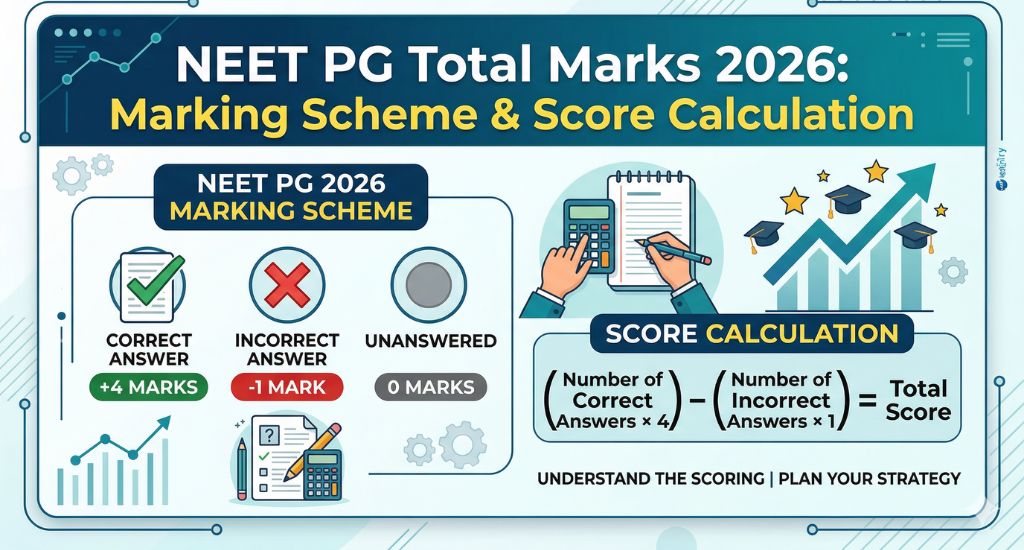
NEET PG 2026 Marking Scheme & Score Calculation
The NEET PG 2026 will employ a simple but strategic marking scheme, which includes the following criteria:
- Correct Answer: 4 points
- Incorrect Answer: -1 point
- Unattempted: 0 points
To illustrate how the scoring will work with the above criteria:
If a candidate answers 160 out of 200:
- They would have 130 correct x 4 = 520 points
- They would have 30 incorrect x -1 = -30 points
- They would have 40 unattempted, so 0 points.
- The candidate’s final score will be 520 points – 30 points = 490 / 800 possible points.
If a candidate answers 180 questions but answers less accurately than the first candidate:
- They would have 120 correct = 480 points
- They would have 60 incorrect = -60 points
- So their final score would be 420 / 800 possible points.
Clearly, fewer attempts with higher scores are better than more attempts with lower scores; negative marking is used to deter guessing, so only attempt questions if you feel confident (60-65%) that the answer is correct.
Also Read : How to Crack NEET 2026
How to Use NEET PG Total Marks for Rank Prediction
Your NEET PG total marks will determine your AIR (All India Rank), which in turn dictates which colleges and specialties you will be able to choose during counselling. The following table contains a wide range of scores (based on recent trends) as a basis of comparison:
Note: These are approximate trends based on previous years and may vary depending on exam difficulty
| Score Range (Max 800) | Approximate AIR | Expected Category / Type of Seat |
| 650 – 800 | Top 500 | Top Government MD seats available |
| 550 – 649 | Approx. 500 – 2500 | Good Government seats for MD/MS |
| 450 – 549 | Approx. 2500 – 8000 | Government PG Diploma / Private MD seats available |
| 350 – 449 | Approx. 8000 – 20000 | Private college seats available |
| Less than 350 | Greater than 20000 | Very few available options |
In addition to the raw score, a “percentile” score is calculated for each test taker, and the minimum qualifying percentile to be eligible for counselling is the 50th percentile for candidates applying in the General Category, while candidates applying in a Reserved Category need to attain a minimum of the 40th percentile.
Important Changes in NEET PG Exam Pattern 2026
Recent Changes in NEET PG Pattern (Expected for 2026). There are several things that all aspirants for the year 2026 need to be aware of, as follows:
- Sectional Time Locking: Each of the three sections of the test has been assigned its own unique time limit, and when time is up for an individual section, it will automatically lock so that no further questions can be attempted within that section.
- No Inter-Section Navigation: Once you have completed a section, you cannot go back to review your work in that section. This is a significant change from the formats that have been used in the past.
- Increased Clinical Weighting: Clinical subjects now comprise 50% of the total test; thus, this places a much greater emphasis on applied clinical knowledge.
- CBT Interface Updates: The CBT interface has been enhanced to allow for easier navigation and more user-friendly options for flagging questions.
- Stricter Identity Verification: The biometric verification and live photo capture will now be subjected to a more stringent level of scrutiny at the time and location of the exam.
Also Read : NEET Exam Time 2026: Reporting Time, Duration & Schedule Details
Tips to Maximize Your Score in NEET PG 2026
- Quality over quantity: Attempting 150 questions correctly 85% of the time is better than attempting 180 questions and answering only 65% of them correctly.
- Time management methodology: Use a proportionate amount of time preparing.
- Start by mastering high-yield subjects: The areas of General Medicine, Pathology, Pharmacology, and Surgery make up approximately 40 to 50 percent of the test.
- Solve at least 10,000 MCQs before taking the exam: There is no substitute for being familiar with the multiple-choice test format and answering patterns.
- Take full-length practice tests: Take a full-length CBT test approximately once every week over the last three months.
- Avoid blind guessing: If you have no basis for picking one answer over another, skip the question, as missing the question will cost you one point, and you may receive points for not trying.
- Avoid blind guessing: If you have no basis for picking one answer over another, skip the question, as missing the question will cost you one point, and you may receive points for not trying.
- Regularly revise materials using short notes: Subjects that have a high concentration of information.
- Mentally prepare for the exam day: Get enough sleep; take your ID; arrive at the test center 45 minutes before the start time, and trust yourself.
Expert Guidance for MBBS Admission & Medical Career Planning
EOCL India guides you through every step of your medical journey, from application to admission, and all the way to visa approval. No confusion, no hidden steps. Just clear, practical support.
Whether you’re planning your MBBS in India or exploring options like MBBS in Russia, EOCL India helps you move forward with clarity and confidence. We simplify the entire process so you can focus on what actually matters- your future in medicine.
If you’re serious about building a career in medicine, we’re here to help you do it right. Get in touch today.
FAQs on NEET PG Total Marks & Exam Pattern
What are the NEET PG total marks and questions in 2026?
There are 200 multiple-choice questions (MCQs) with a total score of 800 in NEET PG 2026.
How is the NEET PG score calculated with negative marking?
For each right answer, you receive +4 points; for each incorrect answer, you receive -1. Unattempted questions are worth zero points. Total correct marks minus total incorrect marks equals your final score.
Can I skip questions in NEET PG without penalty?
Yes, it is better to choose not to attempt than to guess.
What is the duration of the NEET PG exam, and is there sectional timing?
The length of the exam is 3 hours and 30 minutes. NEET PG now has sectional time limits (45–45–120 min) for each section; therefore, sections cannot be revisited once they have been completed.
Which subjects have the highest weightage in NEET PG 2026?
The greatest amount of weightage given to each subject by the number of questions within NEET PG 2026 is General Medicine (~18–22 questions), followed by Surgery, Pathology, Anatomy and Physiology. Clinical subject matter represents approximately 50% of the entire paper.