


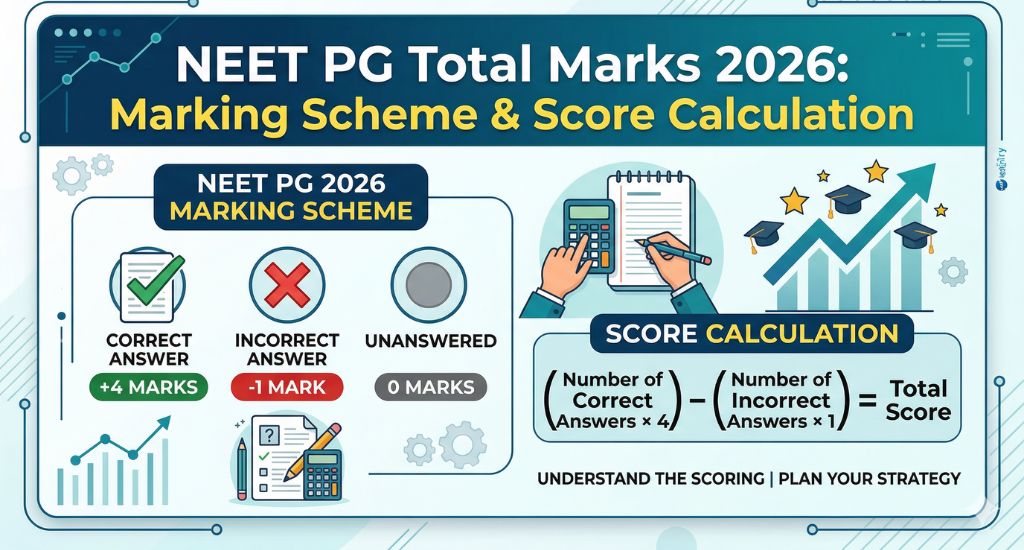

NEET PG total marks are 800. Students searching for total marks in NEET PG, NEET PG full marks, or NEET PG how many marks should know that the examination contains 200 multiple-choice questions, with every correct answer carrying 4 marks and every incorrect answer resulting in a 1-mark deduction.
Understanding the marking scheme is important because your final NEET PG score directly impacts your All India Rank (AIR), counselling eligibility, and chances of securing preferred MD/MS seats in government or private medical colleges.
The NEET PG examination is conducted by National Board of Examinations in Medical Sciences (NBEMS) in computer-based mode with section-wise time restrictions. Along with understanding NEET cutoff trends, candidates should also know how negative marking, sectional timing, and subject weightage affect their final performance.
NEET PG Total Marks at a Glance
| Parameter | Details |
| Total Questions | 200 MCQs |
| Total Marks in NEET PG | 800 |
| Marks for Correct Answer | +4 |
| Negative Marking | -1 |
| Unattempted Questions | 0 |
| Exam Duration | 3 Hours 30 Minutes |
| Exam Mode | Computer-Based Test |
| Language | English |
| Conducting Authority | NBEMS |
| Qualifying Percentile | 50th percentile (General), 40th percentile (Reserved Categories) |
So, NEET PG full marks are 800.
Candidates should always verify the latest NEET PG information bulletin on the official NBEMS website because the NEET exam pattern, marking scheme, tie-breaking criteria, eligibility rules, and counselling procedures may change from year to year.
Related Post : NEET Age Limit 2026 (Updated): Minimum Age, Maximum Age, Eligibility & Attempts
NEET PG Exam Pattern 2026
Section-Wise Distribution and Timing
| Section | Subjects Included | Approx. Questions | Time Allotted |
| Section A | Anatomy, Physiology, Biochemistry | 50 | 45 Minutes |
| Section B | Pathology, Pharmacology, Microbiology, Forensic Medicine, PSM | 50 | 45 Minutes |
| Section C | Medicine, Surgery, OBG, Pediatrics, ENT, Ophthalmology, Orthopedics, Psychiatry, Dermatology and allied subjects | 100 | 120 Minutes |
| Total | All Subjects | 200 | 210 Minutes |
One of the biggest changes in recent NEET PG exams is sectional time locking. Once a section ends, candidates cannot return to unanswered questions from that section.
This makes time management just as important as conceptual preparation. Section C contributes nearly half of the total marks in NEET PG, making clinical subjects especially important for achieving a higher rank.
NEET PG Subject-Wise Weightage
| Subject | Approx. Questions | Approx. Marks |
| Anatomy | 15–18 | 60–72 |
| Physiology | 15–18 | 60–72 |
| Biochemistry | 14–17 | 56–68 |
| Pathology | 14–16 | 56–64 |
| Pharmacology | 12–15 | 48–60 |
| Microbiology | 10–13 | 40–52 |
| Forensic Medicine | 6–8 | 24–32 |
| Community Medicine (PSM) | 10–12 | 40–48 |
| General Medicine | 18–22 | 72–88 |
| General Surgery | 14–18 | 56–72 |
| Obstetrics & Gynaecology | 10–14 | 40–56 |
| Pediatrics | 8–12 | 32–48 |
High-Weightage Subjects in NEET PG
General Medicine, Surgery, Pathology, Pharmacology, and Obstetrics & Gynaecology consistently contribute a large portion of total marks in NEET PG.
Recent papers also include more clinical and image-based MCQs. Students focusing only on factual memorisation often struggle with integrated clinical reasoning questions.
Related Post : NEET Counselling Process and Registration Guide 2026
How NEET PG Marks Are Calculated
The NEET PG score formula is:
Score=(Correct Answers×4)−(Wrong Answers×1)\text{Score}=(\text{Correct Answers}\times4)-(\text{Wrong Answers}\times1)Score=(Correct Answers×4)−(Wrong Answers×1)
Unattempted questions receive zero marks and do not attract negative marking.
Example Calculation
Scenario 1: Better Accuracy
- Correct Answers: 130 × 4 = 520
- Wrong Answers: 30 × 1 = -30
- Final Score = 490 / 800
Scenario 2: More Attempts but Lower Accuracy
- Correct Answers: 120 × 4 = 480
- Wrong Answers: 60 × 1 = -60
- Final Score = 420 / 800
This clearly shows why accuracy matters more than blind guessing in NEET PG.
Is There Negative Marking in NEET PG?
Yes. NEET PG follows a negative marking system in NEET exam.
| Response Type | Marks |
| Correct Answer | +4 |
| Incorrect Answer | -1 |
| Unattempted Question | 0 |
Strategic question selection is important because repeated incorrect answers can significantly reduce your final score and AIR rank.
Qualifying Marks and Percentile in NEET PG 2026
Many students confuse NEET PG total marks with qualifying marks. NEET PG qualification is based on percentile, not fixed marks.
| Category | Required Percentile |
| General / EWS | 50th Percentile |
| SC / ST / OBC | 40th Percentile |
| UR-PwD | 45th Percentile |
The actual score required to achieve these percentiles changes every year depending on exam difficulty, competition level, and overall candidate performance.
NEET PG Score vs Rank Trends
| Score Range | Approximate AIR | Expected Outcome |
| 650–800 | Top 500 | Top government MD/MS seats |
| 550–649 | 500–2,500 | Strong government college chances |
| 450–549 | 2,500–8,000 | Mid-range government and private colleges |
| 350–449 | 8,000–20,000 | Mostly private college options |
| Below 350 | Above 20,000 | Limited choices |
These are indicative trends based on previous counselling data and should not be treated as guaranteed outcomes.
Related Post : NEET UG Result 2026: Expected Date, Cutoff & Rank Details
Latest NEET PG Exam Pattern Updates
- Sectional Time Restrictions : Candidates cannot transfer unused time between sections.
- No Inter-Section Navigation : Once a section closes, revisiting previous questions is not allowed.
- Higher Clinical Weightage: Recent NEET PG papers increasingly focus on integrated clinical scenarios rather than direct factual recall.
- Biometric Verification : Exam centres now follow stricter identity verification, biometric checks, and live image capture procedures.
Preparation Strategy to Improve NEET PG Score
- Prioritise Accuracy: Because of negative marking, solving fewer questions accurately is often more beneficial than random guessing.
- Practice Timed Mock Tests: Section-wise mock tests improve speed, confidence, and time management under exam pressure.
- Focus on High-Yield Subjects: Medicine, Surgery, Pharmacology, Pathology, and OBG should receive additional revision time due to higher weightage.
- Solve Clinical MCQs Regularly: Case-based question practice improves analytical thinking and clinical application skills.
- Create Quick Revision Notes: Short revision notes become highly useful during the final weeks before the examination.
Important Information for MBBS Abroad Graduates
Indian students who complete MBBS abroad from NMC recognized universities must fulfil Indian licensing requirements before becoming eligible for NEET PG admissions in India. Depending on current regulations, this may involve FMGE or the future NExT pathway.
Students should verify:
- NMC recognition status
- WHO AVICENNA listing
- Internship eligibility
- Clinical training compliance
- Registration eligibility in India
Students comparing low cost MBBS abroad admission 2026 options should also evaluate:
- Medium of instruction
- Clinical exposure quality
- FMGE/NExT performance trends
- Indian student support systems
- Total course expenses including hostel and living costs
For official recognition verification, students can check:
EOCL India provides informational guidance related to MBBS abroad counselling, document assistance, and NEET predictor tools for Indian students exploring international medical education pathways.
Related Post : NEET Category Wise Cutoff 2026 (GEN, OBC, SC, ST)
FAQs About NEET PG Total Marks
What are the total marks in NEET PG?
NEET PG total marks are 800. The exam contains 200 questions, with each correct answer carrying 4 marks and each incorrect answer deducting 1 mark.
Is there negative marking in NEET PG?
Yes. NEET PG follows negative marking. Every wrong answer deducts 1 mark, while each correct answer adds 4 marks.
How many questions are asked in NEET PG?
NEET PG includes 200 multiple-choice questions covering pre-clinical, para-clinical, and clinical subjects.
Is NEET PG qualification based on marks or percentile?
NEET PG qualification is based on percentile, not fixed marks. General category candidates usually need the 50th percentile to qualify.
Can MBBS abroad students appear for NEET PG?
Yes. MBBS abroad graduates can appear for NEET PG after meeting NMC eligibility and licensing requirements applicable in India.
YMYL Disclaimer
Disclaimer: The information on this page is intended for educational and informational purposes only. NEET PG exam patterns, qualifying percentiles, counselling rules, and MBBS abroad eligibility criteria are subject to change. Students and parents are advised to verify all details directly through NBEMS, NMC, and official university sources before making any admission or career-related decisions.