

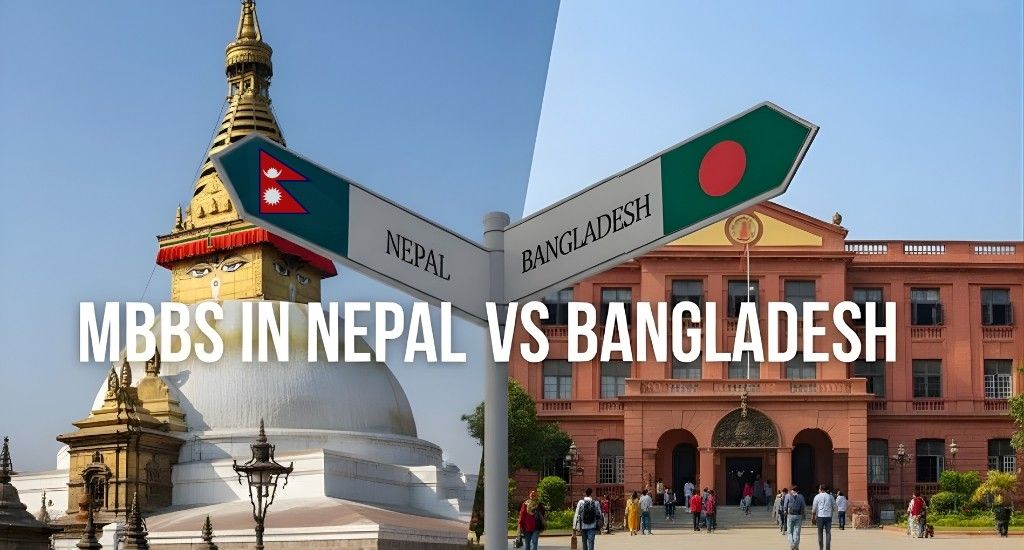
Both Nepal and Bangladesh have cultural similarities with India; both provide English-based medical education, and both have costs that are substantially lower than the costs of private Indian medical schools. However, in choosing between Nepal and Bangladesh, it is not quite as simple as heads or tails; both countries have distinct advantages, which will determine how each country will affect your future medical career.
We will exclude the marketing hyperbole and only evaluate REAL factors, including:
- Quality of Education
- FMGE Pass Rates
- Cost
- Clinical Experience
- Career Potential
Geographic Advantages
Nepal shares a Border with India. An Indian student can travel to Nepal without a visa or an identity card—in essence, Indian students may “walk” across the border into Nepal. Because of the geographic proximity between Nepal and India:
- Parents may visit anytime, without a visa.
- Students can return home for short breaks.
- Emergencies may be dealt with.
- Cultural Shock is virtually nonexistent.
Bangladesh does still have a border with India, but an Indian student still must obtain a Visa before travelling.
FMGE Parameters
Despite their affordability and the fact that they are operated by the government, these institutions will not provide an opportunity to study medical training in India unless students successfully complete the FMGE and obtain a license to practice in India. The comparison of the 2024 FMGE (Federation of Medical Graduates Examination) statistics for Nepal and Bangladesh is as follows:
- Nepal FMGE Statistics
With a passing percentage of 30% (FMGE Pass Rate), Nepal ranks as one of the better-performing countries. However, there were significant discrepancies in the performance of individual colleges and universities within the country.
- Chitwan Medical College (CMC): 100% (6 students) pass rate
- KIST Medical College: 100% (2 students) pass rate
- B.P. Koirala Institute of Health Sciences: 71.43% (77 students) pass rate
- Kathmandu Medical College: 42.16% (102 students) pass rate
- National Medical College, Birgunj: 15.72% (318 students) pass rate
- Bangladesh FMGE Statistics
Overall pass rate of 26.79% FMGE (FMGE Pass Rate). Again, Bangladesh is also maintaining its status as one of the more competitive countries. An overview of significant educational institutions would include:
- Brahmanbaria Medical College maintained a 100% FMGE pass rate, but several colleges reported pass rates between 40% and 75% (smaller batch sizes)
The larger institutions consistently demonstrated varying degrees of performance
Cost Parameters
Now, it gets more fascinating. Everybody discusses affordable fees, but let’s look at the specific numbers for the total 5.5-year program:
- MBBS Costs in Nepal:
- Total fee— ₹50-65 lakh for the full program.
- Tuition fee each year— ₹3,000 – 7,000 US dollars.
- Monthly expenses— ₹8,000 – 15,000.
Thus, the total investment cost is approximately ₹60 -70 lakh (including living expenses).
- MBBS Costs in Bangladesh:
- Total fee— ₹24 – 35 lakh for the full program.
- Tuition fee each year— much less than that of Nepal.
- Monthly expenses— ₹8,000 – 12,000.
So the total investment for a Bangladeshi MBBS degree is about ₹30 – 45 lakh (including living costs).
Clinical Exposure
- Nepal has clinical training available through the following
- Teaching hospitals with moderate amounts of patients
- The majority of the diseases being treated are similar to those treated in India (Tropical Diseases and Infections).
- Smaller batches in top institutions will allow for better teacher-student ratios.
- Training in many government hospitals gives notice to the magnitude of cases treated.
- Bangladesh has
- The medical colleges have numerous affiliated clinics providing many opportunities due to the vast numbers of patients seen through their clinics.
- Larger numbers of patients give students more opportunity for hands-on experiences.
- There are 25 government and over 50 private medical colleges in Bangladesh, giving students a variety of clinical experiences.
- Urban Hospitals in Dhaka expose students to complex patients using the most modern technology in medicine.
Curriculum Alignment
The medical curriculum in Nepal is largely comparable to India’s, meaning that preparing for the FMGE will be more straightforward due to the similarity of syllabus content and examination patterns. Bangladesh has a greater advantage, however. The FMGE is more compatible with the examination pattern in Bangladesh than with other countries, which will help Indian students prepare for the FMGE. Many medical colleges in Bangladesh include FMGE preparation within their regular curricula, indicating that many Indian students will take the FMGE at some point.
Cultural and Language Integration
- Nepal
- Instruction is provided in English; therefore, Indian students will not encounter any language difficulties.
- Hindi is widely spoken in Nepal.
- The two nations observe many of the same holidays, consume many of the same foods, and practice many of the same customs.
- In border areas, many stores accept Indian Rupees.
- Bangladesh
- Numerous medical colleges provide the MBBS program via English.
- Bengali is the vernacular in Bangladesh, although English is the language for communication in the cities.
- Bangladesh shares a rich history and culture with India (especially West Bengal).
- The two nations share similar diets, making cultural adjustment easier for Indian students.
MBBS in Nepal vs Bangladesh: Which Should You Choose?
- You should select Nepal based on the following reasons
- The convenience of having an open border between Nepal and India for your family situation
- You will be able to attend a smaller institution with a higher teacher-to-student ratio.
- The comparatively high FMGE pass rates provide you with a sense of psychological confidence in terms of continuing your studies.
- You will enjoy being in a mountainous environment.
- You should select Bangladesh based on the following reasons
- Your major concern is budget (having savings between ₹20-30 lakhs)
- You will have the most clinical exposure, with high patient volumes.
- Examinations being similar to India helps boost your confidence when taking them.
- You prefer to be in a more urbanized medical setting with modern infrastructure.
- You will be comfortable with the basic Visa application process.
EOCL India
To make the right choice between MBBS in Nepal vs Bangladesh—or any overseas MBBS destination—contact us immediately. Education Orbit Counselling & Link (EOCL India) becomes your trusted partner. Since 2013. Most importantly, EOCL India provides honest, data-driven counseling. Contact EOCL India today for personal counseling.