English
 हिन्दी

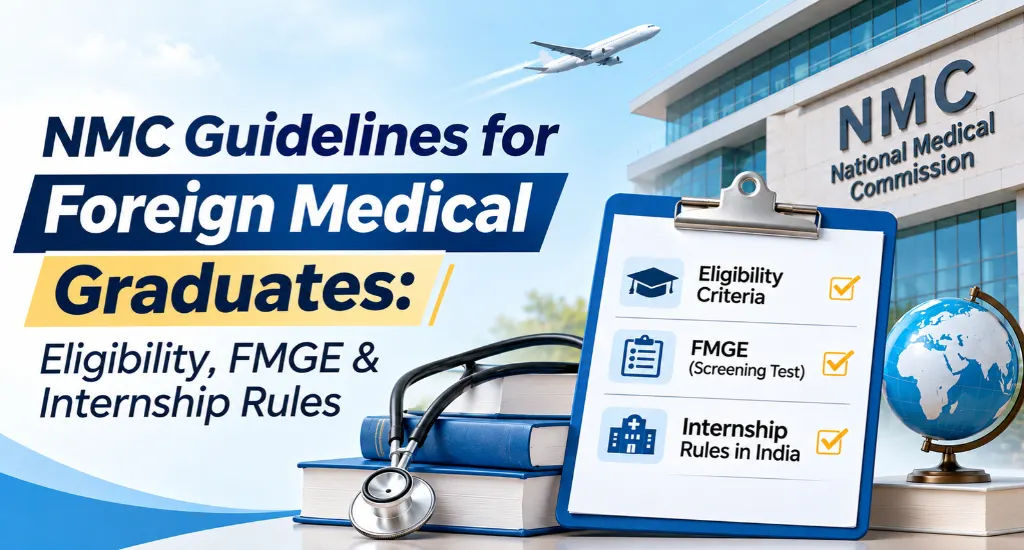
Pursuing an MBBS degree abroad is a popular option among Indian medical students. However, completing a medical degree from a foreign university does not automatically allow you to practise medicine in India. You must meet the applicable National Medical Commission (NMC) requirements for eligibility, medical education, internship and registration.
The NMC has established specific rules for Foreign Medical Graduates (FMGs), including the Foreign Medical Graduate Licentiate (FMGL) Regulations, 2021. These regulations cover important aspects such as course duration, clinical training, foreign medical registration, FMGE and compulsory internship in India. However, requirements may differ depending on your admission date and the regulations applicable to your batch.
Understanding the NMC guidelines for foreign medical graduates before choosing a foreign medical university can help you avoid admission-related mistakes and plan your medical career in India. This guide explains the NMC rules for foreign medical graduates, FMGE examination requirements, internship conditions, registration procedures and the latest NMC clarifications issued in 2026.
Get the right university for your NEET score
- Personal admission guidance
- Visa & immigration support
- Accommodation & post-arrival help
What Are the NMC Guidelines for Foreign Medical Graduates?
The National Medical Commission (NMC) has established specific rules for Indian students who obtain their primary medical qualifications from foreign universities. These rules ensure that foreign medical graduates meet the required medical education, clinical training and registration standards before practising in India.
The foreign medical graduate guidelines also help students understand the conditions they must fulfil before choosing an MBBS programme abroad. These include the minimum course duration, mandatory subjects, internship requirements, foreign medical registration and qualifying examinations.
Related Post : NMC MBBS Passing Marks 2026: Latest Rules Explained
Foreign Medical Graduate Licentiate (FMGL) Regulations, 2021
The NMC introduced the Foreign Medical Graduate Licentiate (FMGL) Regulations, 2021, under the National Medical Commission Act, 2019. These NMC regulations were notified on 18 November 2021 and specify the eligibility and training requirements for foreign medical graduates seeking registration in India.
The regulations cover important conditions related to:
- Minimum duration of medical education.
- English as the medium of instruction.
- Mandatory theoretical, practical and clinical subjects.
- Internship at the same foreign medical institution.
- Registration or licensing requirements in the country of qualification.
- FMGE or another examination prescribed under the applicable regulatory framework.
- Compulsory rotating medical internship in India.
Meeting the applicable requirements is essential to obtain registration and practise modern medicine legally in India.
Who Comes Under These Regulations?
A Foreign Medical Graduate (FMG) is a person who obtains a primary medical qualification from a medical institution outside India and seeks registration to practise medicine in India.
For example, students completing MBBS in Russia, MBBS in Kazakhstan or MBBS in Georgia may fall under the applicable foreign medical graduate regulations.
The applicability of regulations depends on the student’s admission and course status.
Under Regulation 5 of the FMGL Regulations, 2021, candidates who had already acquired a foreign medical qualification or were pursuing medical education abroad before 18 November 2021 are governed by the previously applicable regulations, subject to the relevant conditions.
The NMC’s public notice dated 18 March 2026 separately clarifies the CRMI requirements:
- Candidates admitted on or after 18 November 2021 are covered by the CRMI Regulations, 2021 and must complete one year of Indian CRMI after qualifying FMGE.
- Candidates admitted before 18 November 2021 are governed by the Screening Test Regulations, 2002 for the relevant internship requirements. They may need to complete CRMI in India if they returned without completing the mandatory internship required as part of their foreign medical course.
Therefore, students should check their admission date and applicable regulatory pathway rather than assuming that identical rules apply to every foreign medical graduate.
NMC Eligibility Requirements for Studying MBBS Abroad
Before taking admission to a foreign medical university, check whether its medical programme meets the applicable NMC requirements. This is particularly important if you plan to return to India and practise medicine after completing your medical degree from abroad.
Under the FMGL Regulations, 2021, the following conditions apply to candidates covered by these regulations.
| Eligibility requirement | NMC condition / explanation |
| NEET qualification | Indian students must qualify NEET as applicable for pursuing medical education abroad. |
| Course duration | Minimum 54 months of medical education. |
| Foreign internship | Minimum 12 months of internship at the same foreign medical institution. |
| Medium of instruction | The medical course must be taught in English. |
| Mandatory subjects | The curriculum must cover the subjects specified in Schedule I of the regulations and be equivalent to the applicable Indian MBBS curriculum. |
| Foreign registration | Students must meet the applicable registration or licensing requirements in the country of qualification. |
| Host country eligibility | The qualification must meet the prescribed conditions for medical practice in the country where the degree is awarded. |
| Course completion period | The medical course must be completed within the applicable 10-year period from the date of admission. |
Remember, the 54-month medical education period and 12-month foreign internship are separate requirements. The internship is additional to the prescribed medical course duration.
NEET qualification also does not guarantee final eligibility for Indian medical registration. Students must fulfil all applicable NMC requirements.
Before choosing an MBBS in a foreign country, check the university’s medical programme, curriculum, clinical training, internship structure and licensing framework. Some admission agents may make misleading claims about university recognition, course eligibility or registration in India. Always verify the relevant requirements before paying admission fees or signing an agreement with a university.
Related Post : NEET Guidelines 2026: Eligibility, Exam Day Rules
FMGE Examination Rules for Foreign Medical Graduates
The Foreign Medical Graduate Examination (FMGE) is a screening examination for eligible Indian citizens and Overseas Citizens of India (OCI) candidates who obtain primary medical qualifications abroad.
Candidates must qualify the applicable screening examination before proceeding with the medical registration process in India. The National Board of Examinations in Medical Sciences (NBEMS) conducts FMGE under the Screening Test Regulations, 2002.
Here are the key FMGE examination rules under the foreign medical graduate guidelines:
- Exam authority: NBEMS conducts the FMGE examination in India.
- Examination format: It is a computer-based examination with multiple-choice questions (MCQs).
- Total questions: The examination consists of 300 questions divided into two parts of 150 questions each.
- Total marks: The examination carries 300 marks.
- Qualifying marks: Candidates must score at least 150 marks out of 300 (50%) to pass.
- Negative marking: There is no negative marking for incorrect answers, as per the applicable examination scheme.
- Number of attempts: There is no restriction on the number of attempts under the applicable FMGE examination rules. However, candidates who have already qualified FMGE cannot appear again to improve their score.
- After qualifying: Candidates can apply for provisional registration with the concerned State Medical Council and complete the applicable internship requirements.
Important 10-Year Rule for Foreign Medical Graduates
The NMC has specified a 10-year completion requirement under the applicable medical education regulations.
According to the NMC FAQ dated 8 June 2026, the 10-year requirement for qualifying the FMG examination is to be implemented in accordance with the Graduate Medical Education (Amendment) Regulations, 2019.
Foreign medical graduates who took admission to medical courses outside India after 2019 are required to clear the FMG examination within 10 years from their admission date, subject to the applicable regulatory conditions.
The FMGL Regulations, 2021 also specify that the total duration of the foreign medical graduation course must be completed within 10 years from the date of joining the course.
Students should maintain their admission records and check the latest NMC clarification to understand how these requirements apply to their individual circumstances.
Remember, NEET is relevant before pursuing medical education abroad, while FMGE is taken after obtaining the foreign medical qualification. FMGE qualification is also different from admission to postgraduate medical courses.
Always check the latest NBEMS information bulletin for examination dates, application conditions and required documents.
Internship Rules for Foreign Medical Graduates in India
Completing your MBBS degree abroad does not always mean you have fulfilled all the internship requirements for medical practice in India. Eligible foreign medical graduates must also complete the applicable compulsory rotating medical internship (CRMI).
The requirements depend on the NMC regulations applicable to the student’s admission batch.
Compulsory Rotating Medical Internship (CRMI)
Under the FMGL Regulations, 2021 and the applicable CRMI Regulations, foreign medical graduates admitted on or after 18 November 2021 must complete a one-year CRMI in India after qualifying FMGE.
The training must take place at a medical institution approved for CRMI. Candidates must obtain the required provisional registration and follow the applicable internship allocation procedure through the concerned authorities.
The internship is an important step towards obtaining permanent medical registration in India.
Foreign Internship and Indian Internship Are Different
The FMGL Regulations, 2021 require at least 12 months of internship at the same foreign medical institution where the primary medical qualification is obtained.
This foreign internship is separate from the one-year Indian CRMI requirement for candidates covered by the 2021 regulations.
However, students admitted before 18 November 2021 follow the applicable provisions of the Screening Test Regulations, 2002.
The NMC clarification dated 18 March 2026 explains that eligible candidates from the earlier admission batch may be considered for permanent registration without an additional Indian internship if they have completed the recognised mandatory foreign internship and satisfy the applicable conditions.
The NMC FAQs dated 8 June 2026 further clarify that such cases are subject to verification and final decisions by the concerned State Medical Council.
Students should maintain their internship certificates, clinical training records, transcripts and other supporting documents.
Related Post : NMC NEET 2026 Leave Policy: MBBS Attendance Rules
Step-by-Step Process for Foreign Medical Graduates to Get Registered in India
Getting permanent medical registration in India involves several steps. Foreign medical graduates must fulfil the applicable NMC requirements, qualify the required examination and complete the prescribed internship.
The concerned State Medical Council handles the registration process. Document verification and state-specific procedures may also apply.
Follow these steps:
- Complete your foreign medical degree: Fulfil the required course duration, curriculum and clinical training conditions.
- Obtain your foreign internship certificate: Complete the prescribed internship at the same foreign medical institution and collect supporting documents.
- Meet foreign licensing requirements: Obtain the required registration or licence in the country where your medical qualification was awarded, wherever applicable.
- Qualify FMGE: Pass the screening examination conducted by NBEMS, where applicable.
- Apply for provisional registration: Submit the required documents to the concerned State Medical Council.
- Complete Indian CRMI: Finish the applicable internship at an approved medical institution, according to your admission batch and regulatory requirements.
- Apply for permanent registration: Submit your internship certificate and other required documents for verification.
Understanding the NMC guidelines for FMG is important before starting this process. At EOCL India, we guide students who have completed their MBBS abroad in understanding the applicable NMC rules, FMGE requirements and registration procedures.
Our guidance helps students understand the steps involved in qualifying the examination and progressing towards medical registration in India.
NMC Rules for Online Medical Education and Compensatory Training
Online medical education became a major concern during COVID-19 and the Ukraine-Russia war. Many Indian students completed parts of their foreign medical courses remotely because they could not attend their universities physically.
However, online medical education may not automatically satisfy NMC requirements. Some foreign medical graduates may need additional physical training or compensatory education before becoming eligible for registration in India.
NMC Rules for Online Classes
Through public notices dated 7 December 2023 and 19 June 2024, the NMC clarified requirements for foreign medical graduates affected by online medical education.
The regulatory framework requires physical, onsite compensatory training for periods of medical education conducted online, subject to the applicable notices and individual circumstances.
Candidates who have completed compensatory training at their parent foreign medical institution should maintain valid certificates and official academic records.
Latest NMC Clarification Issued in March 2026
The NMC issued an important public notice on 18 March 2026 concerning physical onsite compensation for online studies undertaken by foreign medical students.
The notice provides further clarification on the implementation of earlier public notices dated 7 December 2023 and 19 June 2024.
It addresses important issues, including:
- Physical compensatory classes for online medical education.
- Verification of compensatory training completed at foreign universities.
- Requirements for official academic transcripts and clinical training records.
- One-year or two-year clerkship requirements in India for certain affected FMGs who have not completed the required physical compensation.
- Verification of internship and compensatory training certificates.
The 18 March 2026 notice supersedes the earlier notice dated 6 March 2026. However, it does not replace the notices dated 7 December 2023 and 19 June 2024. It should be read together with those earlier instructions.
NMC FAQs Issued on 8 June 2026
The NMC published additional FAQs on 8 June 2026 to clarify the implementation of its March 2026 public notice.
These FAQs explain several important situations:
Compensatory classes completed after final examinations
Students who completed physical compensatory training after their final examinations should not be rejected solely because the training took place after the examinations. The concerned State Medical Council will examine the circumstances and supporting documents.
Verification of compensatory training
Official transcripts, academic records, mark sheets, internship certificates and authenticated compensatory training certificates may be considered during verification. The State Medical Council evaluates the documents according to the individual case.
Existing CRMI allotments
Foreign medical graduates who were already allotted one-year or two-year CRMI before the March 2026 clarification must continue and complete the internship according to the directions already issued by the competent authority.
Related Post : NMC Guidelines for MBBS in Georgia: Latest Rules (2026)
Additional clerkship in India
Candidates who have satisfactorily completed the required compensatory physical training and internship at their parent foreign medical institution, supported by valid documentation, should not ordinarily be required to repeat the same training in India solely for duplication. The final decision remains subject to applicable regulations and State Medical Council verification.
Earlier admission batches
Foreign medical graduates admitted before 18 November 2021 may be considered for permanent registration without an additional Indian internship if they have completed the recognised foreign internship and satisfy all applicable regulatory conditions. The State Medical Council makes the final determination.
These NMC regulations for FMGs are particularly important for students who completed part of their medical education online during COVID-19 or war-related disruptions.
Before applying for registration, check the latest NMC guidelines for FMG and maintain all relevant compensatory training certificates, transcripts, passport records and institutional documents.
Documents Required for FMG Registration and Verification in India
Foreign medical graduates must maintain proper academic, internship, examination and identity documents. These records are important for registration and verification with the concerned authorities.
Keep both original documents and clear copies ready.
Important documents may include:
- Foreign medical degree certificate.
- Academic transcripts and mark sheets.
- Foreign internship completion certificate.
- FMGE pass certificate.
- Passport and identity documents.
- Foreign medical registration or licence, where required.
- Provisional registration certificate.
- Indian CRMI completion certificate and logbook, where applicable.
- Compensatory training certificates and official transcripts, if applicable.
- Passport and travel records supporting physical attendance at the foreign medical institution, where relevant.
- Additional documents requested by the concerned State Medical Council.
The required documents may vary based on your admission year and applicable regulations. State Medical Councils may also have specific verification procedures.
For students affected by online medical education, the NMC’s June 2026 FAQs explain that official transcripts, mark sheets, compensatory certificates and other authenticated academic records may be examined to verify physical training.
Therefore, check the latest document checklist before applying. Understanding the NMC rules for foreign medical graduates can help you prepare your documents correctly and avoid unnecessary delays.
Planning MBBS Abroad? Understand NMC Rules Before Choosing a University
Choosing a foreign medical university involves more than comparing tuition fees, hostel facilities and countries. You must also check whether its medical programme meets the applicable NMC requirements.
A medical degree from abroad should meet the necessary conditions for your future registration in India. EOCL India helps aspiring students compare universities and understand important admission requirements before making a decision.
Before choosing an MBBS in a foreign country, check the following:
- Course duration and academic structure.
- English-medium instruction.
- Mandatory medical subjects and curriculum.
- Clinical training facilities.
- Foreign internship structure and duration.
- Medical registration and licensing requirements in the host country.
- Eligibility conditions under the applicable NMC regulations.
Most importantly, understand the latest NMC regulations and official notices. Do not rely only on an admission agent’s claims about university recognition or future medical registration.
These checks can help you make a more informed decision about your medical education and future practice in India.
Related Post : NMC Approved Medical Colleges in Kazakhstan
How EOCL India Can Support Your MBBS Abroad Planning
For Indian medical aspirants, MBBS abroad can be an alternative to studying medicine in India. However, selecting the right university is only one part of the process. You must also understand the applicable eligibility, examination, internship and registration requirements to practise medicine in India.
Understanding the NMC Guidelines for Foreign Medical Graduates can help you plan each stage more carefully.
EOCL India supports students and parents throughout their MBBS abroad planning through:
- University shortlisting: Compare foreign medical universities based on fees, facilities and course structure.
- Eligibility and documentation guidance: Understand applicable NMC requirements and prepare the necessary admission documents.
- Admission support: Get guidance with university applications, admission procedures and related formalities.
- Regulatory awareness: Understand important NMC updates, foreign medical graduate guidelines and the requirements that may affect your future registration in India.
With the right information and guidance, you can make a more informed decision about your medical education abroad and plan your future career with greater clarity.
FAQs About NMC Guidelines for Foreign Medical Graduates
1. What are the latest NMC guidelines for foreign medical graduates?
The FMGL Regulations, 2021 specify eligibility, course duration, medical training, foreign internship and registration requirements for covered foreign medical graduates. Additional NMC notices and clarifications address internship and compensatory training requirements. Applicable rules may differ based on the student’s admission date.
2. Is FMGE compulsory for all foreign medical graduates in India?
Eligible Indian citizens and OCI candidates with foreign primary medical qualifications must qualify the applicable screening examination before proceeding with registration in India. FMGE is the current screening examination under the applicable framework. Candidates should check the regulations relevant to their admission batch.
3. Is a 12-month internship in India compulsory after MBBS abroad?
The FMGL Regulations, 2021 require candidates admitted on or after 18 November 2021 to complete one year of Indian CRMI after qualifying FMGE. Candidates admitted before this date follow the Screening Test Regulations, 2002 and may have different internship requirements depending on their foreign internship and applicable NMC clarifications.
4. Is a 5-year MBBS degree from abroad valid in India?
Course duration alone does not determine eligibility for Indian medical registration. Under the FMGL Regulations, 2021, covered candidates must complete at least 54 months of medical education and an additional 12-month internship at the same foreign medical institution, along with the other prescribed requirements.
5. Can foreign medical graduates practise in India without FMGE?
Eligible foreign medical graduates must qualify the applicable screening examination and fulfil the required registration conditions before practising medicine in India. Completing an MBBS degree abroad alone does not provide the right to practise in India.
6. Does NMC allow online medical education from foreign universities?
Online medical education is subject to specific NMC requirements. Foreign medical graduates who completed parts of their medical course online may need physical compensatory training at their parent foreign medical institution or additional clerkship in India, depending on their circumstances. The NMC public notice dated 18 March 2026 and FAQs dated 8 June 2026 provide further clarification.
7. What is the 10-year rule for foreign medical graduates?
The NMC’s 8 June 2026 FAQ clarifies that foreign medical graduates who took admission to medical courses outside India after 2019 must clear the FMG examination within 10 years from their admission date, in accordance with the applicable regulatory framework. The FMGL Regulations, 2021 also specify a 10-year limit for completing the foreign medical graduation course.
8. Can students admitted before 18 November 2021 get permanent registration without an Indian internship?
Certain foreign medical graduates admitted before 18 November 2021 may be considered for permanent registration without an additional Indian internship if they completed the recognised mandatory internship abroad and satisfy the applicable NMC requirements. The final decision is made by the concerned State Medical Council after verification of documents.
9. Which authority handles permanent registration for foreign medical graduates?
The concerned State Medical Council handles provisional and permanent medical registration. Candidates must submit the required documents and fulfil the applicable examination, internship and regulatory conditions.
10. What documents are important for FMG registration in India?
Important documents include the foreign medical degree certificate, academic transcripts, internship completion certificate, FMGE pass certificate, passport, foreign medical registration or licence and applicable Indian CRMI documents. Candidates affected by online education should also maintain compensatory training certificates and supporting academic records.