

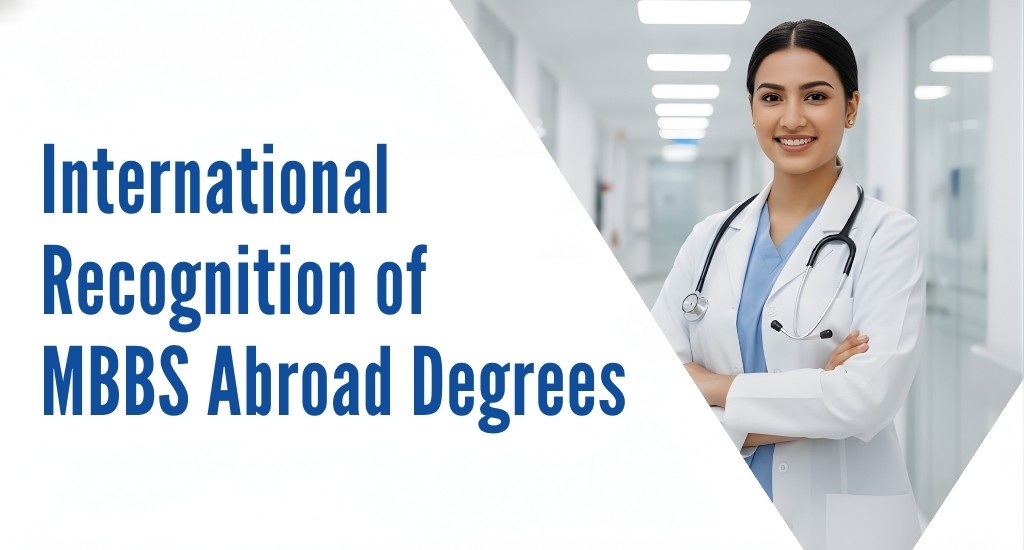
Is it worth it to go and study MBBS abroad in terms of time, money, and the total effort needed to complete your studies and become a practicing physician? One of the biggest concerns for both pupils who have chosen to study MBBS abroad and their parents or guardians is whether or not their MBBS degree will be accepted by foreign countries. You should familiarize yourself with exactly how an MBBS degree from abroad is recognized by other countries so that you can make sound choices regarding where you want to study and develop a medical career path. This guide will hopefully eliminate the confusion about how medical degrees are recognized in different countries and by different certification and licensing bodies.
Medical Degree Recognition: A Primer
Prior to getting into country-specific information, you should familiarize yourself with the definition of “recognition” as it relates to medical education, as well as how the process works within the worldwide medical licensing infrastructure.
- What Recognition Really Means
The international legitimacy of foreign degrees gained through medical programs is examined in terms of whether the applicable regulatory medical organizations in particular countries will recognize a given degree as an acceptable minimum level of education sufficient to practice medicine there. Even though obtaining recognition allows you to apply for licensure to practice medicine, it does not mean you have met all the requirements for the issuance of a medical license.
To expand on this concept, recognition allows you access to the path of licensure, but does not allow you access to that path until you satisfy all the conditions required by the state associated with that path (e.g., pass their exam for licensing, or pass their exam in a clinical setting as part of completing their residency or other experience, etc.). In other words, just like everyone else who received an MD or DO degree in their own country, graduates from even the most prestigious schools (e.g., Harvard and Oxford) must qualify for and complete licensure in the new country where they want to practice.
There are a number of important international recognition authorities. Please refer to each below for further information:
- The World Health Organization (WHO)
The WHO maintains the World Directory of Medical Schools (Formerly the IMED). The directory lists all accredited medical schools worldwide. Although being listed in the WHO does not mean your school has been formally accredited, it can provide some degree of legitimacy and is often referenced by licensing organizations around the world.
- The Educational Commission for Foreign Medical Graduates (ECFMG)
Students wishing to become licensed to practice medicine in the United States must apply for ECFMG certification; therefore, the ECFMG verifies your credentials and administers testing to determine whether you meet its criteria for accreditation.
Factors Affecting Recognition
Your choice of university is not the only influence on how an MBBS obtained overseas is viewed internationally, or on whether you will be qualified to practice overseas.
- The Language of Instruction
Medical schools that teach in the English language have a higher likelihood of having their graduates recognized internationally, as applicants for licensing exams will need to show competency in the English language (e.g., USMLE, PLAB, AMC). Those who have attended medical schools that teach in local languages will have limited recognition within English-speaking countries unless they can prove their proficiency in English using IELTS or TOEFL.
- Quality and Length of Clinical Training
The bodies responsible for recognition of foreign medical degrees will evaluate whether the clinical training that you received (exposure to patients, supervised practical training, and hands-on experience) met the requirements of their respective standards. If a program does not have the required amount of clinical training, it may have difficulties achieving recognition regardless of the quality of its theoretical instruction.
- Changes in Accreditation
The recognition status of an overseas university can change over time, as licensing bodies will periodically evaluate the standards of foreign med schools. If a university’s standards decline, it can lose recognition, so make certain to verify that the university you choose is currently recognized and has a good reputation and a history of accreditation.
- Bilateral Recognition Agreements
Some countries have entered into bilateral agreements that establish a streamlined process for recognizing medical graduates from one country and vice versa. For example, India and several other countries have established bilateral agreements that facilitate this process between the two countries, as well as between Commonwealth nations.
Strategies for Maximizing Recognition
Have a clear understanding of how your medical experience abroad (MBBS) will be acknowledged by other countries before you make any important decisions related to your medical education. When choosing where to study medicine abroad, carefully consider the reputation of the schools you apply to for medical programs and whether or not they are recognized by your target practice country.
When looking for schools abroad to pursue a degree in medicine, try to choose those that:
- Have established international recognition through listings from reputable organizations such as the World Health Organization (WHO), and list the relevant accreditations.
- Have a strong track record of graduating students who successfully pass their licensing examinations.
- Provide students with comprehensive clinical training that meets international standards.
- Verify the recognition of your foreign medical school directly with the medical council of the country you want to work in, instead of depending only on what the medical school claims or what the agent says.
Successful academic performance can help open doors for you in your journey to becoming a doctor, regardless of whether or not your foreign medical school is recognized. Good grades, licensing examination scores, research publications, and clinical competence distinguish you from others during selection processes that involve competition for residency; this means that a strong academic performance can lead to more competitive opportunities.
Students who participate in educational electives at the clinical level in countries where they would like to practice medicine, who conduct research in those countries and present their research at conferences, publish their research in peer-reviewed journals, and provide evidence to residency or licensing panels of their capability beyond the minimum requirements of their degree program.
Start researching early in the educational process for licensure requirements to practice medicine in your target country. As you progress through medical school, begin preparing for your examinations and certification for your country, follow established systems to reach your goals, and use any backup options available to you should your primary target country become unavailable.
Common Misconceptions About Recognition
- Misconception
“If I pay a high tuition fee for my medical degree, there will be a guarantee that my medical degree from an expensive program will be more widely recognized compared to cheaper programs.”
Reality: Recognition of a degree depends mainly on meeting the regulatory standards set forth by each country; therefore, an inexpensive medical degree may be highly regarded and well recognized by several countries, while a more expensive program may have poor recognition.
- Misconception
“Once I graduate from my medical program, I can immediately practice medicine in any country without undergoing a licensing process.”
Reality: No matter where you received your medical training or whether the country in which you trained has recognized your degree, you must complete a licensing process to become a licensed physician in any country. In most countries, successful completion of examinations, assessments, and supervised practice is required to achieve this goal.
Education Orbit Counselling and Link
EOCL India is committed to providing support for students as they explore medical degree recognition, identify recognized institutions in partnership with EOCL, and create a pathway toward practicing in a destination country.
When you select an NMC-approved medical institution with an international accreditation from EOCL’s partner institutions, EOCL assures that you will be able to use your education investment to find appropriate practice opportunities in your destination country.