

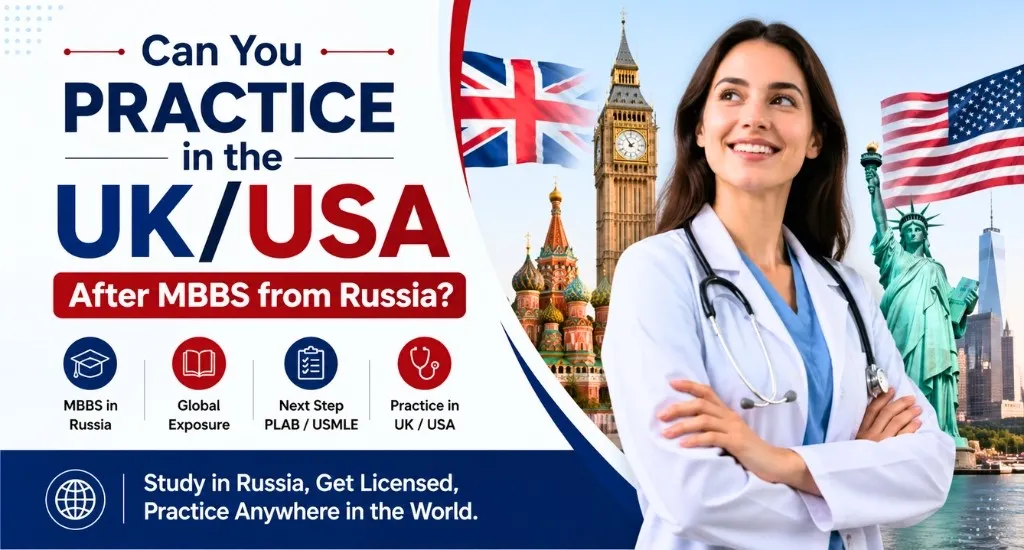

One question frequently asked by many aspiring Indian doctors is whether or not their MBBS from Russia will allow them to practice in the UK and the USA when they return home. The answer is yes, but only if you complete licensing exams and meet strict eligibility requirements.
This article provides specifics on the process for each country and the impact of your choice of university (such as Tver Medical University) on your path to licensure in your new country.
Why Is This Important Now?
Due to the fact that the world requires more qualified medical practitioners than ever before, the UK healthcare system continues to face GP shortages (official NHS workforce reports highlight staffing gaps). The Association of American Medical Colleges forecasts a physician shortage of up to 86,000 physicians by 2036.
While demand exists, entry remains highly competitive due to strict licensing and residency requirements. But only those who can complete medical licensing exams and comply with strict regulations will have an opportunity to fill these vacancies in either the US or the UK.
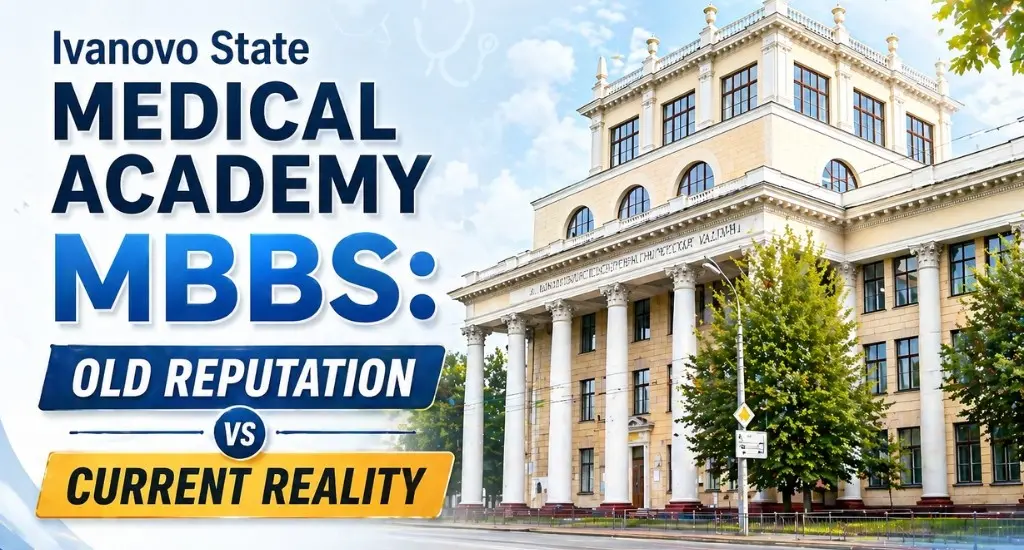
Related Post :Ivanovo State Medical Academy MBBS: Old Reputation vs Current Reality
Practicing in the UK After MBBS from Russia
The General Medical Council (GMC) is the body that regulates Medical Licences in the UK, and anyone with an MBBS degree from a Russian university must pass the PLAB test (Professional and Linguistic Assessment Board) in order to be licensed to practice medicine in the UK.
PLAB consists of two parts:
- PLAB 1 is a written exam of 180 (one best answer) multiple-choice questions covering clinical knowledge from each of the main clinical specialties.
- PLAB 2 is an Objective Structured Clinical Examination (OSCE) performed in Manchester at the GMC clinical assessment centre to assess practical clinical skills against simulated patient scenarios.
To sit for PLAB you are required to hold an MBBS degree from a Russian university registered in WDOMS (World Directory of Medical Schools).
There are several Russian medical universities registered with WDOMS, such as Tver Medical University, Sechenov University, Kazan Federal University, and Kursk State Medical University. WDOMS listing is one of the requirements, but candidates must also meet GMC eligibility criteria.
In addition, all candidates for PLAB 2 must provide proof of their ability to communicate in English using either IELTS (grade 7.5 minimum overall) or OET (band B minimum in each of the 4 components) prior to being able to register & sit for PLAB 2.
Practicing in the USA After MBBS from Russia
After completing an MBBS degree from a Russian medical school, you will need to take the United States Medical Licensing Exam (USMLE) to become a licensed physician in the United States.
The USMLE is composed of three tests administered by the Federation of State Medical Boards (FSMB) and the National Board of Medical Examiners (NBME). ECFMG certification requires graduation from a recognized and accredited medical school meeting updated global standards.
Related Post :Why Immanuel Kant Baltic Federal University Is Gaining Popularity Among Indian Students
The USMLE Pathway – Three Steps
The purpose of the USMLE is to ensure that foreign-trained physicians possess the necessary knowledge and skills to function as licensed practitioners in the United States. The three-stage exam assesses an applicant’s qualifications and readiness to practice medicine in America. The three stages of the USMLE are as follows:
- Step 1 tests knowledge of the basic sciences: Anatomy, Physiology, Biochemistry, Pathology, Pharmacology, and Microbiology.
- Step 2 CK (Clinical Knowledge) tests knowledge of clinical sciences.
- Step 3 is typically taken during or after the early stage of residency.
To be eligible for a residency position in the United States, an international medical graduate must have an ECFMG certificate.
To obtain an ECFMG certificate, candidates must pass Step 1 and Step 2 CK of the USMLE, as well as either pass the Occupational English Test (OET) or provide proof of English language proficiency equivalent to that required by the ECFMG.
The Residency Match – Where the Real Competition Begins
The final step in securing authorization to practice in the United States is to receive a residency position through the National Resident Matching Program (NRMP), or The Match. Unfortunately for IMGs, this is where things become increasingly challenging.
In general, IMGs have significantly lower match rates compared to their American counterparts. Approximately 50–60% of non-U.S. IMGs match into residency (varies yearly -verify latest NRMP data).
IMGs have little to no access to highly competitive specialties such as orthopedics, dermatology, and neurosurgery; their best options are internal medicine, family medicine, psychiatry, and pathology.
Several WDOMS Russian medical school graduates have successfully matched into American residency programs with USMLE Step 1 scores of 240+ and Step 2 CK scores of 245+.
While it may be difficult to find an American residency through The Match as an IMG, it is not impossible. There are documented examples of IMGs matching successfully.
Relaated Post : Tver Medical University vs Other Russian Medical Colleges: What Actually Matters
How Your Choice of Russian University Affects These Pathways
Three factors will affect your ability to practice in any country, regardless of where you graduated from:
- Your university must be listed in WDOMS at the time you graduated. However, some smaller or recent universities do not have a long history of being listed in WDOMS, and therefore, they will disqualify graduates who went through an otherwise legitimate program.
- Both PLAB and USMLE are conducted in English – Universities where English is used for instruction rigorously may help improve performance on these exams more than if the instruction is nominally offered in English. Check on the actual classroom experience and not just what is stated in the program brochure or website.
- PLAB 2 and USMLE Step 2 CK are very clinically oriented exams. Graduates who completed their 4th to 6th year bedside clinical rotations of their Russian MBBS will have had significantly more hospital and clinical exposure than graduates who did not have sufficient exposure.
EOCL India Helps Turn Your MBBS Abroad Dream into Reality
EOCL India provides several services to assist students pursuing MBBS in Abroad via expert counseling, selecting universities in addition to steering students toward future global licensing processes like PLAB and USMLE.
EOCL India’s services cover everything from selecting a reputable Russian university to developing an appropriate plan for practicing medicine in the UK or USA.
Therefore, students will not only be provided with half-truths but also provided with genuine and practical knowledge that can be utilized over their career in medicine; thereby helping them to be successful throughout their careers.
Contact EOCL India today to obtain fast, reliable information and/or support to begin their journey of becoming an internationally recognized physician.
Related Post : Chechen State University MBBS Review: Pros, Cons, and Ground Reality
FAQs About MBBS from Russia
Q1. Can I practice in the UK directly after completing an MBBS degree from Russia?
You will not be able to work as a doctor in the UK straight away. After you have an MBBS from Russia, you will need to complete the PLAB 1 and PLAB 2 exams and pass either IELTS or OET for your English language proficiency (before you can register with the GMC), and then you can practice in the UK.
Q2. Is Tver Medical University accepted for PLAB and USMLE eligibility?
Yes, Tver Medical University is listed on the WDOMS list. Which is the primary eligibility requirement for both.
Q3. What USMLE score is competitive for residency matching as an international medical graduate?
Step 1 score above 240 and a Step 2 CK score above 245 are generally considered competitive for most specialties for international medical graduates who completed their MBBS in Russia or another country. Students who secure MBBS admission in Russia often aim for these scores to stay competitive globally.
Q4. How long does the full process take to start practicing in the USA after MBBS from Russia?
The estimated time after completing a Russian MBBS degree to be able to practice independently in the USA is typically 4–7+ years depending on exam success, matching, and visa processes.
Q5. Does Tver Medical University provide any support for students planning PLAB or USMLE preparation?
Similar to most Russian medical schools, Tver does not offer its students structured PLAB or USMLE programs within the curriculum. Therefore, students wishing to pursue those licensing examinations must independently sign up for a PLAB or USMLE program through either an online platform or through a coaching institution that specializes in helping international graduates obtain licensure and practice legally in the USA.