

The first and foremost thing an aspirant should take into account before starting their preparation for the NEET UG exam in India is to have a complete and thorough understanding of the NEET UG syllabus.
The NEET UG Syllabus for 2026 was published by the National Testing Agency (NTA) on January 8, 2026, following the National Medical Commission (NMC) notice in December 2025. The NEET UG Syllabus includes three main subjects, which are Physics, Chemistry, and Biology, which serve as the foundation for admission into courses like MBBS, BDS, and AYUSH in India.
The NEET UG Syllabus is fully aligned with the NCERT curriculum for Class 11 and Class 12. This allows students preparing for both the NEET exam and their Board exams to study the same material simultaneously.
In total, approximately 79 chapters are presented in the NEET UG Syllabus – that includes 20 chapters from Physics, 20 chapters from Chemistry, and 39 chapters from Biology—all of which come directly from the NCERT textbooks for Classes 11 and 12.
Being able to have a complete and in-depth knowledge and understanding of the NEET UG Syllabus allows you as a student to plan better, allocate your time more effectively and not waste time on topics that are not relevant to the NEET UG Syllabus.
This EOCL INDIA blog covers the complete subject-wise NEET UG Syllabus, NEET chapter-wise Weightage for each subject, strategies for success with study time, and books that are recommended for success in the NEET UG examination.
Also Read : minimum marks required in neet for mbbs in government college
NEET UG 2026 Exam Pattern Overview
Before going into more detail about the NEET UG syllabus, it is important to understand the NEET UG 2026 exam pattern. When you take the NEET UG 2026 exam, your score will be made up of a total of 180 multiple-choice questions (MCQs) worth a total of 720 points.
You will have 3 hours 20 minutes to complete the entire exam. There will be three sections: in the Biology section, you will see 90 MCQs that are each worth 4 points, for a total of 360 points; and the Physics & Chemistry sections each have 45 MCQs, each worth 4 points, for a total of 180 points each.
Each section may be represented as follows:
| Subject | Questions | Total Marks |
| Physics | 45 | 180 |
| Chemistry | 45 | 180 |
| Biology (Botany + Zoology) | 90 | 360 |
| Total | 180 | 720 |
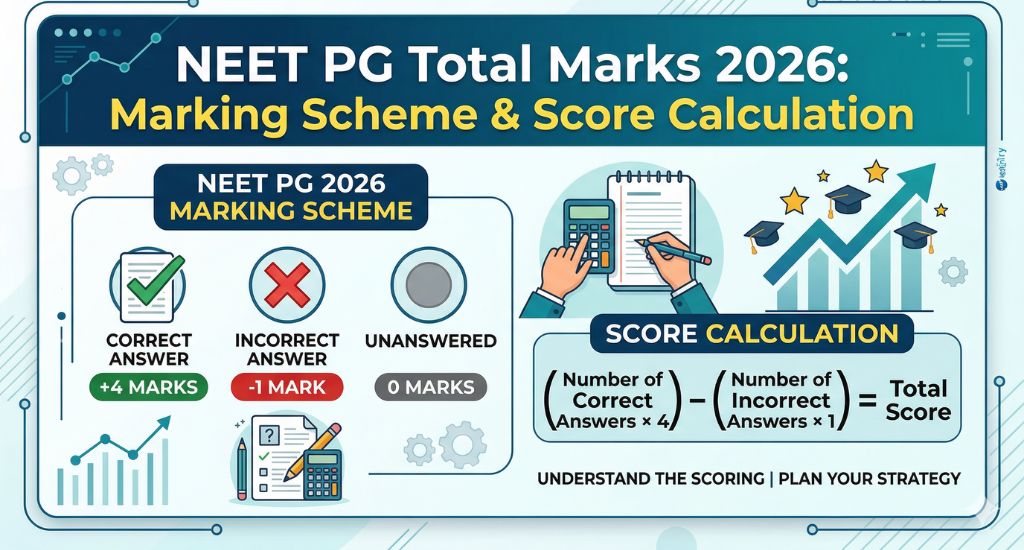
When adding a correct answer to your score, you earn 4 points; however, for each incorrect answer, you will lose 1 point. This means that the overall impact of negative marking can greatly affect your rank and overall average. Try to make only those attempts that you feel you can answer correctly; random guessing will greatly reduce the total number of points you earn. Lastly, even though there are some differences in the difficulty of questions, the NEET UG syllabus covers all three subjects equally, so you must cover all syllabi equally in your preparation.
Detailed Subject-wise NEET UG Syllabus 2026
Physics Syllabus for NEET UG 2026:
The syllabus for NEET Physics in 2026 includes topics such as Mechanics, Thermodynamics, Electrodynamics, Optics, Modern Physics, and experimental skills.
In the NEET examination, the Physics subjects will test not only numerical problem-solving but also assess the understanding of technical aspects of Physics, evaluated in a variety of ways, such as through analysis of a situation, graph interpretation, and logical reasoning about concepts being used within the constraints of time.
Topics Covered in Class 11:
- Physical World and Measurement
- Kinematics
- Newton’s Laws of Motion
- Work, Energy, and Power
- Motion of Systems of Particles and Rigid Bodies
- Gravitation
- Properties of “Bulk” Matter
- Thermodynamics
- Behavior of Ideal gases and the Kinetic Theory of Matter
- Oscillations and Waves
Topics Covered in Class 12:
- Electrostatics
- Current Electricity
- Magnetic Effects of Electric Current and Magnetism
- Electromagnetic Induction and Alternating Current
- Electromagnetic Waves
- Optics (Ray Optics and Wave Optics)
- Dual Nature of Radiation and Matter
- Atoms and Nuclei
- Electronic Devices
Chemistry Syllabus for NEET UG 2026:
The NEET Chemistry syllabus for 2026 is divided into three subjects: Physical Chemistry, Organic Chemistry, and Inorganic Chemistry. The types of questions given in the NEET Chemistry Exam will be conceptual, applied, and statement-based.
Topics in Physical Chemistry:
- Basic Concepts of Chemistry
- Atomic Structure
- States of Matter
- Thermodynamics
- Equilibrium
- Redox Reactions
- Solutions
- Electrochemistry
- Chemical Kinetics
- Surface Chemistry
Organic Chemistry:
The Organic Chemistry syllabus covers the concepts, reactions, and mechanisms of hydrocarbons; haloalkanes and haloarenes; alcohols, phenols, and ethers; aldehydes, ketones, and carboxylic acids; amines; as well as biomolecules, polymers, and chemistry in everyday life.
Inorganic Chemistry:
Systematic way to classify the elements of nature and distinguish them through periodicity, use of chemical bonds in the formation of molecular structures, the properties, uses, and different groups of s-block, p-block, d- and f-block elements, and coordination complexes; and the connection of chemistry with the environment (environmental chemistry).
Also Read: Documents Required for NEET Counselling 2026: Complete Checklist
NEET Biology Syllabus 2026
The NEET Biology syllabus, divided into two main subjects (Botany and Zoology), requires students to study both Botany and Zoology and places greater emphasis than Physics and Chemistry on the concepts of reproduction, human anatomy, genetics, and ecology.
Therefore, the impact on the overall score will be significant, as it will include 90 questions, which will represent nearly half of the total number of questions in the exam.
Botany (Class 11 & 12): The Botany syllabus includes the following topics: the living world, biological classification, the plant kingdom, morphology and anatomy of flowering plants, cell structure and function, cell division, transport in plants, mineral nutrition, photosynthesis, respiration in plants, plant growth and development, sexual reproduction in flowering plants, genetics and evolution, and biotechnology.
Zoology (Class 11 & 12): The Zoology syllabus includes the following topics: animal kingdom, structural organization in animals, human physiology (including digestive, respiratory, circulatory, excretory, nervous, and endocrine systems), human reproduction, reproductive health, principles of inheritance, molecular basis of inheritance, evolution, human health and disease, microbes in human welfare, and ecology and environment.
NEET Chapter-Wise Weightage 2026
To prepare effectively for the NEET exam, understanding the NEET chapter-wise weightage provided through past academic exam results is critical. By analyzing the different weightages assigned to the chapters, the student would know how to allocate preparation time accordingly to allow for maximum focus on the most heavily weighted chapters.
Below are the NEET chapter-wise Weightages assigned to the Physics Chapters Based on Last Year’s Exam Patterns.
Physics — NEET Chapter-wise Weightages
| Chapter | Approx. Weightage |
| Electrostatics and Current Electricity | 15% – 17% |
| Optics (Ray + Wave) | 10% – 12% |
| Modern Physics (Atoms, Nuclei, Dual Nature) | 9% – 11% |
| Kinematics and Laws of Motion | 10% – 12% |
| Thermodynamics | 8% – 10% |
| Oscillations and Waves | 7% – 8% |
| Magnetics and Electromagnetic Induction | 7% – 9% |
Below are the Weightages assigned to the Chemistry Chapters Based on Last Year’s Exam Patterns
Also read: Total MBBS Seats in India 2026: State-wise Seat Distribution
Chemistry — NEET Chapter-wise Weightages
| Chapter | Approx. Weightage |
| Organic Chemistry (All) | 30% – 35% |
| Chemical Bonding & Molecular Structure | 8% – 10% |
| Coordination Compounds | 7% – 9% |
| Equilibrium (Chemical + Ionic) | 7% – 8% |
| Electrochemistry | 6% – 8% |
| Biomolecules | 5% – 7% |
Below are the Weightages assigned to the Biology Chapters Based on Last Year’s Exam Patterns.
Biology — NEET Subject and Chapter Weightages
| Chapter | Approx. Weightage |
| Human Physiology | 18% – 20% |
| Genetics and Evolution | 15% – 18% |
| Ecology & Environment | 10% – 12% |
| Plant Physiology | 8% – 10% |
| Cell Biology & Cell Division | 8% – 10% |
| Reproduction | 7% – 9% |
| Biotechnology | 5% – 7% |
Biology subjects and chapters for Human Physiology, Genetics and Evolution, and Ecology tend to provide students with consistently higher mark patterns over the years. The chapters in Physics that tend to provide students with more reliable mark patterns are Kinematics, Current Electricity, and Dual Nature of Matter. Use the weightage tables above when ensuring your effort allocation and chapters you prepare for; however, don’t totally exclude any chapters in your preparation, as NEET is an overall examination of the full syllabus, which NEET UG covers.
How to Strategically Prepare for the NEET UG Syllabus 2026
Successful preparation for the NEET UG exam requires a systematic approach to completing the NEET UG syllabus and is therefore best accomplished through strategies that maximize your time usage. The following are some of the most successful methods:
- Master NCERT First: The majority (over 80%) of questions on the NEET exam depend on the NCERT text.
- Use NEET Topic Weightages to Prioritize Your Studies: Use the NEET chapter weightage table given above to construct a schedule for your studies based on the amount of weight each chapter carries.
- Develop a Weekly Study Schedule Based on Subject: You should divide your weekly study time among all three subjects of the NEET UG exam.
- Daily MCQ Practice: You should not rely solely on theoretical knowledge to pass the NEET UG exam; you should also complete 50-100 MCQs every day related to the topics studied that day.
- Complete full-length mock tests regularly: After each mock test, thoroughly review your incorrect answers and determine which areas of the NEET UG syllabus require additional study.
Recommended Books for NEET UG Syllabus 2026
Recommended Books for NEET UG 2026 Preparation As Per New UG Syllabus:
| Book Name | Subject | Why Needed for NEET |
| NCERT Physics – Class 11 & 12 | Physics | 80%+ of NEET questions are based on this; very important |
| H.C. Verma – Concepts of Physics | Physics | Strong conceptual clarity and problem-solving practice |
| NCERT Chemistry – Class 11 & 12 | Chemistry | Core source for all three sections; must-read |
| O.P. Tandon – Physical & Organic Chemistry | Chemistry | Extensive practice for Organic & Physical Chemistry |
| NCERT Biology – Class 11 & 12 | Biology | Most critical resource for NEET preparation |
| Trueman’s Biology – Vol 1 & 2 | Biology | Extra MCQs, diagrams, and detailed explanations |
| DC Pandey – Objective Physics for NEET | Physics | Chapter-wise MCQs aligned with NEET pattern |
End-to-End Guidance for NEET and MBBS Aspirants
EOCL India equips students with the knowledge, skills, and confidence needed to achieve their medical career goals. It serves as a reliable resource for NEET (National Eligibility cum Entrance Test) aspirants, offering accurate and up-to-date guidance on career choices, preparation strategies, and opportunities such as MBBS in Russia. With timely updates on syllabus changes, practical preparation tips, and clear application guidance for MBBS programs in India and abroad, EOCL India supports students at every step of their journey.
Also read : NEET Cut Off 2026 Explained: Qualifying Marks & College Cutoffs in India
FAQs About NEET UG Syllabus 2026
How many chapters are in the NEET UG 2026 syllabus?
The total number of chapters as per the NCERT syllabus for Classes 11/12 is 79 chapters divided evenly into three separate subjects as follows: Physics—20 chapters, Chemistry—20 chapters, and Biology—39 chapters.
Where can I download the official NEET UG 2026 syllabus PDF?
You can download the NEET UG 2026 syllabus PDF from the official site neet.nta.nic.in (available to download January 2026).
Has the NEET UG syllabus changed significantly in 2026 compared to 2025?
No, the NEET 2026 syllabus will be identical to the NEET 2025 syllabus with an equal balance of content to both assessments.
How significant is the NEET UG 2026 syllabus?
The NEET UG syllabus is extremely valuable; the majority of questions (especially from the Biology section) are based directly on material in the NEET UG curriculum.
Are there any topics removed from the NEET UG syllabus 2026?
There will be no topics removed from the NEET UG 2026 syllabus.
Is there a penalty for guessing on the NEET Exam?
Yes, if you guess correctly, you receive 4 points; if you guess incorrectly, you lose 1 point. Making random guesses should be avoided; use effective guessing techniques instead.