

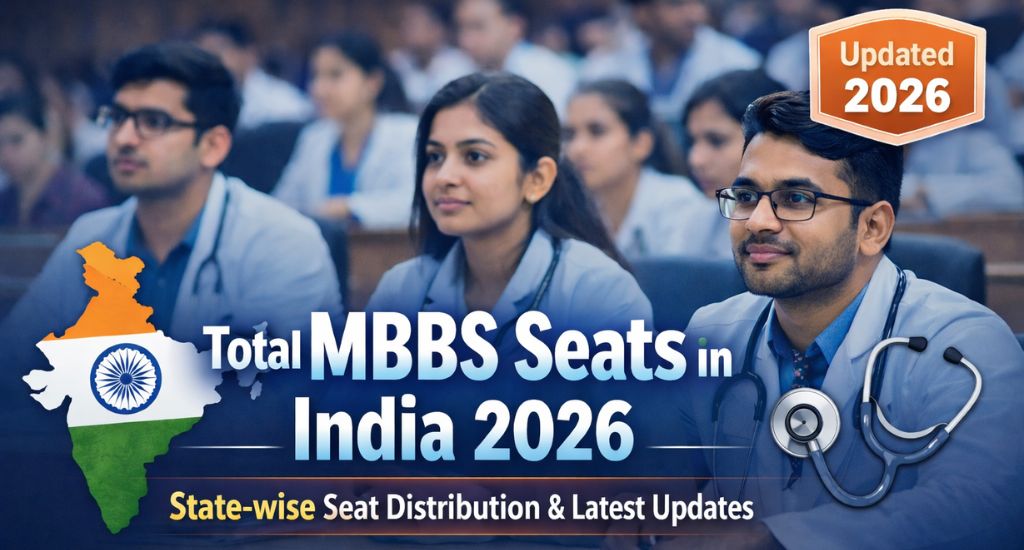

India now has 1,29,805 MBBS seats across 824 medical colleges – up from roughly 1,15,000 seats just two years ago. Of these, approximately 63,657 seats are in government colleges (including AIIMS and central institutions), while 66,148 seats fall under private and deemed universities.
Despite this growth, the gap between supply and demand remains stark. Over 23 lakh students appeared for NEET UG 2025, competing for roughly 1.3 lakh seats – meaning nearly 22 lakh aspirants walked away without an MBBS seat in India. Understanding exactly how many seats exist, where they are, and how they are filled is the first step toward building a realistic admission strategy.
Government vs. Private MBBS Seats: Key Numbers (2026)
| Category | Colleges | Seats |
| Government / Government Society | ~454 | ~63,657 |
| Private & Deemed Universities | ~370 | ~66,148 |
| Total | 824 | ~1,29,805 |
Central Institutions (within Government Seats):
- AIIMS (22 institutes): ~2,257 seats
- JIPMER: ~243 seats
- ESIC / Armed Forces Medical College: ~500+ seats
Postgraduate (NEET PG) Seats – 2025–26:
- Total PG seats: ~80,291
- Government MD/MS seats: ~33,000
- Private MD/MS seats: ~21,000
- Remaining: DNB, deemed university PG programmes
Also Read: What is the Full Form of MBBS? Meaning, Course Details & Scope
How Seats Are Divided: AIQ vs. State Quota
Every government medical college seat is split between two counselling pools:
- All India Quota (AIQ) – 15%: Filled by MCC (Medical Counselling Committee) through central counselling. Open to students from any state.
- State Quota – 85%: Filled by respective state counselling authorities. Reserved for domicile candidates of that state.
Private and deemed university seats are filled entirely through their own counselling, with sub-categories including:
- Management Quota – Direct college-level admissions at higher fees
- NRI Quota – Reserved for non-resident Indians, with significantly higher fee structures
- Institutional Preference Quota – For specific categories defined by the college
Students appearing for AIQ must register separately with MCC even after qualifying NEET UG.
State-Wise MBBS Seat Distribution 2026
| State / UT | Government Seats | Private Seats | Total Seats |
| Maharashtra | 5,500 | 6,000 | 11,500 |
| Karnataka | 3,800 | 7,000 | 10,800 |
| Tamil Nadu | 5,200 | 5,500 | 10,700 |
| Uttar Pradesh | 4,000 | 5,500 | 9,500 |
| Gujarat | 3,700 | 2,000 | 5,700 |
| Rajasthan | 3,000 | 2,000 | 5,000 |
| Madhya Pradesh | 2,700 | 2,500 | 5,200 |
| West Bengal | 3,200 | 1,500 | 4,700 |
| Bihar | 1,500 | 900 | 2,400 |
| Delhi | 1,200 | 200 | 1,400 |
What these numbers mean for you:
- Maharashtra, Karnataka, and Tamil Nadu together account for over 25% of all MBBS seats in India – if you’re open to studying outside your home state, these three are the highest-opportunity states.
- Karnataka has the most private MBBS seats of any state (~7,000), making it the go-to destination for students who miss government cutoffs but can manage private college fees.
- Delhi has very few private seats (only ~200), which is why Delhi-domicile students face some of the fiercest competition for government college berths.
- Bihar, Jharkhand, and northeastern states remain severely underserved relative to population – students from these states often need to apply across multiple states via AIQ.
Also Read : NEET Dress Code 2026: Complete Guidelines for NEET Exam Dress Code
Reservation Policy: How Seats Are Allocated Within Each College
Both government AIQ and state quota seats follow constitutional reservation norms:
| Category | Reservation Percentage |
| Scheduled Caste (SC) | 15% |
| Scheduled Tribe (ST) | 7.5% |
| Other Backward Classes (OBC) | 27% |
| Economically Weaker Section (EWS) | 10% |
| Unreserved / General | 40.5% |
Private and deemed universities are not mandated to follow OBC/EWS reservations in management quota seats, though SC/ST reservations apply to their AIQ-filled seats.
What’s Driving the Increase in MBBS Seats Year on Year?
India added roughly 15,000 new MBBS seats for the 2026 counselling cycle compared to the previous year. The main drivers are:
- New AIIMS Campuses: The government has established 22 AIIMS institutions across the country, compared to just 7 a decade ago. Each new AIIMS adds 100–150 MBBS seats plus PG and super-speciality capacity.
- Upgradation of District Hospitals: Under the Pradhan Mantri Swasthya Suraksha Yojana (PMSSY), district hospitals in underserved states are being upgraded to medical college status, directly adding government seats in regions that previously had none.
- NMC’s Revised Seat Addition Norms: The National Medical Commission revised its college approval norms in 2023, making it somewhat easier for existing colleges with good infrastructure to add seats in batches of 50. This has led to incremental increases across dozens of colleges.
- Private Sector Expansion: New private medical colleges continue to receive NMC approval, particularly in South India and Maharashtra, where the ecosystem of hospital infrastructure supports them.
- However, it is worth noting that private sector growth is constrained by NMC’s strict faculty-to-seat ratios and mandatory teaching hospital bed requirements. Not every application for a new college or seat addition gets approved.
NEET UG 2026 Counselling: Step-by-Step Process
All MBBS admissions – government and private – require a valid NEET UG score. Here’s how the process flows after results are declared:
- NEET UG Result & Merit List – NTA publishes the All India Merit List. Your rank determines which seats are realistically accessible.
- MCC Registration (for AIQ) – Register on mcc.nic.in for All India Quota counselling. This covers AIQ seats in government colleges plus all AIIMS, JIPMER, and ESIC seats.
- State Counselling Registration – Simultaneously register with your state’s counselling authority for the 85% state quota seats.
- Choice Filling & Locking – Enter your preferred college-course combinations in order of priority. The system allots seats based on your rank and available seats.
- Seat Allotment & Reporting – If allotted a seat, report to the college within the deadline with original documents, pay the fee, and confirm admission.
- Upgradation Rounds – Multiple rounds of counselling allow candidates to upgrade to a better college if a higher-preference seat opens up.
- Mop-Up Round – Remaining unfilled seats are offered in a final open round. This is often the last chance for borderline candidates.
Documents needed at reporting:
- NEET UG scorecard and admit card
- Class 10 and Class 12 mark sheets and passing certificates
- Transfer Certificate (TC) from last school/college
- Domicile / nativity certificate (for state quota)
- Category certificate (SC/ST/OBC/EWS, if applicable)
- Aadhaar card or valid government photo ID
- Passport-size photographs
Also Read : NEET Exam Fees 2026: Category-Wise Application Charges & Payment Guide
Government vs. Private MBBS: Which Makes More Sense for You?
| Factor | Government College | Private College |
| Annual Tuition Fee | ₹10,000 – ₹1,00,000 | ₹5 lakh – ₹25 lakh |
| NEET Cutoff | Higher (more competitive) | Lower (relatively) |
| Clinical Exposure | Extensive (large public hospitals) | Varies significantly by college |
| Infrastructure | Improving, varies by state | Usually modern |
| Bond / Rural Service Obligation | Often required post-MBBS | Rarely required |
| Hostel & Mess Quality | Variable | Generally better |
The fee difference is the decisive factor for most families. A full MBBS course at a government college costs ₹50,000–₹6 lakh total, while the same degree at a private college can cost ₹30 lakh–₹1.5 crore depending on the institution and state.
FAQs About MBBS Seats In India
How many total MBBS seats are there in India in 2026?
As of April 2026, there are 1,29,805 MBBS seats across 824 medical colleges — approximately 63,657 in government institutions and 66,148 in private and deemed universities.
Which state has the most MBBS seats?
Maharashtra leads with approximately 11,500 seats, followed by Karnataka (10,800) and Tamil Nadu (10,700).
What percentage of government seats fall under All India Quota?
15% of seats in government medical colleges are filled through All India Quota (AIQ) via MCC counselling. The remaining 85% go to state quota candidates.
What NEET score do I need for a government MBBS seat?
For unreserved category students, a rank within the top 50,000–70,000 is generally needed to secure a government seat somewhere in India. Cutoffs vary significantly by state and college.
Can I get an MBBS seat with a low NEET rank?
Students with ranks beyond 6–8 lakh may find it very difficult to secure a private MBBS seat in India at an affordable fee. In such cases, MBBS programmed abroad (Russia, Kazakhstan, Philippines, etc.) are a commonly explored alternative.
Are DNB and DM/MCh seats included in the 1,29,805 figure?
No. The 1,29,805 figure covers only MBBS (undergraduate) seats. DNB, MD, MS, DM, and MCh are postgraduate qualifications counted separately (~80,291 PG seats total).
What happens if I don’t get allotted a seat in any counselling round?
Candidates who go unallotted through all rounds — including the mop-up round — must either repeat NEET the following year or explore private college management quota seats (if fees are manageable) or pursue MBBS abroad.