


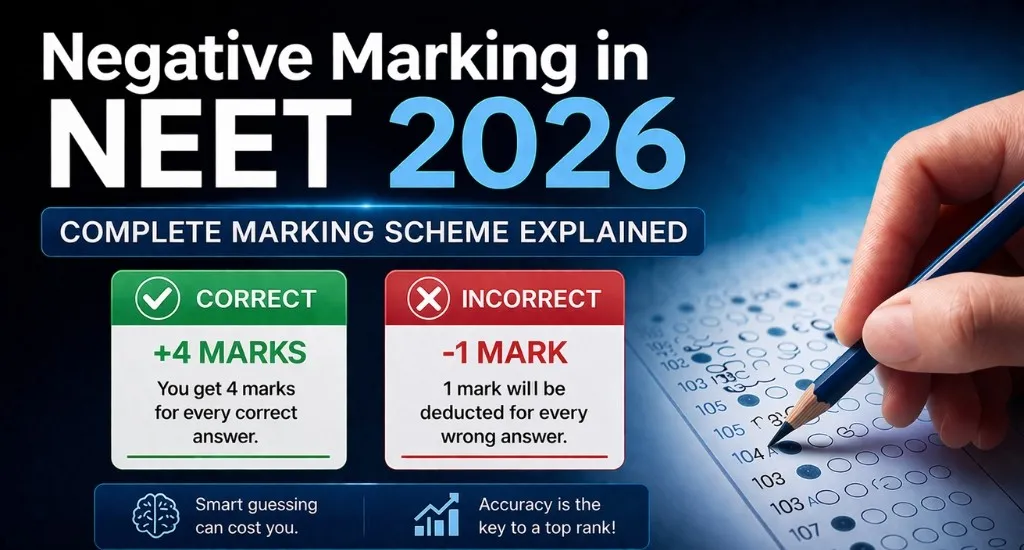
What Is Negative Marking in NEET?
Negative marking in NEET or scoring for incorrect answers is called “Negative Marking” and is used by the National Testing Agency (NTA) to identify prepared students from unprepared ones under the NEET marking scheme.
Therefore, negative marking will help genuine students with conceptual understanding, who are prepared, obtain top scores on the exam. Simply put, a student who answers a question incorrectly will not just receive 0 points but will lose points from their overall score.
A NEET Aspirant needs to understand how to use the concept of negative marking to build an effective and intelligent strategy for taking the NEET exam Negative marking in NEET also encourages students to focus on accuracy rather than attempting every question blindly.
NEET Marking Scheme 2026
The NEET Marking Scheme 2026 provides for a uniform scheme of evaluation for the answers to the three disciplines (Physics, Chemistry, and Biology) with a fair and uniform system of scoring:
- Every question has 4 points.
- Every correct answer is worth 4 points.
- Every Incorrect Answer is deducted 1 point.
- All unanswered questions are 0 points.
Mark per Category of Response (OMR Sheet)
| Response Type | Marks |
| Correct | +4 |
| Incorrect | -1 |
| Unanswered | 0 |
If you mark more than one answer for a question in NEET, that question is not evaluated, and you get 0 marks. There is no negative marking in this case.
Related Post: Minimum Marks Required in NEET for MBBS
How to Calculate Your NEET Score
Calculating NEET scores can be difficult, but the basic procedure follows a fixed principle:
NEET Score = (Number of Correct Answers x 4) – (Number of Incorrect Answers x 1)
Example 1:
- Attempted Overall – 160
- Accurate – 140 Correct Attempts
- Inaccurate – 20 Incorrect Attempts
- NEET Score = (140 accurate attempts x 4) – (20 incorrect attempts x 1) = 560 – 20 = 540
Example 2:
- Attempted Overall – 180
- Accurate – 140 Correct Attempts
- Inaccurate – 40 Incorrect Attempts
- NEET Score = (140 accurate attempts x 4) – (40 incorrect attempts x 1) = 560 – 40 = 520
In the above two examples, both students have the same number of correct attempts (140); however, the second student will receive 20 fewer points simply because of the 20 additional incorrect attempts. Thus, it is easy to see that attempting all questions may not be as productive as answering only the questions that you are confident about.
Related Post : How to Crack NEET in First Attempt: Proven Strategy for 2026
Why Negative Marking Matters in NEET 2026
Negative marking in NEET directly affects your total score. Minor mistakes can equate to a large scoring variance.
- Although minor differences will exist between students’ scores, it only takes a 5-point difference for thousands of students’ rankings to change.
- Every incorrect answer results in a deduction of 1 mark, while each correct answer gives 4 marks. This means that four incorrect answers can reduce your total score by 4 marks, which is equal to the marks gained from one correct answer. Therefore, excessive incorrect attempts can significantly lower your overall score.
- Accurate attempts vs. all attempts will have the greatest bearing on the student succeeding in the exam.
- A positive difference in marks could mean the difference in being accepted into a government college as opposed to a private institution.
For students taking such a highly competitive exam as the NEET, avoiding negative marking is as important as obtaining marks.
NEET Exam Pattern 2026 (Quick Overview)
NEET is scheduled to follow the Basic Examination Pattern, which will include the following:
- The NEET 2026 examination is conducted in an Offline mode. (Pen & Paper)
- The total number of questions will be 180 MCQs.
Subjects will include:
- Physics contains 45 Questions
- Chemistry contains 45 Questions
- Biology contains 90 Questions (Botany + Zoology)
- Total Marks will equal 720 Marks.
- The duration of the exam will be 3 hours and 20 minutes.
- The Marking Scheme will be as follows:
- +4 for each correct answer.
- -1 for each incorrect answer.
- Since Biology has the most weightage (360 marks), many students consider it to be their highest-scoring subject.
Related Post : Documents Required for NEET Counselling & MCC List
Smart Strategies to Avoid Negative Marking
Top 5 Strategies to avoid negative marks.
- NO BLIND GUESSING – If you cannot answer a question, leave it blank. Points are deducted for wrong answers, and left blanks do not lose points.
- ELIMINATING – Try to ensure that you can eliminate at least 2 (two) wrong answers to increase your chances of being correct.
- START WITH YOUR STRONGEST SUBJECT – This creates a sense of momentum and confidence early on in the examination.
- USE A TWO-ROUND STRATEGY – Use round one for easier questions, and round two for harder questions.
- TIME MANAGEMENT – Spending too much time on one question leads to poor time management, which leads to rushed, incorrect answers.
The 3-Tier Question Approach
High achievers use a systematic strategy when sitting the NEET; Working on 3 tiers.
- TIER 1 – SURE THING – Yes – 100% chance of correct answer.
- TIER 2 – ELIMINATION – Two answers eliminated from the four answer choices
- TIER 3 – RISKY – No knowledge of the right answer
Concentrate on using Tiers 1 and 2 only; Avoid Tier 3 unless you can eliminate some options and make a logical guess.
Related Post : Best Books for NEET Preparation 2026 | Physics,
Common Mistakes That Lead to Negative Marking
Question Overattempts
Many students feel pressured to attempt all of the 180 questions. Attempting every question leads to more errors on the exam. Attempt questions for which you are confident in the answer only.
Carelessness in physics
Problems with physics commonly arise from incorrect formula use, misusing units, calculation errors, etc.
Changing correct answers
Changing your mind tends to turn your correct answer into an incorrect answer. If you were confident, it would regularly return to browse through the answer again until you’re 100% certain.
Misreading of Questions
The word “not” and the word “except” can completely change the answer to the question. Carefully read every question.
Random Guessing
Guessing answers without logic is highly likely to create a Negative marking in NEET against your answer. If you don’t know your answer, skip it.
Related Post: NEET PG Total Marks 2026: Marking Scheme & Score
NEET Preparation and MBBS Admission Guidance by EOCL India
EOCL India has been assisting NEET students with relevant knowledge and information through credible resources and proven techniques to enhance performance and help them build a successful career in medicine since its inception. Whether you need assistance with the latest syllabus changes or guidance for MBBS admissions in India or options like MBBS in Russia, we ensure you have access to all the resources required to make informed decisions and confidently pursue your medical career.
Negative Marking In NEET for 2026 Examination
What score do I receive for responding to a question correctly?
The score for each response answered correctly is +4 marks. The exam’s total number of possible points is 720.
Does negative marking apply to questions left blank (unanswered)?
No. Questions not responded to (unanswered) will result in zero points being awarded to the student, not a deduction of points.
Does negative marking apply to each subject in the three subjects of Physics, Chemistry, or Biology?
Yes. The same scoring guidelines are followed for all three subjects of Physics, Chemistry, and Biology.
Can you use guessing as a strategy during the NEET exam?
No, there is no advantage in guessing/estimating when taking the NEET test, because due to the application of negative markings, it is very likely that your overall score will be reduced by substantial factors from the guessing of answers.
Can you establish how much the ranking will be altered due to negative marks?
It is possible for a difference of only five to ten marks due to negative marking to produce a change in overall rank by over 1000 ranks.