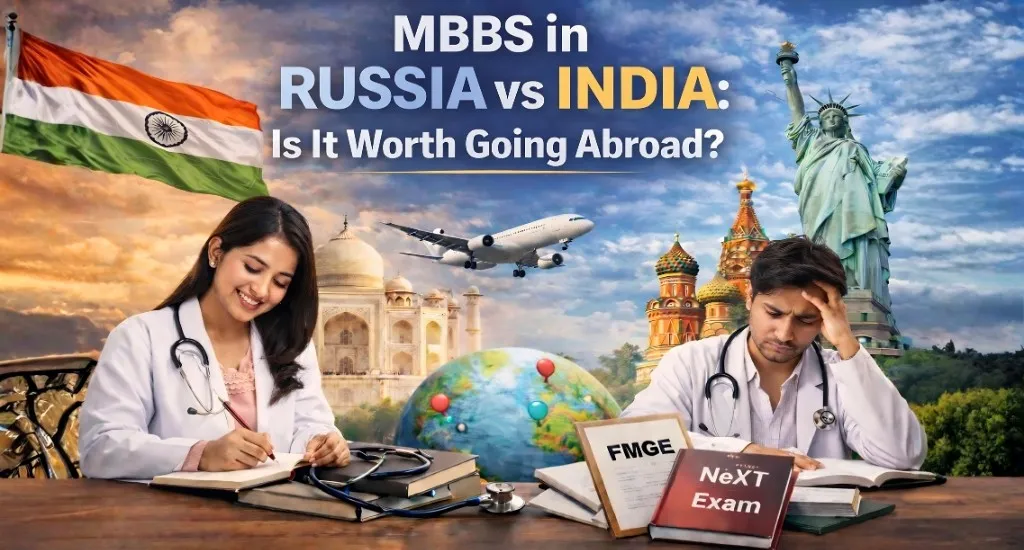


When you want to study medicine abroad, Russia and China are among the most preferred destinations. Both offer affordable tuition, globally recognized degrees, and English-medium education. So how do you choose which country to study in?
To help you decide, this guide looks at the differences between studying MBBS in Russia & China, covering aspects such as cost of study, recognition, job opportunities, etc., so that you can make an informed decision about your future medical education.
MBBS in Russia and China – Duration of Study
Those studying MBBS in Russia will attend six years of education, with one year of clinical training in a hospital. There is also a strong clinical component throughout the program.
Those studying MBBS in China will also typically study for a total of six years, including five years of academic/subject-based study and one year as an intern or resident. The general structure for both programs is similar, but one will find that some universities in China provide clinical placements differently from others.
Fees Comparison
MBBS abroad tuition fees are often the first thing that studentns and their families want to know when researching medical schools.
MBBS Fees in Russia
MBBS fees in Russia are highly affordable, typically ranging from ₹2.5 lakh to ₹6 lakh per year for Indian students.
- Annual: ₹2.4–₹5.1 lakhs (approximately $3,000–$8,000)
- Total for 6 Years: ₹19–₹41 lakhs
- Rent and Other Living Expenses: the monthly cost of living is estimated to be ₹13–₹20,000
- There are no donation or capitation fees.
MBBS Fees in China
MBBS fees in China are affordable for Indian students, typically ranging from ₹3 lakh to ₹6 lakh per year depending on the university.
- Annual: ₹3–₹6 lakhs (approximately $3,000–$6,000)
- Total for 6 Years: ₹18–₹40 lakhs
- Rent and Other Living Expenses: The monthly cost of living is estimated to be ₹15,000–₹25,000
- There are no donations or additional entrance exams required apart from NEET.
In comparison with private medical colleges in India that charge between ₹10 and ₹25 lakhs per year, both Russia and China are significantly cheaper. Russia has lower costs of living than China, but China can compete with Russia in terms of tuition, depending on which school you are applying to.
Also Read :MBBS in Russia vs Kazakhstan: Which is Better for Indian Students
Recognition: WHO, NMC & Global Bodies
It is necessary to have an accredited degree. A degree that won’t be recognized in your country will hold little or no value.
MBBS in Russia: MBBS degrees from Russian universities are recognized by the World Health Organization (WHO), National Medical Commission (NMC), USA ECFMG, WFME (World Federation for Medical Education), and UK GMC; the country has many Russian universities listed with the NMC and is considered one of the best options for Indian medical students.
MBBS in China: The Chinese Government Ministry of Education has approved 45 major universities in China to offer licensed clinical medicine education to foreign students; however, Only graduates from approved universities are eligible to practice outside China.
General rule: Students need to check with their respective universities to ensure that they are listed on the official approval list before applying for a university course from either country. Both countries offer valid internationally recognized degrees.
Eligibility & Admission Process
The following are the admission requirements and criteria for MBBS in Russia and China.
For MBBS in Russia
- Students must have completed the NEET Entrance exam.
- Students must have at least 50% in 12th grade (Physics, Chemistry, Biology) and at least 40% for Reserved category students.
- Admission is granted based on academic eligibility, NEET qualification, and document verification-without any additional entrance exams.
- The process of admission to universities, medical schools, or colleges in Russia is much less complicated than obtaining a government medical school seat in India.
For MBBS in China
- Students must have completed the NEET Entrance Exam.
- Students must obtain at least 50% in 12th grade (Physics, Chemistry, Biology)
- No separate admission or donation fees for any other universities in China.
- Most universities in China may require an interview for educational qualification or for the purposes of English language proficiency.
- The admission process in China is less complicated than obtaining a seat in a government medical school in India.
Language of Instruction
In Russia, the primary medium of instruction is English in most universities for MBBS programs. However, certain universities may require all students to master basic conversational Russian to communicate with patients during clinical years. Initial language difficulties can be overcome with time.
All 45 universities approved by the Chinese Ministry of Education will provide MBBS programs in English; some universities encourage and require students to learn basic Mandarin language skills to communicate with their patients during clinical rotations.
Both countries will allow students to learn their required language over time, and in both countries, the initial years are taught in English.
FMGE / NEXT Exam Performance
Indian students studying in both Chinese and Russian universities must pass NEXT (previously FMGE) in order to be able to practice medicine. In the past, graduates from Russia and China have tended to have lower pass rates than those students who graduated domestically, even though there are universities in China and Russia that have aligned their curriculum with NMC (National Medical Commission) guidelines and produce graduates who have had much better exam performance.
Graduates from both countries are eligible to appear for the NEXT/FMGE exam to practice in India.
When selecting a university, students should only consider those schools whose curriculum aligns with NMC and has a strong overall academic standard.
Also Read :NEET Category Wise Cutoff 2026 (GEN, OBC, SC, ST)
Career Opportunities After Graduation
Career Options After Completing an MBBS in Russia:
- The ability to take the NEXT/FMGE to practice medicine in India.
- Eligible to appear for exams like USMLE (USA), PLAB (UK), and AMC (Australia).
- Opportunities to pursue postgraduate (MD/MS) degrees in Russia or abroad.
- The research opportunities available to students in Russia provide excellent training opportunities for those students wishing to enter academic medicine.
Career Options After Completing an MBBS in China:
- The ability to take the NEXT/FMGE to practice medicine in India.
- Recognized by the ECFMG for licensure in the USA.
- The ability to pursue postgraduate education in China and throughout the European economic area, the Middle East, and Southeast Asia.
- The diversification of the healthcare system in China allows for adequate experience in both internships and residencies for students pursuing postgraduate education.
Career opportunities are relatively similar after graduation from a university in China or Russia, and the primary factors in the success of a graduate will be the student’s performance, preparation for the examination, and the quality of clinical training received.
Safety, Campus Life & Student Experience
For international medical students, Russia has a long history of medical education, with many universities having over 100 years of experience. Russian universities provide structured campus life, affordable hostel accommodations, and an active Indian community in nearly every major city. Winters can be severe; therefore, you should prepare accordingly.
China has modern infrastructure, technology-filled facilities, and fast-paced academics. Chinese universities have great labs, libraries, and sports facilities. In addition to cultural differences, there are also many Indian students (over 23000 students pursuing medicine) studying in China. Thus, the transition will be much easier.
Comparison of MBBS in Russia vs MBBS in China
| Factors | MBBS in Russia | MBBS in China |
| Duration | 6 years | 6 years |
| Total Fees | ₹19 lakh – ₹41 lakh | ₹18 lakh – ₹40 lakh |
| Tuition Fees (Annual) | ₹2.4 lakh – ₹5.1 lakh | ₹3 lakh – ₹6 lakh |
| NMC Accredited Universities | 60+ | 45+ |
| WHO Accredited Universities | Yes | Yes |
| Language of Instruction | English | English |
| NEET Requirement | Yes | Yes |
| Monthly Living Expenses | ₹13,000 – ₹20,000 | ₹15,000 – ₹25,000 |
Also Read : 650 Marks in NEET Rank 2026
Build Your Medical Career with EOCL India’s Expert Guidance
EOCL India helps students to choose universities that have the approval of the NMC, which offer good and sufficient clinical exposure, and have experienced, proven NEXT/FMGE success rates to provide a safe and successful medical career path. Whether you choose Russia or China, the right guidance and university selection play a crucial role in building a successful medical career. Contact us and remove all the doubts from your mind.